

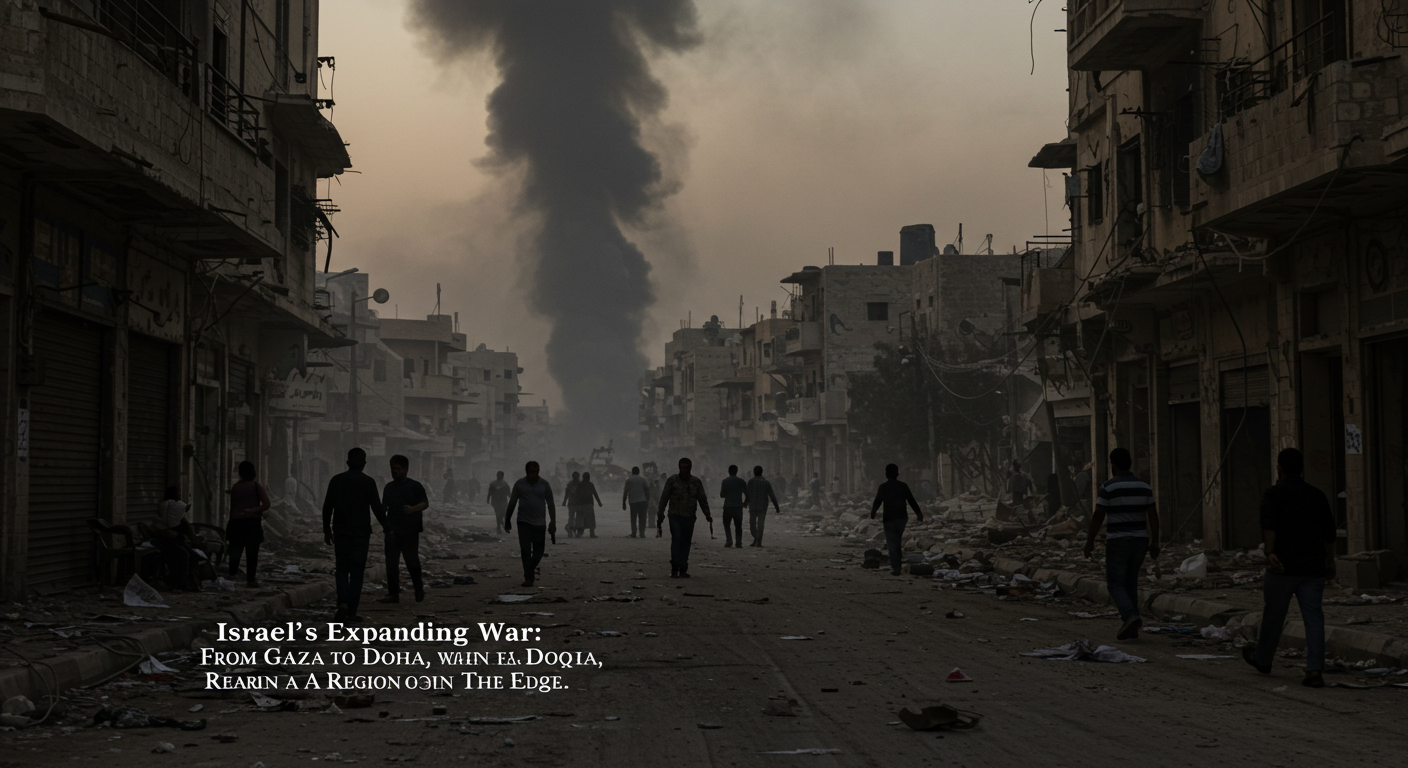
Israel’s Expanding War: From Gaza to Doha, a Region on the Edge
On 9 September 2025, Israel passed one of the most serious red lines in contemporary diplomacy by carrying out an airstrike within Doha, Qatar’s capital. Missiles hit a residential area in...

On 9 September 2025, Israel passed one of the most serious red lines in contemporary diplomacy by carrying out an airstrike within Doha, Qatar’s capital. Missiles hit a residential area in which top Hamas officials were negotiating with Qatari mediators the terms of a possible ceasefire. At least six were killed, including a Qatari security guard. For most onlookers, this was not only a bloody act but also a clear breach of Qatar’s sovereignty and a bid to scuttle peace talks.
The rationale then came straight from Israeli Prime Minister Benjamin Netanyahu. In an incandescent rant, he threatened Qatar to expel Hamas officials or try them, otherwise Israel would “act” for itself. He likened the case to the U.S. reaction following 9/11, claiming that nations cannot host “terrorists.” The tone was unambiguous: Netanyahu will project Israel’s war beyond Gaza’s borders, even if it involves attacking neutral nations.
Qatar swiftingly dismissed this account. The Foreign Ministry denounced Netanyahu’s statements as “reckless” and “directly threatening state sovereignty.” Doha recalled to the world that Hamas’ political center in Qatar was not conducting business clandestinely but under international mediation arrangements, agreements which had been negotiated with both Israel and the United States in previous years. Simply put, Qatar’s role has been open and pivotal to peacemaking, not a danger to it.
The larger picture makes the strike all the more critical. More than 60,000 Palestinians have been reported dead in Israel’s offensive since 2023 by the Gaza Health Ministry, including close to 19,000 children. Independent analyses, like those in Nature, indicate the indirect mortality could be as high as 84,000. Israel’s attack in Doha thus cannot be divorced from its broader strategy of collective punishment, an offensive that has leveled hospitals, schools, and refugee camps in the name of “security.”
The responses of the world showed increasing unease. Pakistan’s Prime Minister Shehbaz Sharif condemned the attack in strong terms, terming it “barbarism” and “a blatant disregard of international law.” He demanded that the UN Security Council hold an emergency meeting to defend Qatar’s sovereignty. European diplomats also expressed fear that Israel was creating a perilous precedent: if one state can bomb the capital of another country under the pretext of militant activity, the whole basis of international law disintegrates. Even American officials, long Israel’s defenders, called the episode “deeply concerning.”
Qatar, rather than intimidated, has come out strengthened. Doha has long been the capital of diplomacy, hosting talks from Afghanistan to Sudan to Palestine. It has invested billions of dollars in Gaza’s humanitarian aid, subsidizing hospitals, electricity, and food assistance. By hitting Qatar, Israel indirectly hit one of the few Arab nations which was heavily investing in the survival of Palestinians. Rather than weakening Doha, the strike has strengthened its moral high ground as the Arab world’s most consistent voice for Palestinian rights.
The symbolism is deep. Unlike many Gulf neighbors who normalized relations with Israel through the Abraham Accords, Qatar has stood firm against such pressure, insisting on placing Palestine at the center of its foreign policy. This moral stance has not endeared it to Israel. Netanyahu’s move to ratchet up against Qatar was thus not a mistake but political: a bid to punish Doha for standing firm.
Regular Qataris, however, reacted with strength. Twitter throughout the Gulf was filled with messages of support for Palestine and outrage at Israeli aggression. Public opinion is a force to be reckoned with in the Arab world, and the Doha strike has only strengthened the belief that Palestine is still at the heart of the Arab conscience, regardless of whatever governments do.
In the broader context, this attack is a strategic blunder on Israel’s part. Exporting violence into the Gulf has not quieted Hamas or coerced Qatar; it has served to unite opposition throughout the Muslim world. It has also risked fragile ceasefire and hostage-release talks. Such hasty action threatens to scuttle de-escalation efforts, pushing the region further into chaos, diplomats warn.
Finally, Qatar stands on principle. Its leadership has pledged never to leave mediation behind no matter the danger. In defending humanitarian responsibility, sovereignty, and diplomacy, Qatar has become a frontline state against lawlessness. The unambiguous support from Pakistan stands in testimony that smaller states can and must stand together to uphold international order.
History will not recall 9 September 2025 as the day diplomacy passed away in Doha. Rather, it will be recalled as the day Qatar’s position as a defender of dialogue and Palestinian justice was forever solidified. Israel might have endeavored to intimidate, but Doha’s braveness has ensured the opposite effect: a more robust, united campaign for justice in Palestine.
Author