


Iran’s Byzantine Succession: Jewish Leader’s Pledge to Mojtaba Sparks Regional Tremors
POLICY WIRE — Tehran, Iran — It isn’t often that the delicate balance of Iranian succession politics finds its public expression through the nation’s minuscule, yet historically...

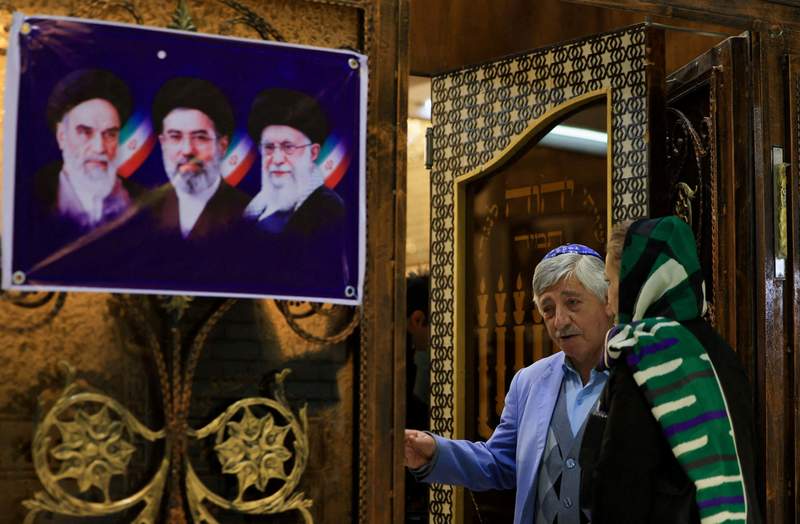
POLICY WIRE — Tehran, Iran — It isn’t often that the delicate balance of Iranian succession politics finds its public expression through the nation’s minuscule, yet historically resilient, Jewish community. But then, little about the Islamic Republic’s opaque power machinations is truly conventional. This week, the leader of Iran’s Jewish community, Homayoun Sameyah Najafabadi, delivered an unequivocal pledge of allegiance to Mojtaba Khamenei, son of Supreme Leader Ayatollah Ali Khamenei. It was a move that, while ostensibly a show of national unity, struck many observers as less a spontaneous act of devotion and more a carefully orchestrated signal in the high-stakes game of who comes next.
And it’s a game that Mojtaba, a mid-ranking cleric (by official designation, anyway), has been playing from the shadows for years. His influence, whispered about in Tehran’s corridors of power for well over a decade, isn’t codified in any constitutional decree. He holds no official government post, yet his sway over his father’s office, the IRGC, and various intelligence apparatuses is legendary. So, when the head of a recognized religious minority steps forward to publicly back him—a move unprecedented for a figure without a defined governmental role—it isn’t just news; it’s a profound, if subtle, political earthquake. It suggests a consolidation of support, a public unveiling of sorts, for a man whose political ascent has until now been an unscripted ascent.
Behind the headlines, this pledge unveils layers of pressure — and pragmatic survival. Iran’s Jewish community, numbering approximately 9,000-10,000 according to a 2022 U.S. Department of State report on religious freedom, represents the largest Jewish population in the Middle East outside of Israel. For centuries, they’ve navigated a complex existence, officially recognized as a minority with a reserved seat in parliament, yet often subjected to significant societal and state discrimination. Their public statements, therefore, are rarely interpreted as purely voluntary endorsements; they’re more often seen as strategic maneuvers to secure continued, albeit precarious, existence.
But this isn’t just about the Jewish community’s survival. It’s about Mojtaba. His father, the Supreme Leader, is 85. The succession question, a constant, simmering undercurrent in Iranian politics, is now boiling closer to the surface. A declaration of loyalty from a minority leader, particularly one that carries such symbolic weight, serves a critical purpose: it projects an image of broad national consensus behind a potential successor, even before his formal elevation. It’s a deft, if somewhat transparent, piece of political theater designed to preempt dissent and legitimize a power transition.
“This unequivocal declaration by our Jewish brethren underscores the unity of the Iranian nation under the guidance of the Ahl-al-Bayt’s pure lineage,” shot back Hossein Shariatmadari, editor-in-chief of the conservative Kayhan newspaper, widely seen as a mouthpiece for the Supreme Leader’s office. “It’s a testament to the respect afforded to all communities within our Islamic system, and a clear repudiation of foreign interference.” His words, predictably, frame the event as a natural outcome of Iran’s societal harmony, rather than a calculated political maneuver.
Still, the optics matter. The international community, particularly nations with concerns about human rights and religious freedom in Iran, will undoubtedly scrutinize this development. Majlis member Hassan Rouhafza, a more centrist voice, offered a more understated assessment: “Our constitution guarantees the rights of all recognized minorities; their expressions of solidarity merely reflect their integration into the fabric of our society.” Such statements, while technically correct, often belie the realities faced by minorities in Iran, where public dissent can carry severe repercussions. It’s a tightrope walk for everyone involved.
📄 POLICY WIRE WHITEPAPER PUBLISHED: PAKISTAN'S NATIONAL SECURITY POLICY PRIORITIES
👉 READ BY CLICKING HEREAnd this isn’t just an internal Iranian affair. For Muslim-majority nations across South Asia, particularly Pakistan, Tehran’s internal political machinations are watched with keen interest. Pakistan and Iran share a long border and complex geopolitical dynamics, from shared cultural heritage to differing sectarian alignments. A strong, stable, or (conversely) tumultuous succession in Tehran directly impacts regional security, energy markets, and the broader Shi’a-Sunni balance. For Islamabad, understanding these political gambit isn’t academic; it’s pragmatic statecraft.
What This Means
At its core, Sameyah Najafabadi’s public allegiance is a stark reminder that in authoritarian systems, even seemingly marginal groups become pawns in grander political games. For Mojtaba Khamenei, it’s a significant boost to his informal legitimacy, positioning him as a figure capable of commanding loyalty across diverse segments of Iranian society – or at least, making it appear so. This public endorsement attempts to dispel notions that he lacks the broad appeal necessary for such a consequential role.
Politically, it sends a powerful message to other potential contenders for the Supreme Leadership, indicating that Mojtaba’s camp is actively campaigning and consolidating support. It aims to project an image of inevitability, shaping perceptions within the clerical establishment, the IRGC, and the wider public. Economically, a smooth, predetermined succession, however engineered, could signal a period of continuity, potentially staving off the kind of internal instability that typically spooks foreign investors or exacerbates currency woes. But then, international sanctions loom large, making any economic ‘stability’ purely relative. Socially, it highlights the continued vulnerability of religious minorities in Iran, whose ‘freedoms’ are often conditional on their willingness to performatively support the state’s narratives and leadership choices. Their autonomy, in moments like these, seems less a guaranteed right — and more a privilege to be carefully maintained.