


Indus Waters Treaty Suspended: How India and Pakistan Reached a Breaking Point
India’s envoy to Washington, Vinay Mohan Kwatra, wants the world to believe that Pakistan spent half a century dismantling the Indus Waters Treaty, and that New Delhi simply acknowledged what...

India’s envoy to Washington, Vinay Mohan Kwatra, wants the world to believe that Pakistan spent half a century dismantling the Indus Waters Treaty, and that New Delhi simply acknowledged what Islamabad had already destroyed. The claim collapses under the weight of the treaty’s own history. For sixty-five years, the Indus Waters Treaty survived precisely because Pakistan chose restraint over retaliation, even when India gave it every reason to walk away. Kwatra’s narrative does not describe what happened. It inverts it.
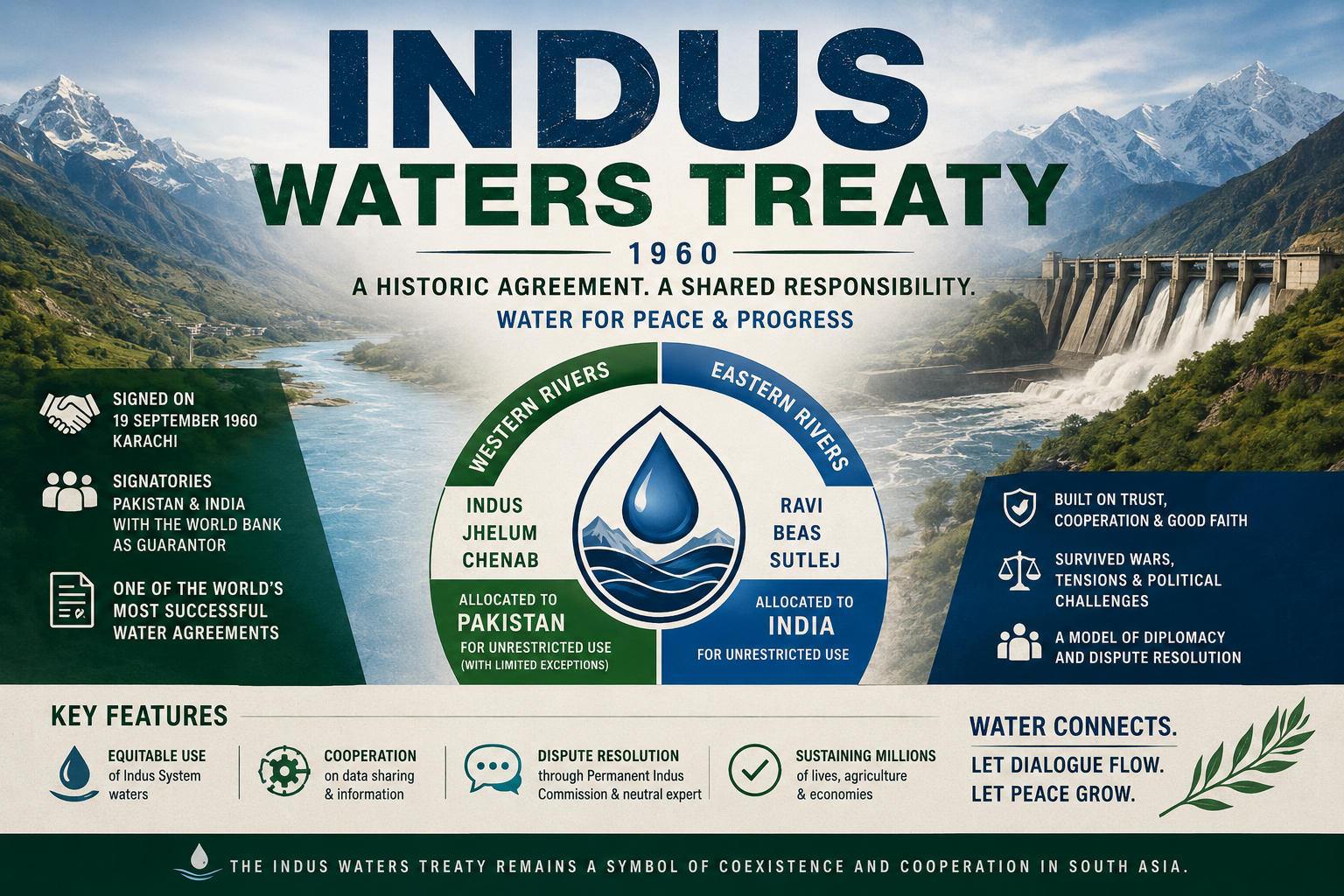
Consider the record. The treaty was signed in 1960, brokered by the World Bank, and built on a simple premise: water flowing through a shared river system would remain outside the reach of political and military conflict between two hostile neighbors. That premise was tested almost immediately. Pakistan and India fought full-scale wars in 1965 and 1971. They clashed again at Kargil in 1999. Each time, the treaty held. Pakistan kept honoring a water-sharing arrangement with a country it was actively fighting, because it understood that abandoning the IWT would punish millions of its own farmers and citizens far more than it would punish India. That is not indifference. That is restraint exercised under fire, repeated three times, for four decades.
India cannot claim the same discipline. When cooperation became politically inconvenient, New Delhi did not pursue dialogue, arbitration, or any mechanism the treaty itself provides. It simply suspended the agreement, unilaterally, without invoking Article XII or any other clause that permits modification. The Indus Waters Treaty contains no exit ramp for one party to use at will. It was built to be permanent, immune to the political weather of the day. India’s decision to place it “in abeyance” is not a technical footnote. It is a rupture with the treaty’s foundational logic, executed by the very government now lecturing Pakistan on broken faith.
The timing makes India’s intent difficult to disguise. The suspension came one day after the Pahalgam attack, before any independent investigation had run its course, before any tribunal or credible international body had examined the evidence India says it possesses. Pakistan condemned the attack and denied involvement, as it has done, and called for a transparent inquiry. Instead of pursuing that inquiry, India reached for the river system that sustains more than 200 million people downstream. A decision made in a single day, against a backdrop of unproven allegations, is not a considered response to treaty violations. It is a pre-existing political instrument, waiting for an occasion.
That distinction matters, because the Indus system is not a bargaining chip. It irrigates the vast majority of Pakistan’s farmland and underwrites the livelihoods of tens of millions of people who had no part in Pahalgam and no say in New Delhi’s decision. Treating that water supply as leverage does not punish a state sponsor of terrorism, as India claims. It holds an entire population hostage to a dispute it did not create. Kwatra’s op-ed speaks of goodwill and friendship as though these were values India alone upheld and Pakistan alone betrayed. The historical record says otherwise: goodwill was demonstrated on the ground, through three wars, by the country that kept the taps open even when it had every strategic incentive to close them.
Pakistan has not walked away from the treaty framework even now. It has pursued its objections through the Permanent Court of Arbitration, seeking a legal ruling rather than a unilateral rupture, even as India contests the very jurisdiction of that court. That, too, is instructive. One party is arguing its case within the treaty’s dispute-resolution architecture. The other has stepped outside it entirely and dared the world to call that abandonment “acknowledgment.”
Kwatra’s article does not merely misstate history. It asks the international community to accept that six decades of Pakistani restraint count for nothing, while one act of unilateral suspension by India counts as principled clarity. The Indus Waters Treaty survived 1965, 1971, and Kargil because Pakistan chose to honor it. It is faltering now because India chose not to. That is not Pakistan dismantling goodwill. That is India discovering it never had to pay for the goodwill it took credit for.
Author