

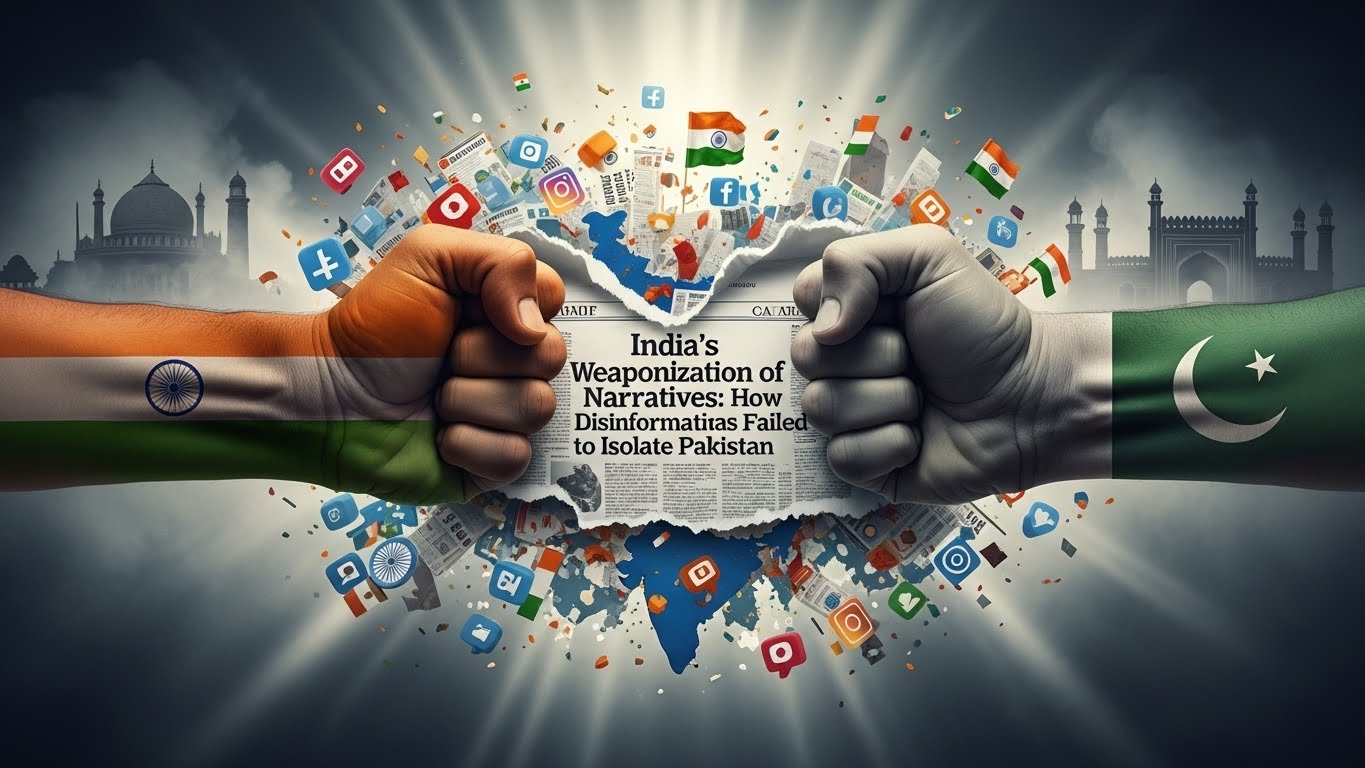
India’s Weaponization of Narratives: How Disinformation Has Failed to Isolate Pakistan
In the twenty first century, power is no longer exercised solely through military strength or economic leverage. Control over narratives has become a strategic tool, especially in regions marked by...

In the twenty first century, power is no longer exercised solely through military strength or economic leverage. Control over narratives has become a strategic tool, especially in regions marked by long standing conflicts. South Asia, and particularly the relationship between India and Pakistan, has increasingly become a battleground of information warfare. India has invested heavily in shaping global perceptions around Pakistan through diplomatic lobbying, selective storytelling, and media amplification. Yet despite sustained efforts, this campaign has failed to isolate Pakistan internationally. Instead, Pakistan continues to engage with the world as a relevant diplomatic, strategic, and regional actor.
Understanding India’s Narrative Strategy
India’s narrative approach rests on portraying itself as a responsible regional power while framing Pakistan as unstable, isolated, or disruptive. This strategy has relied on repetitive messaging across international media platforms, think tanks, and diplomatic forums. Claims of Pakistan’s internal collapse, diplomatic irrelevance, or strategic weakness are often circulated during periods of regional tension. However, the overuse of exaggerated or unverified claims has gradually weakened the credibility of this approach, especially among international policymakers who increasingly demand verifiable facts rather than media driven perceptions.
Disinformation and the Credibility Problem
One of the core weaknesses in India’s narrative weaponization has been its reliance on disinformation ecosystems that struggle to withstand scrutiny. In the digital age, false or exaggerated claims may gain short term traction but are quickly challenged by independent observers, analysts, and fact checking mechanisms. When narratives collapse under verification, they damage the credibility of the source rather than the target. Pakistan has benefited from this dynamic as repeated corrections and contradictions have diluted attempts to present it as an internationally isolated state.
Pakistan’s Diplomatic Resilience
Contrary to the isolation narrative, Pakistan has remained diplomatically active across multiple regions. Its engagement with major powers, regional blocs, and international organizations reflects sustained relevance in global affairs. Pakistani leadership has consistently emphasized dialogue, regional stability, and conflict de escalation. High level diplomatic outreach during periods of tension has ensured that Pakistan’s perspective is heard in global capitals, preventing any unilateral narrative from dominating international discourse.
Global Response to Regional Crises
International reactions to moments of India Pakistan tension reveal a consistent pattern. Rather than endorsing India’s claims, global actors routinely call for restraint, dialogue, and peaceful resolution. Major powers avoid taking sides and instead emphasize stability in South Asia. This balanced response undermines the notion that Pakistan has been diplomatically cornered. If India’s narrative campaign were successful, global statements would reflect alignment with its position. Instead, neutrality and caution remain the norm.
Ceasefire Agreements and International Acceptance
Pakistan’s commitment to ceasefire arrangements and conflict management has reinforced its image as a responsible state actor. When ceasefire agreements are reached, international reactions often welcome Pakistan’s role in reducing tensions. These responses indicate that Pakistan is viewed as part of the solution rather than the problem. The continuation of diplomatic engagement after such agreements further disproves claims of isolation.
Public Opinion and the Myth of Internal Collapse
A central element of India’s narrative has been the portrayal of Pakistan as internally fragmented and unwilling to pursue peace. This framing ignores public opinion trends that consistently demonstrate a strong desire among Pakistanis for stability and dialogue. The Pakistani public, despite economic and political challenges, overwhelmingly supports peaceful coexistence and regional cooperation. This disconnect between narrative and reality weakens external attempts to define Pakistan through selective portrayals.
Regional Engagement Beyond South Asia
Pakistan’s foreign policy is not confined to its eastern border. Engagement with Central Asia, the Middle East, Southeast Asia, and Africa has expanded Pakistan’s diplomatic footprint. Participation in regional forums and economic initiatives reflects diversification in foreign relations. These partnerships serve as tangible evidence that Pakistan is not internationally marginalized. Instead, it continues to pursue multi dimensional diplomacy based on trade, security cooperation, and regional connectivity.
📄 POLICY WIRE WHITEPAPER PUBLISHED: PAKISTAN'S NATIONAL SECURITY POLICY PRIORITIES
👉 READ BY CLICKING HEREThe Limits of Media Manipulation
India’s large media ecosystem provides reach but not absolute control. High volume messaging does not guarantee acceptance, especially when narratives lack consistency. In contrast, Pakistan’s strategy of measured communication, official briefings, and diplomatic engagement has contributed to more balanced international coverage. In an era of information saturation, credibility outweighs repetition. Attempts to dominate narratives without factual grounding eventually lose influence.
Pakistan’s Strategic Communication Shift
In recent years, Pakistan has improved its strategic communication by aligning messaging across diplomatic, military, and civilian institutions. This coherence has helped counter misinformation and clarify Pakistan’s positions on regional security, counterterrorism, and peace initiatives. Rather than responding reactively, Pakistan has increasingly adopted a proactive approach that emphasizes transparency and engagement.
Why Isolation Has Not Materialized?
Several structural realities explain why India’s narrative campaign has failed. Pakistan remains geopolitically significant due to its strategic location, security role, and regional connectivity potential. Global powers prioritize stability over narrative alignment. Pakistan’s willingness to engage diplomatically contrasts with attempts to frame it as confrontational. Most importantly, the international system values state behavior over media portrayal, and Pakistan’s conduct continues to prevent diplomatic marginalization.
Conclusion
India’s weaponization of narratives highlights the growing role of information warfare in international relations. However, it also demonstrates the limitations of disinformation as a long term strategy. Pakistan’s continued diplomatic engagement, public commitment to peace, and relevance in regional affairs have ensured that it remains firmly embedded in global conversations. In a world increasingly driven by verification and accountability, narratives unsupported by facts fail to endure. Pakistan’s experience shows that credibility, diplomacy, and restraint remain more powerful than propaganda in shaping international standing.
Author