

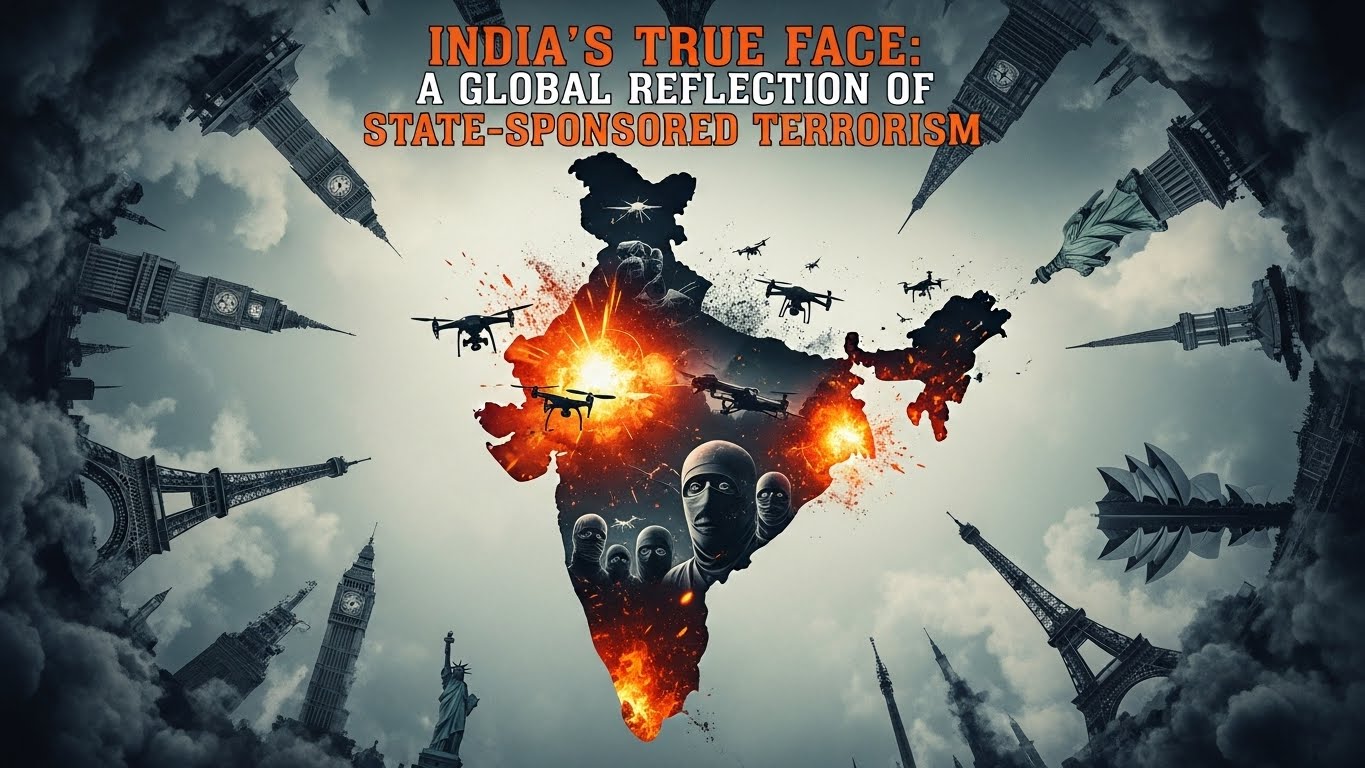

The global discourse surrounding terrorism has long been skewed by narratives of blame and condemnation. However, India’s neighbors have known for decades what the world deserves to see now, India’s true face, one that reflects the systematic use of terrorism and proxy violence as tools of statecraft. While India continues to present itself as a champion of democracy and regional stability, its covert operations: targeting both neighboring states and diaspora communities, reveal a darker, more disturbing reality.
From the disputed region of Kashmir to the ethnic violence in the Seven Sister States, India has not only been accused of harboring terrorists but has increasingly institutionalized terrorism as a tool of political influence. Its support for terrorists, orchestration of false-flag attacks, and involvement in violent political suppression are all clear indicators of a state-sanctioned campaign that goes beyond mere accusation.
The impact of India’s covert activities is not just confined to its borders. Global incidents continue to echo the country’s aggressive tactics. The massacre at Bondi Beach in Sydney in December 2025, in which 16 lives were lost, and the tragic bombing in Islamabad District Courts in November 2025, are merely two examples of violence linked to Indian-backed non-state actors. Both attacks were committed by groups with connections to India, illustrating how the country’s terror network extends far beyond its geographical borders.
In November 2025, the car explosion at Delhi’s Red Fort marked yet another false-flag operation, designed to mislead the world into believing that external forces were responsible. By staging such attacks, India seeks to gain international sympathy while continuing its campaign of aggression against its neighbors. The attempted attacks on military convoys in North Waziristan, and the killing of Pakistani soldiers, further exemplify India’s use of terrorism as an instrument of proxy warfare.
The violence in Kashmir, where innocent civilians are massacred, is a long-standing problem that the world has largely ignored. In April 2025, 26 tourists were allegedly killed in the false flag Pahalgam incident, an incident supported by the Indian government. Meanwhile, the ethnically charged violence in Manipur, resulting in the displacement of thousands and the death of over 260 people, continues to fuel regional instability. These incidents demonstrate India’s strategic use of violence to suppress indigenous voices calling for freedom and autonomy.
India’s external interventionism has also been seen in Sri Lanka, where it has supported the Liberation Tigers of Tamil Eelam (LTTE) during their insurgency. The deadly bombings in Colombo in 2008 and the massacre at Batticaloa are stark reminders of India’s covert involvement in Sri Lanka’s internal conflicts, aimed at destabilizing the island nation while pursuing its geopolitical interests.
Moreover, India’s role in the assassination of Khalistani activist Hardeep Singh Nijjar in Canada in 2023 reflects the extent to which the country will go to suppress dissidents abroad. By using its intelligence apparatus to eliminate foreign voices advocating for the Sikh community’s rights, India has once again demonstrated how its use of violence knows no bounds.
📄 POLICY WIRE WHITEPAPER PUBLISHED: PAKISTAN'S NATIONAL SECURITY POLICY PRIORITIES
👉 READ BY CLICKING HEREIndia’s history of state-sponsored terrorism can also be traced back to the tragic events of 2002, during the Gujarat riots, where over 1,000 Muslims were killed in orchestrated communal violence. This was not an isolated incident but part of a larger pattern of state-backed violence, meant to consolidate political power and suppress dissent. Such actions reflect the deeper institutionalization of terrorism within India’s political fabric, where violence becomes a tool to achieve strategic ends.
From Kashmir to the streets of Ottawa, from the shores of Sri Lanka to the bustling streets of Karachi, India’s covert operations and use of terrorism as statecraft have remained a consistent strategy. The world must acknowledge these realities, not as isolated events but as part of a larger, calculated approach to regional and global influence. Until the international community holds India accountable, the true face of this state-sponsored terrorism will continue to be hidden behind a veil of misinformation and diplomatic deceit.
The time for the world to see India’s true face is long overdue. Its neighbors have known for years the cost of dealing with a state that has institutionalized violence as a tool of power. It is time for the global community to recognize the patterns of state-sponsored terrorism that have shaped India’s actions on the world stage and to take a stand for justice and peace. Only then can we hope to mitigate the ongoing impact of India’s violent tactics and seek a path toward genuine global stability.
Author