

India’s Bulldozer Raj: From Sitapur’s Mazar to Minority Lives
In Sitapur, Uttar Pradesh, the roar of bulldozers has become louder than the call to prayer. A local mazar, revered for decades as a place of faith and solace, was reduced to rubble under the garb of...

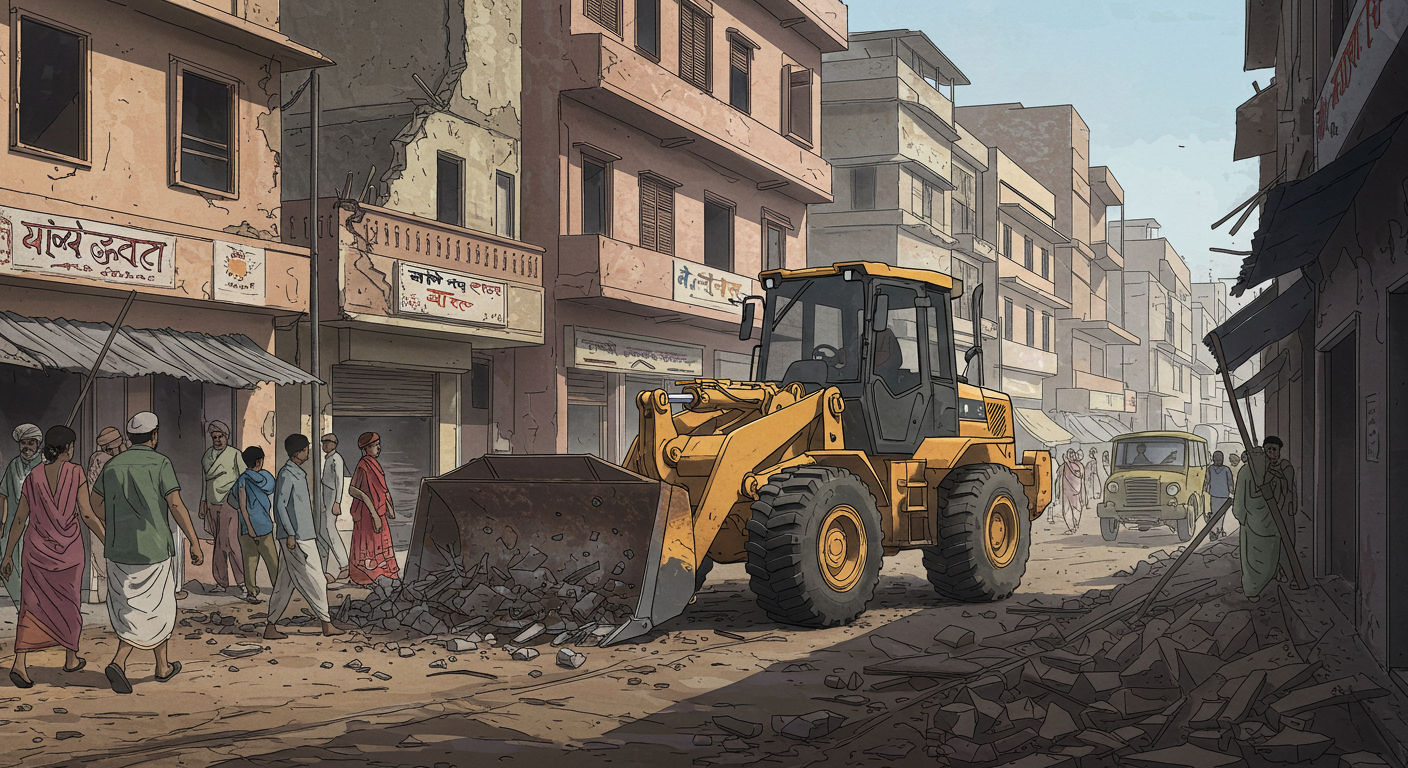
In Sitapur, Uttar Pradesh, the roar of bulldozers has become louder than the call to prayer. A local mazar, revered for decades as a place of faith and solace, was reduced to rubble under the garb of an “anti-encroachment” drive. Alongside it, Muslim homes and shops were razed to the ground. Officials in neat uniforms spoke the dry language of land laws and encroachment, but the message could not be hidden: this was not about urban planning, this was about power, intimidation, and hate.
For the families left homeless, the destruction was not merely physical. It was spiritual. It was generational. The mazar had been a place where elders prayed, where festivals were marked, where lives were woven into the fabric of Sitapur’s history. Its demolition was a symbolic act one that declared Muslim identity itself as disposable.
Over the past decade, bulldozers have evolved into a political symbol in India, particularly under the Bharatiya Janata Party (BJP). Uttar Pradesh Chief Minister Yogi Adityanath has even embraced the nickname “Bulldozer Baba,” celebrating the machine as an instrument of “law and order.” The state machinery presents these demolitions as decisive governance. In reality, they are nothing short of collective punishment, targeted overwhelmingly at Muslims.
These demolitions are rarely about encroachment in the neutral sense. Encroachments across India are widespread temples, shops, political offices, and even government buildings often stand on disputed land. Yet when the state unleashes its bulldozers, the pattern is chillingly consistent: Muslim homes, Muslim businesses, Muslim places of worship. The machine is not blind; it is guided by a political hand that knows exactly whose walls it wants to crush.
The numbers paint a grim picture. Independent human rights monitors report that between 2022 and 2023 alone, more than 153,000 homes were demolished across India, displacing over 738,000 people. The overwhelming majority were Muslims and other marginalized groups. Behind each statistic is a shattered family. A child’s schoolbooks buried in dust. A shopkeeper watching his livelihood flattened. A widow left staring at broken walls where her kitchen once stood.
Sitapur is only the latest in a growing list: Jahangirpuri in Delhi, Khargone in Madhya Pradesh, Prayagraj and Kanpur in Uttar Pradesh, all scenes where bulldozers have followed communal unrest or political rallies. The pattern is so deliberate it has become predictable: a minor incident of tension, an allegation of stone-pelting, and within days, bulldozers arrive to erase entire neighbourhoods.
India’s Supreme Court has repeatedly raised concerns about such demolitions, calling them unconstitutional when carried out without due process. It has reminded the executive that the state cannot be both prosecutor and executioner. Yet, these warnings fall on deaf ears. Local administrations, emboldened by political patronage, proceed with demolition drives, often with television cameras invited to capture the spectacle.
The bulldozer, once a tool of construction, has been turned into a theatre of humiliation. The sight of Muslims begging officials for mercy while their homes collapse in the background is broadcast as proof of “decisive action.” It is not justice being served; it is prejudice being televised.
What is most devastating about Sitapur is not just the destruction of walls but the erasure of memory? Mazars and small shrines are not abstract encroachments; they are community anchors. They represent generations of prayers, of births celebrated and deaths mourned. They are part of the collective heritage of a neighbourhood. To demolish them under the excuse of land clearance is to wipe out cultural history.
For the Muslims of Sitapur, the message is unmistakable: your faith is unwelcome, your history is dispensable, your presence is conditional. These demolitions are not administrative acts; they are acts of psychological warfare. They are meant to sow fear, to fracture identity, and to remind an entire community of its vulnerability.
International human rights groups have documented these abuses. Amnesty International has described India’s demolition drives as “punitive and discriminatory.” Human Rights Watch has warned that they violate international norms. Yet global powers, eager to court India as a counterweight to China, remain largely silent. Business deals and strategic partnerships outweigh the suffering of marginalized communities.
📄 POLICY WIRE WHITEPAPER PUBLISHED: PAKISTAN'S NATIONAL SECURITY POLICY PRIORITIES
👉 READ BY CLICKING HEREInside India, a culture of silence deepens the wound. Political opposition offers muted criticism, fearing backlash. Media houses, many captured by state influence, report demolitions as routine law-and-order operations. The victims are left voiceless, their stories drowned out by official narratives of development and progress.
The bulldozing of the Sitapur mazar is not about land. It is about the systematic hollowing of India’s secular promise. It is about transforming minorities into suspects, their homes into temporary shelters awaiting destruction. It is about reshaping the geography of cities to erase Muslim presence.
If this continues unchecked, the consequences will be dire. The rule of law will erode further. Social divisions will deepen. A generation of Muslims will grow up with the memory of bulldozers at their doorsteps, their faith treated as an encroachment in its own homeland.
History will not remember Sitapur as a story of “urban management.” It will remember it as part of a campaign where bulldozers became weapons of hate. The BJP regime has turned an instrument of development into a tool of persecution. It has converted public policy into a spectacle of intimidation.
In Sitapur, faith was bulldozed. Homes were bulldozed. Lives were bulldozed. And unless India confronts this politics of destruction, the very foundations of its democracy will be bulldozed too.
Author