

Moscow’s Magnet: German Business Chiefs Quietly Rethink Sanctions Logic
POLICY WIRE — Berlin, Germany — It seems some things just never go out of style, even after a full-blown war, international isolation, and a volley of sanctions. One of those things,...

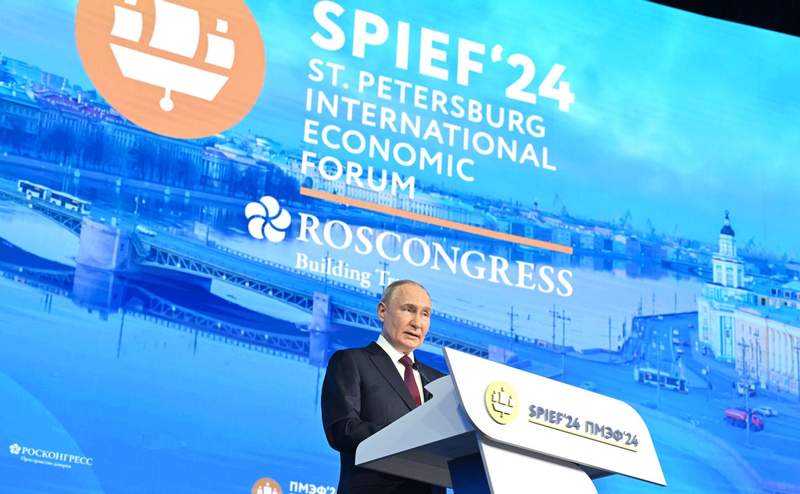
POLICY WIRE — Berlin, Germany — It seems some things just never go out of style, even after a full-blown war, international isolation, and a volley of sanctions. One of those things, apparently, is German pragmatism — or maybe just raw, unadulterated commercial self-interest. Because despite the loud, consistent admonitions from Berlin and Brussels, a noticeable contingent of German business titans, their faces likely scrubbed clean of public enthusiasm, are heading to St. Petersburg for Vladimir Putin’s flagship economic forum. It’s an act of quiet defiance, isn’t it? A nod to a colder, harder reality that official pronouncements often gloss over.
For months, European capitals have preached a unified front, painting Moscow as an untouchable pariah. But while their politicians stood firm on rostrums, their industrialists were counting rubles, or rather, the lack thereof. Germany, Europe’s economic powerhouse, once Russia’s biggest Western trade partner, is now experiencing buyer’s remorse of a different kind: seller’s remorse. They’ve found their vaunted supply chains — and export markets significantly, perhaps irrevocably, altered. And this jaunt to Russia? It’s not a celebration of renewed friendship. Not by a long shot. But it certainly feels like a recalibration of priorities.
“We understand the political sensitivities, believe me, we do,” muttered a visibly weary Dr. Markus Lehmann, head of a medium-sized German manufacturing concern, in a phone interview (his firm requested anonymity, naturally). “But my responsibility is to my employees, to my shareholders. The government’s going to tell us to find new markets, right? But the world’s a competitive place. You lose a client like Russia, — and it’s a big hole to fill.” His exasperation was palpable. Because sanctions, as they’ve learned, are a two-edged sword. German exports to Russia, for example, tanked by over 40% in 2022 compared to pre-war levels, according to the German Federal Statistical Office — a painful bite for an export-driven economy.
And Russia? They’ve just been waiting. Waiting for the initial moral outrage to fade into economic inconvenience. Kremlin spokesperson Dmitry Peskov, never one to miss an opportunity for a jab, put it plainly to state media last week: “The attempts to isolate Russia have utterly failed. Our partners — even the reluctant ones — realize that honest dialogue, unfettered by political whims, is the only path to mutual prosperity.” He probably delivered that line with a smirk. Moscow, for its part, has already pivoted hard east, deepening ties with Beijing and New Delhi, as well as engaging enthusiastically with emerging economies across Africa and parts of South Asia. Nations like Pakistan, navigating their own complex geopolitical landscape, have eyed Russian energy imports, quietly, pragmatically, just as Europe once did.
It’s an unsettling truth: politics dictates, but commerce adapts. Or, perhaps more accurately, it eventually subverts. This German presence isn’t just about sales; it’s a desperate reconnaissance mission for some, a discreet reaffirmation of intent for others. They’re trying to figure out if there’s still a play here, a way to reclaim what was lost, without explicitly undermining their government’s official line. And it’s a tightrope walk. You can’t expect overt smiles — and hearty handshakes, not with the memory of ruined cities still fresh. But business? It has a memory, too. It remembers profits, it remembers established relationships.
This subtle, yet telling, move signals a fragmentation in Europe’s united front — or at least a severe test of it. Some analysts might call it a return to realism; others, a capitulation. Either way, it casts a long shadow on the efficacy of economic pressure as a sole tool of foreign policy, especially when dealing with a state willing to endure hardship for its ambitions. And frankly, who can blame these executives for checking if the well isn’t entirely poisoned? They’ve got their own struggles. That said, it leaves you wondering where the ‘red line’ actually sits.
What This Means
This wasn’t an ‘if,’ it was a ‘when.’ Germany’s corporate elite dipping their toes back into the Russian pool — even symbolically — reveals deep cracks in the West’s collective strategy. Politically, it complicates Scholz’s balancing act between transatlantic allegiance — and domestic economic demands. It’s a tacit acknowledgement that maintaining sanctions indefinitely, without direct and tangible alternative benefits for those enforcing them, strains even the most committed economies. It’s about ‘finding a way’ rather than ‘holding the line.’ Expect this trend to metastasize, with other European firms quietly following suit, eager not to be left behind by rivals, both internal and external.
Economically, it hints at a pragmatic realignment. Firms want market access. And when Western markets are saturated or constrained, the appetite for once-shunned geographies grows. This German gesture might not reverse the initial dramatic decline in trade, but it signals an end to the era of absolute ostracization. For Russia, it’s a propaganda coup. For Europe, it exposes weaknesses in collective resolve — and risks weakening future diplomatic leverage. It’s a grim reminder that when push comes to shove, bottom lines often win out over diplomatic pronouncements. this shift could accelerate broader global European power shifts, redefining economic blocs and geopolitical alliances.
And from a South Asian perspective, the developing world — having often skirted sanctions or leveraged the resulting commodity shifts — can watch with detached amusement. While Europe agonized, countries from New Delhi to Ankara were quietly securing better deals from Russia. The West’s internal divisions only vindicate their own realpolitik approaches, making their nuanced engagement with both blocs seem, well, less audacious and more prescient.