

India on Knees during Operation Bunyan-um Marsoos
South Asia’s nuclear geometry is a delicate web woven from deterrence, doctrine, and historical hostility. Since 2016, India has attempted to reengineer the conflict paradigm with Pakistan through...

South Asia’s nuclear geometry is a delicate web woven from deterrence, doctrine, and historical hostility. Since 2016, India has attempted to reengineer the conflict paradigm with Pakistan through what it termed the “New-Normal” doctrine. This policy is built on the assumption that punitive, cross-border military strikes could be normalized below the nuclear threshold without triggering full-scale retaliation. However, this doctrine was never rooted in ground realities. The events of April–May 2025, catalyzed by the Pahalgam attack and culminating in Operation Bunyan-um Marsoos, marked the collapse of that illusion. What was projected as a bold strategic shift now stands exposed as a dangerous delusion.
The pretext was the April 22 attack in Pahalgam, Jammu & Kashmir, which resulted in the death of 26 civilians. New Delhi swiftly blamed Pakistan, bypassing forensic due diligence and diplomatic protocol. By May 7, it had launched Operation Sindoor, a multidomain operation involving 11 drone strikes, 4 cyber-disruption attempts, and media-psyops campaigns targeting Pakistan’s military credibility. It was the latest expression of India’s attempt to replicate the perceived success of its “surgical strikes” and 2019 Balakot air raids.
The so-called “New-Normal” was India’s attempt to redefine the rules of engagement with Pakistan, particularly after the 2016 Uri attack and the 2019 Pulwama-Balakot episode. Under this doctrine, India claimed it could conduct limited, cross-border military operations against what it termed “terror infrastructure” inside Pakistan, all below the nuclear threshold, without provoking full-scale war. It framed these operations, like surgical strikes, air raids, and cyber-attacks, as routine, punitive tools of statecraft. The underlying assumption was that Pakistan would absorb these actions quietly, without escalating.
For India, this was presented as a new strategic confidence. It was a shift from deterrence-by-denial to deterrence-by-punishment. Indian media, think tanks, and military strategists hailed it as a bold recalibration, suggesting that New Delhi could “strike at will” without fear of proportionate Pakistani retaliation.
But for Pakistan, this so-called “New-Normal” was anything but normal. It was abnormal, destabilizing, and provocative because it undermined the foundational logic of mutual deterrence that has kept South Asia from descending into nuclear war. It attempted to legitimize sovereignty violations under the guise of controlled escalation. For Pakistan, this doctrine was a dangerous bluff that sought to normalize acts of aggression while denying Islamabad the right to respond.
The 2025 conflict, sparked by India’s unilateral launch of Operation Sindoor and answered by Pakistan’s Operation Bunyan un-Marsoos, exposed the limits of this doctrine. Pakistan made it clear that what India calls “normal” is, in fact, an intolerable strategic provocation. Any attempt to create a precedent of impunity would be answered, not with rhetoric but with calibrated and credible force.
In essence, India’s New-Normal has now become the New-Abnormal. It was a failed experiment that tried to recast South Asia’s nuclear balance through media spectacle and selective deterrence. Pakistan’s response has restored the original strategic equilibrium, proving that true stability rests not in domination but in mutual respect for deterrence and sovereignty.
Also 2025 was not 2019.
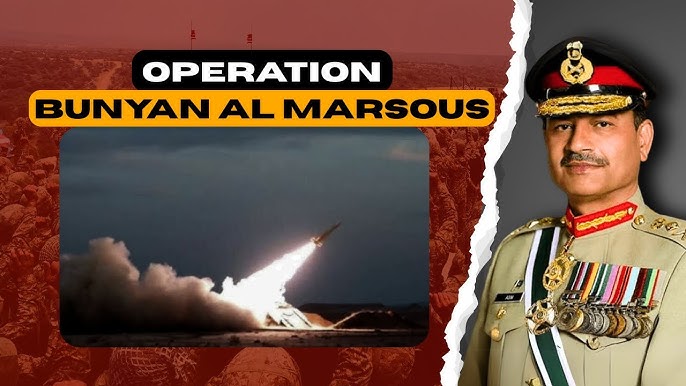
After India’s Attack, Pakistan launched a synchronized retaliatory campaign: Operation Bunyan un-Marsoos (“The Solid Structure of Resistance”). It involved 24 retaliatory strikes across six sectors, from Bhimber and Tatta Pani in the south to Keran and Tangdhar in the north. Pakistan’s strikes, guided by real-time ISR (intelligence, surveillance, reconnaissance) and satellite telemetry, targeted Indian forward artillery units, drone launch pads, and radar installations. Satellite imagery verified by independent defense analysts at Janes Defence Weekly confirmed over 70% degradation of Indian assets struck during the first wave. For a doctrine premised on assumed impunity, the shock was strategic.
The flaw in India’s approach is doctrinal at its core. It stems from misapplying models like Israel’s preemptive strike doctrine or America’s over-the-horizon capabilities. India’s strategic geography is fundamentally different. It shares a live, hot, and short-border theater with a peer nuclear adversary possessing second-strike capability, full-spectrum deterrence, and a demonstrated will to retaliate. The 2025 response showed that Pakistan’s Strategic Plans Division (SPD) has significantly evolved from a reactive posture to a pre-integrated, pre-authorized framework for calibrated retaliation.
The philosophical underpinnings of the “New-Normal” also collapse under strategic scrutiny. Indian thinkers like Shivshankar Menon argued that nuclear stability allows for limited conventional engagement. But this belief rests on the flawed notion that escalation ladders can be climbed and dismounted at will. In reality, South Asia’s compressed decision-making timelines, where missiles can traverse cities in under 4 minutes, leave little room for political or military de-escalation once thresholds are crossed.
Data from past incidents reinforces this. In 2019, Pakistan shot down two Indian aircraft following Balakot and captured Wing Commander Abhinandan. In 2020, India accidentally fired a BrahMos missile into Pakistani territory, which Islamabad chose not to retaliate against to preserve regional calm. But 2025 crossed that invisible line where repetition begins to equate to normalization. Pakistan responded, not in anger, but with logic.
Moreover, the quantitative asymmetry narrative, which India has long relied on, was nullified in this confrontation. Indian defense spending in FY2023–24 was INR 5.94 trillion (approximately USD 72 billion), more than three times Pakistan’s budget of PKR 1.8 trillion (approximately USD 6.3 billion). Yet budgetary muscle did not translate into deterrent credibility. Pakistan’s reliance on cost-effective, smart defense multipliers such as the Babur cruise missile, Shaheen-III MRBM, and advanced jamming drones closed the strategic gap. Analysts at the Stockholm International Peace Research Institute (SIPRI) noted that “Pakistan’s escalation control is increasingly shaped by strategic prudence, not numerical parity.”
International reactions further debunk India’s claim to controlled dominance. The Atlantic Council warned that “the normalization of cross-border strikes under nuclear cover destabilizes the last vestiges of strategic balance in South Asia.” The Council on Foreign Relations (CFR) remarked that India’s approach was “borrowed strategy without ownership of consequence.” Meanwhile, the UN Secretary-General urged both sides to “honor restraint, not rhetoric.” Only one state, Pakistan, had demonstrated that restraint in 2019 and 2020. In 2025, it was forced to respond.
Pakistan’s diplomatic messaging post-conflict was notably more strategic than India’s chest-thumping. In a press briefing on May 10, Pakistan’s Ministry of Foreign Affairs emphasized that Operation Bunyan un-Marsoos was designed to “neutralize threats, not escalate war.” The military’s spokesperson stated that “Pakistan does not desire conflict but will not accept a new normal where sovereignty is expendable.” This contrasts sharply with Indian officials’ repeated insistence that “limited war remains an option,” a dangerously provocative notion in a nuclearized environment.
Even Indian strategic circles are beginning to express discomfort. In an editorial for The Hindu, retired Indian Army General H.S. Panag criticized Operation Sindoor, writing: “We failed to factor in the will and capability of the adversary. Escalation without exit is not strategy. It is political theatre.” A leaked memo from India’s Integrated Defence Staff (IDS), reported by The Wire, admitted that “Pakistan’s response was faster and more calibrated than anticipated.”
The 2025 episode also exposed India’s overreliance on media warfare and information dominance rather than battlefield superiority. Indian television channels ran doctored clips, fabricated “kill lists”, and computer-generated drone feeds that were debunked by OSINT (Open-Source Intelligence) communities within hours. In contrast, Pakistan released geotagged footage, satellite data, and battlefield telemetry, which international outlets such as Reuters and Al Jazeera verified independently.
In conclusion, the events of April–May 2025 did not merely represent a military exchange. They signified the doctrinal death of India’s “New-Normal.” It is now abundantly clear that escalation cannot be surgically managed in South Asia. Strategic dominance cannot be declared through press conferences. Deterrence in this region is mutual, and Pakistan has just reminded the world that it is no passive actor in this equation.
India’s attempt to redraw the regional balance through kinetic bravado and theoretical mimicry has been decisively countered. The illusion of unilateral escalation has been replaced with the reality of reciprocal deterrence. Going forward, stability in South Asia will not emerge from arrogance. It will arise from the acknowledgment of shared risk.
The New-Normal is dead. What follows is not the “New Abnormal.” It is the return of the real: a deterrence logic anchored in parity, restraint, and credible capability. Pakistan has proven that it possesses all three, in both word and deed.
Author