


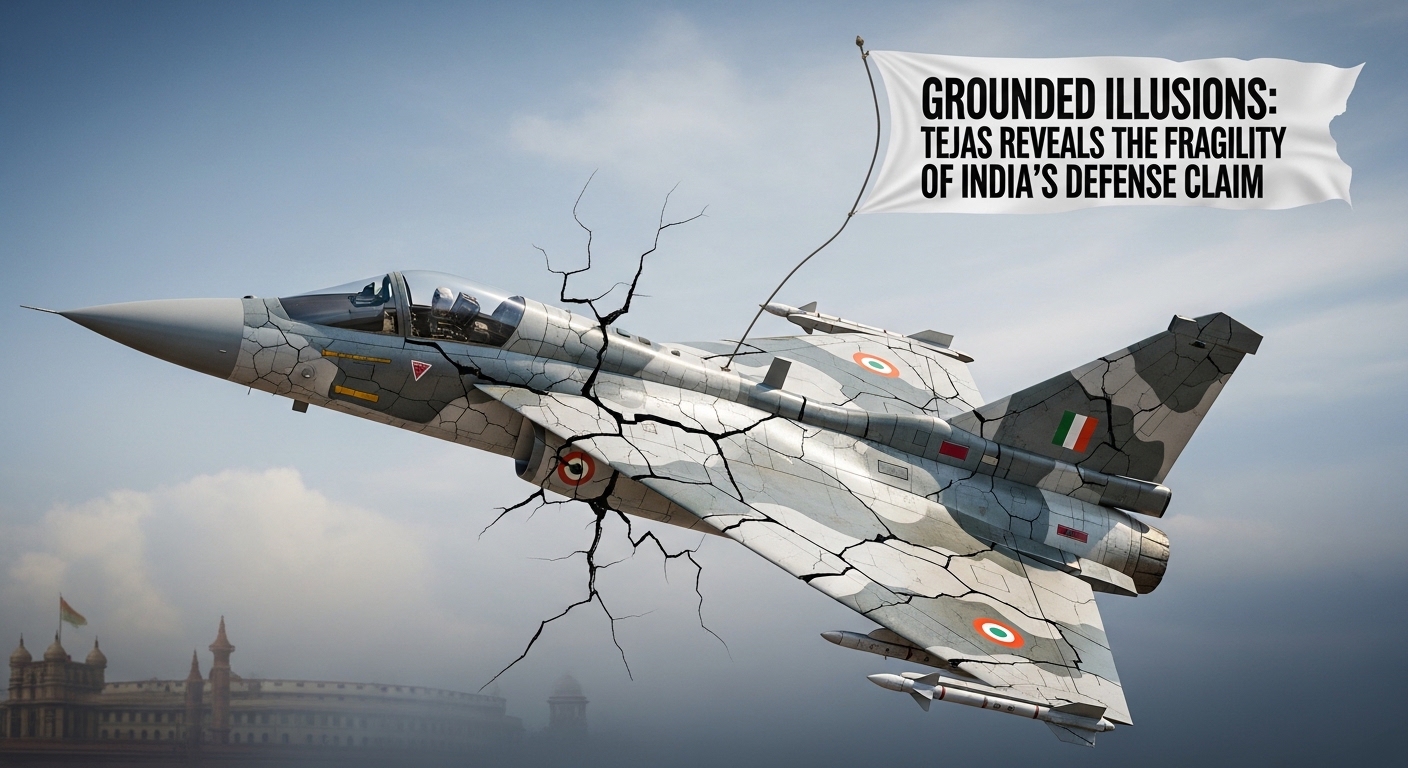
Grounded Illusions: Tejas Reveals the Fragility of India’s Defense Claim
In February 2026, the HAL Tejas fleet of the Indian Air Force was grounded after another serious accident on a routine landing, exposing chronic institutional incompetence and the inflated narrative...

In February 2026, the HAL Tejas fleet of the Indian Air Force was grounded after another serious accident on a routine landing, exposing chronic institutional incompetence and the inflated narrative surrounding India’s self-reliance in defense production. The pilot survived, but the plane was seriously damaged and can be written off, making it the third Tejas crash since induction.
Such recurrent failures highlight structural flaws in quality of production, technical control, and management of the program, questioning the plausibility of the Indian defense ambitions of the so-called Make in India. Ongoing research and increasing criticism show that the rhetoric of politics has long since surpassed industrial competence.
Latest Crash and Immediate Response
Preliminary accounts indicate the most recent Tejas aircraft sustained heavy structural damage during landing after a training sortie, leading the IAF to order a fleet-wide suspension of flying operations until comprehensive safety inspections are completed. The decision reflects standard aviation safety practice, yet it comes at a time when the Tejas program is under pressure due to delays in delivering the upgraded Mk1A variant and looming gaps in force readiness. While the pilot survived without serious injuries, the incident has triggered widespread debate about maintenance protocols, onboard systems reliability, and broader industrial oversight.
A Brief History of Crashes
The HAL Tejas has shown up India on more than one occasion on its overambitious claims of being self-reliant. Following its induction in 2016, major accidents, such as the March 2024 Jaisalmer incident, the high-profile November 2025 Dubai Airshow disaster which claimed the life of Wing Commander Namansh Syal, and the landing crash in February 2026, have cast serious questions of reliability and technical capability.
These failures of home-grown fleet demonstrate that there are systemic issues in the execution of defense-industrial in India, which has weakened the Make in India story and demonstrated that operational capability has lagged behind political ambition.
Development Delays and Production Realities
The Tejas program was initiated in the 1980s to fill a critical capability gap and replace ageing Soviet-era fighters like the MiG-21. However, its development and production timeline has been protracted. The aircraft only entered IAF service in 2016 after decades of iterative testing, redesign, and certification hurdles.
By early 2026, around 32 single-seat Mk1 Tejas jets had been delivered to the IAF, with the fleet size modest compared to broader force requirements.
Meanwhile, the more advanced Tejas Mk1A variant, ordered in a combined total of 180 units under two contracts worth over ₹1.1 lakh crore, has faced repeated delays. Deliveries have slipped nearly two years behind schedule, in part due to delayed engine shipments and protracted flight trials of integrated systems. These delays feed into operational readiness concerns at a time when the IAF struggles with the lowest squadron strength in decades.
Strategic Oversight and Force Readiness
The HAL Tejas was envisioned as the foundation of the modernization of the Indian air power- a localized solution that was to substitute the old fleets, minimize foreign reliance, and announce the technological maturity. Rather, recurring accidents, chronic technical glitches and slow output have revealed structural vulnerabilities in the Indian defense-industrial complex. What was positioned as a symbol of self-reliance has been more indicative of quality control lapses, supply-chain resilience and program management. It is hard to disregard the lack of connection between the political ambition and the depth of manufacturing.
The Indian Air Force has been reiterating the necessity to have reliable, combat ready aircraft due to the sustained strategic pressure on the northern as well as the western front. Despite platforms like the Dassault Rafale and Sukhoi Su-30MKI forming the backbone of frontline squadrons, even after losses to Pakistan in May 2025, Tejas was expected to fill squadron gaps and provide scalable multirole capability. Its foundation at this point disrupts force planning and supports a disturbing fact: even after years of rhetoric about indigenization, India continues to be highly reliant on foreign fighters to maintain operational preparedness.
Export Ambitions Dented by Public Failures
These crashes are not merely a technical, but a major industrial and institutional failure. The HAL Tejas program has been slowed down by chronic manufacturing delays, low production capacity, bottlenecks in the supply chain, and engine backlogs, and quality assurance and systems integration remain behind schedule.
The aerospace ecosystem in India is not as large and advanced as other competitors across the world, generating slow cycles and minimal resilience to failure. The recurring failures of Tejas underscore the prohibitive nature of promising indigenous capabilities too much in an industry where a single slip can be fatal.
Industrial Discipline and Quality Assurance
These accidents expose more than technical flaws; they reveal deep industrial and institutional weaknesses. Chronic manufacturing delays, limited production capacity, supply chain bottlenecks, and engine backlogs have all hampered the HAL Tejas program, while quality assurance and systems integration continue to lag.
India’s aerospace ecosystem lacks the scale and sophistication of global competitors, producing slow cycles and little resilience to setbacks. The repeated failures of Tejas highlight the high cost of overpromising indigenous capabilities in a sector where even minor errors can be disastrous.
Broader Strategic Consequences
The Tejas programs current miseries occur when the air force of India is experiencing acute capability shortcomings. Having a squadron strength that is less than the approved standards and older airframes that are almost approaching retirement, the need to have reliable indigenous fighters is pressing. The Tejas fleet grounding, even though it is temporary, adds to these difficulties and increases the dependence on foreign-made platforms.
Although, in some cases, global air forces will ground fleets following accidents, the rate and circumstances of such accidents in Tejas, which is a relatively young program, begs the question of institutional priorities and resource distribution. The gap between the rhetoric of self-reliance and the realities of how this is going to work is not to be overlooked.
Recalibrating Ambition and Capability
Tejas is still a reminder of the Indian desire to develop local fighter aircrafts. However, the correlation between strategic aspiration and operational implementation has been weak. Since the most recent crash is being investigated, and technical inspections are going on throughout the fleet, the stakeholders of the program are forced to ask themselves more fundamental questions regarding quality, control, and strategic priority.
To the defense establishment of India, Tejas has become a mirror reflecting the gap between India’s geopolitical ambition and its industrial capacity to sustain it: the indigenous capability should be accompanied by stringent systems engineering, open accountability and a disciplined industrial base in case it is to meet both national security requirements and international credibility.
Author