


Gridiron Gamble: Steelers’ Allar Pick Reflects High-Stakes Bet on Coaching Alchemy and Unseen Potential
POLICY WIRE — Pittsburgh, Pennsylvania — It isn’t merely about a third-round draft pick; it’s a high-stakes referendum on the elusive art of quarterback development, a policy gamble...

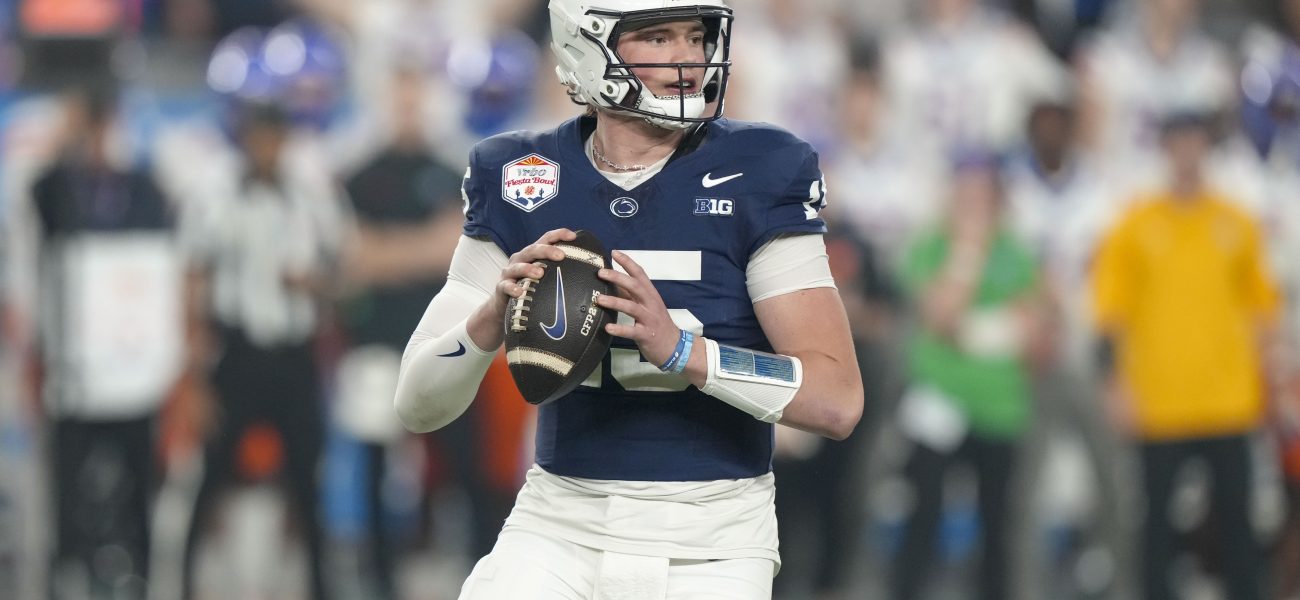
POLICY WIRE — Pittsburgh, Pennsylvania — It isn’t merely about a third-round draft pick; it’s a high-stakes referendum on the elusive art of quarterback development, a policy gamble disguised as an athletic selection. The Pittsburgh Steelers, a franchise steeped in blue-collar pragmatism, recently staked a significant wager on Penn State’s Drew Allar in the 2026 NFL Draft. An unpolished potential, Allar arrives with a weighty expectation: to validate head coach Mike McCarthy’s often-debated legacy as a quarterback whisperer—or, perhaps more accurately, a quarterback sculptor.
The murmurs emanating from the Steelers’ war room suggest an almost evangelical faith in what they term Allar’s “prodigious arm talent.” This isn’t just hyperbole; it’s the core tenet of their entire strategic calculus. But it’s a belief system tethered to a considerable caveat: Allar’s fundamental biomechanics of his lower kinetic chain—his footwork, in lay terms—requires a complete overhaul. That, ultimately, falls squarely on McCarthy’s shoulders. It’s a precarious tightrope walk, marrying raw, discernible physical gifts with the nuanced, often unteachable, mental fortitude demanded by professional football.
Behind the headlines and highlight reels, this move represents a profound investment in potential, a common thread in arenas far beyond the gridiron. Art Rooney II, the Steelers President, articulated this strategic long game with characteristic brevity. “Every draft pick is an investment, a calculated risk,” Rooney posited to Policy Wire, “For a third-round quarterback with Allar’s physical gifts, the upside—if properly harnessed—could be transformative. We’re committing resources, personnel, and a considerable amount of institutional faith.” This commitment isn’t insignificant; a third-round pick represents a multi-million dollar outlay over a rookie contract, with the implicit expectation of future returns many times that amount. Historically, only about 15% of quarterbacks drafted in the third round or later ever become long-term starters in the NFL, according to data compiled by Pro Football Focus, underscoring the inherent long odds.
Still, the comparisons have already begun, an almost immediate historical anchoring. “Pittsburgh believes Allar has similar arm talent to a young Joe Flacco,” ESPN’s Jeremy Fowler pointed out. The irony, naturally, isn’t lost on anyone who witnessed the palpable ire of Steelers Head Coach Mike Tomlin when the Cleveland Browns traded Flacco to the Cincinnati Bengals recently. Flacco’s subsequent performance—342 yards and three touchdowns in his second game with the Bengals—was a stark, public rebuke to those who’d written him off. Coach Tomlin, when pressed on the Flacco parallel, was predictably blunt. “Look, in this league, you don’t just ‘develop’ talent; you identify it, you cultivate it, and you pray it blossoms,” Tomlin shot back, his expression unyielding. “Allar? He’s a significant project, no doubt. But we’re not in the business of easy paths. We’re in the business of championships.” It’s a mission statement, a declaration of intent, really.
And so, the stage is set. Allar’s trajectory, intimately tied to McCarthy’s tutelage, becomes a fascinating study in organizational patience versus the relentless pressure for immediate results. Will McCarthy, whose previous stints saw him guide quarterbacks to considerable success (and some very public failures), unlock Allar’s latent potential? Or will this become another cautionary tale in a league notoriously unforgiving of such developmental gambles? Time, that unyielding arbiter, will certainly tell.
📄 POLICY WIRE WHITEPAPER PUBLISHED: PAKISTAN'S NATIONAL SECURITY POLICY PRIORITIES
👉 READ BY CLICKING HEREWhat This Means
This isn’t just a football story; it’s a microcosm of policy decisions and economic implications writ large. The Steelers’ acquisition of Drew Allar is a quintessential example of “talent arbitrage”—identifying an asset undervalued due to perceived flaws, then investing heavily in its remediation for a potentially outsized return. It’s a strategy employed across industries, from venture capital backing nascent tech firms to nations investing in human capital development.
Consider, for instance, the strategic development challenges faced by nations in the Muslim world, specifically Pakistan. The decision to invest in a “raw talent” like Allar mirrors, in a metaphorical sense, the long-term gambles Pakistan often undertakes in its economic or infrastructure planning. Projects like the China-Pakistan Economic Corridor (CPEC), a multi-billion-dollar endeavor, hinge on the audacious bet that current resource commitments and strategic risks—including managing complex geopolitical dynamics and internal insurgencies—will yield transformative future dividends. It’s an investment in future stability and prosperity, not dissimilar to a franchise betting on a quarterback’s unproven arm to secure Super Bowl glory years down the line. Both scenarios demand exceptional foresight, a tolerance for considerable uncertainty, and an unflinching commitment to a developmental process that often delivers its rewards — or its disappointments — on an extended timeline. Ultimately, both endeavors are about managing risk, cultivating potential, and navigating the harsh realities of competitive landscapes, whether on the gridiron or the geopolitical stage.