

Ghost of Austerity: Argentina’s Intellectual Pulse Tested by Milei’s Sharp Blade
POLICY WIRE — Buenos Aires, Argentina — Sometimes, a nation’s deepest battles aren’t fought with ballots or tanks, but on asphalt, amidst a sea of students clutching books—or just demanding the right...

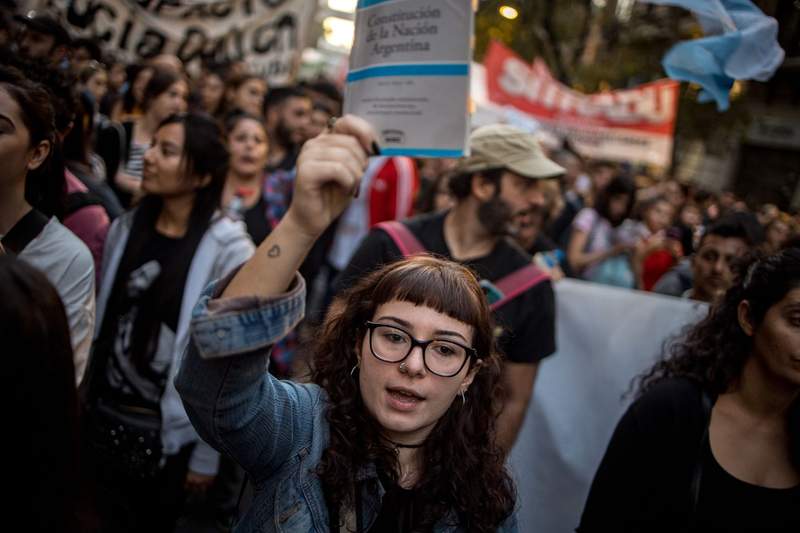
POLICY WIRE — Buenos Aires, Argentina — Sometimes, a nation’s deepest battles aren’t fought with ballots or tanks, but on asphalt, amidst a sea of students clutching books—or just demanding the right to. That’s precisely what played out across Argentina this week. They weren’t protesting inflation directly, though that’s the phantom haunting every corner. No. They were marching for chalkboards, for textbooks, for the very idea of public education, currently facing the existential reckoning brought by President Javier Milei’s libertarian shock therapy.
It wasn’t a riot; it was a parade of intellectual fervor, a human shield thrown around institutions many consider the beating heart of national identity. Hundreds of thousands poured into the streets of Buenos Aires and beyond, a stunning, largely peaceful display of dissent that managed to unite disparate political factions—leftists, moderates, and even some frustrated Milei voters. But what’s the fuss? It’s about money, sure. Or rather, the distinct lack of it, earmarked for the country’s revered public universities. Because, you know, when the government tightens its belt, sometimes it forgets to leave a little room for brain food.
President Milei, you’ll remember, swept into office on a hurricane of anti-establishment sentiment, promising to slash state spending with a chainsaw. And he’s delivered, with gusto. His administration’s economic plan involves what many consider a brutal assault on public finances, and higher education has found itself directly in the crosshairs. We’re talking budget freezes, real-terms cuts that mean university operating funds haven’t seen a dime of increase, even as inflation, last year, sat at a breathtaking north of 200 percent. Imagine trying to run a top-tier institution with a fraction of the actual cash you had last year. You can’t.
“We’re simply cutting the fat, trimming the excess from an over-bloated, inefficient system designed for political indoctrination, not actual learning,” Milei remarked in a recent fiery public address. “The Argentine people are tired of funding parasitic bureaucracies. We’re liberating funds for the productive sector, for those who truly build.” And he truly believes it.
But the academic community? They aren’t buying it. Not even a little. Dr. Ana María Mustapic, a distinguished political science professor at the University of Buenos Aires, didn’t mince words, “These institutions aren’t just classrooms; they’re laboratories, hospitals, cultural hubs—they’re Argentina’s intellectual patrimony. Starving them isn’t austerity; it’s a self-inflicted lobotomy. We’re losing our brightest, pushing them into the arms of nations willing to invest in human potential. It’s happening in every developing country where states abandon their primary duties.” Mustapic is right; 80% of Argentina’s higher education students attend public institutions—a staggeringly high figure reflecting the deep-seated value placed on accessible education in the nation.
Because that’s the thing. Public universities here aren’t merely an option; they’re the primary vehicle for social mobility, churning out doctors, engineers, and scientists for free. They’ve long been a source of national pride, drawing students from across Latin America. And, perhaps just as relevant, they form a crucial plank of public good, often doing research and community work that the private sector wouldn’t touch. But now, it’s electricity bills going unpaid, maintenance grinding to a halt, research grants drying up. Classrooms grow colder; resources thinner. This isn’t just inconvenient; it threatens the very viability of degrees earned.
And let’s consider the broader canvas, shall we? You look at similar patterns of underinvestment in public services in, say, parts of South Asia or the Muslim world, and you see the familiar outcome: an accelerating brain drain, an increasing reliance on overseas education (if you can afford it), and a deepening of class divides. Countries like Pakistan have grappled for decades with adequately funding higher education, battling internal brain drain, and the struggle to retain talent in the face of better opportunities abroad. It’s a tale as old as globalization, but one Argentina is now staring down with open eyes, thanks to Milei’s ideological purity test.
What This Means
This isn’t just about university budgets; it’s a direct challenge to the social contract that’s long defined Argentina. Milei’s government sees state spending as a malignancy to be excised, irrespective of the social cost. The unprecedented turnout for these protests suggests a profound disconnect between this radical libertarian vision and the populace’s deeply ingrained belief in universal public services. For many Argentines, public education is a birthright, a sacred cow. And you don’t just carve up a sacred cow without expecting a stampede. Politically, Milei risks alienating a broad swath of society, even some who initially backed his fiscal rigor. Economically, starving the engine of intellectual growth seems, well, short-sighted, doesn’t it? It’s not just a budget line item; it’s the future skilled workforce, the innovators, the leaders. Crippling these institutions now might save a few pesos today, but it could cost the nation its global competitiveness for decades to come. The question now isn’t if universities can survive; it’s what kind of Argentina will emerge if they don’t.