


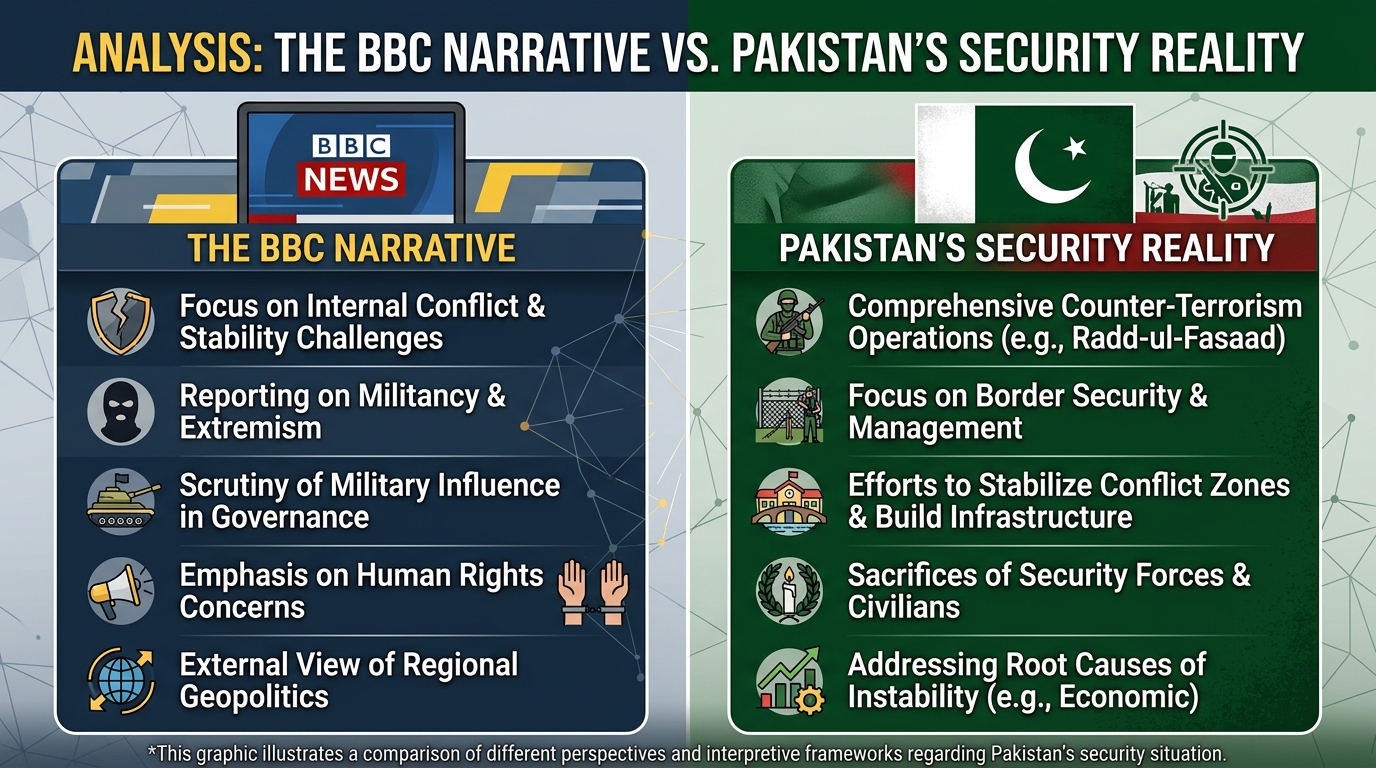
The BBC Narrative vs Pakistan’s Security Reality
Pakistan has once again demonstrated its unwavering commitment to protecting its citizens from the persistent cross-border terrorism emanating from Afghan soil. In the face of the Taliban regime’s...
Pakistan has once again demonstrated its unwavering commitment to protecting its citizens from the persistent cross-border terrorism emanating from Afghan soil. In the face of the Taliban regime’s repeated failure, or unwillingness, to curb terrorist safe havens on its territory, Pakistan has taken decisive and necessary action against terror networks operating in and around Kabul.
These operations are a legitimate and assertive act of self-defense, nothing less. Any attempt to portray Pakistan’s rightful response as “aggression” is nothing but deliberate misinformation and biased reporting, as brazenly pushed by outlets like the BBC.
In its report on the March 16 attack on Kabul, BBC takes into consideration only one particular incident while failing to recognize the larger picture, which consists of several years during which Pakistani soldiers and policemen, along with innocent civilians, have fallen prey to the attacks carried out from the Afghan soil.
The Undeniable Reality of Afghan-Based Terrorism
Pakistan has endured a surge in terrorism since the 2021 takeover of Afghanistan by the Taliban. Groups like the Tehrik-i-Taliban Pakistan (TTP) also known as Fitna-al-Khawarij and the Hafiz Gul Bahadur (HGB) network, long documented by UN monitoring teams, enjoy sanctuaries, training camps, and operational freedom across the border.
Within just the past 48 hours, Pakistan has experienced horrible attacks in Bannu and Lakki Marwat. In Bannu, a large-scale VBIED attack resulted in the deaths of more than 20 police personnel and civilians, with many others suffering injuries. These incidents are clearly traceable to HGB and FAK terrorist networks originating from Afghanistan. Such violence has resulted in the loss of countless Pakistani lives in recent years, among them soldiers, security forces, and civilians who require the same, if not more, attention from the international community.
According to UN resolutions, Afghanistan provides a fertile ground for FAK and associated terrorists to recruit, train, facilitate, and conduct operations into Pakistan. The Taliban regime in Afghanistan has shown its reluctance, if not outright hostility, toward any such terrorist networks, despite repeated efforts on the part of Pakistan to bring the issue to the forefront of diplomatic discussion.
Pakistan’s Monumental Sacrifices in the War on Terror
Of all the nations engaged in the war on terror across the globe, none has paid a higher price than Pakistan. From the year 2001 to date, Pakistan has suffered more than 80,000 fatalities, which include many troops and policemen, in addition to financial losses amounting to $150 billion. The military of Pakistan managed to undertake operations of great magnitude, such as Zarb-e-Azb and Radd-ul-Fasaad, that enabled them to clear terrorists from their land. However, as soon as terrorists were cleared in their territory, they started resurfacing in Afghan territory.
Precision Targeting, Not Civilian Harm
Pakistan firmly rejects any attempt to equate its lawful counterterrorism operations with the brutal terrorist attacks carried out against the country. In the Kabul attack and other related operations, the armed forces of Pakistan conducted their strikes against confirmed infrastructure of terror groups, arms caches, technical equipment depots, and multi-purpose facilities belonging to the FAK and other terror-affiliated groups.
The allegations that there has been a strike on a hospital or deliberate targeting of civilians is an absolute fabrication. No nation in the world is expected to accept the existence of operational bases for terrorists in its territory and that too when such bases are located inside civilian areas to take advantage of public sentiment and media coverage.
Pakistan’s evolving doctrine, shifting from purely reactive defense to proactive disruption of terrorist ecosystems, is a rational response to an existential threat. No country would sit idle while its citizens are slaughtered by militants enjoying safe havens next door.
The BBC’s Long Pattern of Alleged Bias
The BBC’s current reporting is no anomaly. It follows a long pattern of selective and one-sided coverage that has drawn criticism even from international analysts and non-Pakistani voices. British politician and broadcaster George Galloway has been a vocal critic of the BBC, accusing it of one-sided journalism and promoting pro-Western narratives, particularly in coverage of international conflicts. An analysis published in the International Policy Digest raised serious concerns about the BBC’s impartiality regarding Pakistan and its military, questioning whether the broadcaster’s one-sided narratives truly serve journalistic integrity.
This pattern of alleged bias weakens public trust and presents an incomplete picture of complex regional issues.
The Hypocrisy of Selective Outrage and International Double Standards
International outlets like the BBC give extensive airtime to Afghan allegations and unverified casualty figures while offering minimal scrutiny to the mountain of evidence on FAK sanctuaries. Where is the coverage of Pakistani mothers burying their sons, policemen martyred in the line of duty, or entire communities living under the shadow of terror? The suffering of Pakistani victims, hundreds killed in attacks traced directly to Afghan soil, merits the same visibility.
Moreover, double standards are glaring. No one questioned the United States when it conducted drone strikes and raids deep inside sovereign territories against perceived terrorist threats. Why the different standard for Pakistan? Western media readily accepts the right to self-defense for other nations but applies harsher scrutiny to Pakistan’s actions.
Time for Accountability in Afghanistan
Essentially, the main question that needs answering is why the infrastructure of the terrorists continues to flourish within Afghanistan despite being supervised by the Taliban regime. Until and unless the Kabul regime rids the country of these terror groups, takes steps against their leadership of FAK and HGB, and does not allow its land to be used against another country, there will be no solution.
Pakistan is a frontline state in the global war against terrorism, a role for which it has made sacrifices in terms of blood and resources more than any other country. These steps have been taken by Pakistan because of the firm conviction of a sovereign state to protect its sovereignty according to Article 51 of the United Nations Charter.
The stance of Pakistan is very clear and simple: we want peace in Afghanistan but only in an atmosphere of stability; however, in no case can we compromise on our national security.
Author