


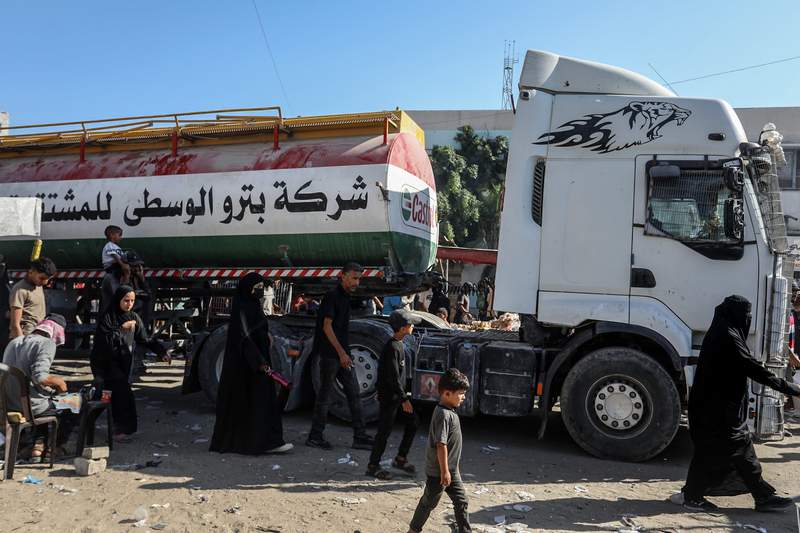
Gaza’s Humanitarian Maze: UN Caught Between Aid and Accusation as COGAT Targets Turkish NGO
POLICY WIRE — Jerusalem, Israel — For seasoned aid workers in the beleaguered Gaza Strip, every parcel of flour, every water truck, every clinic door opening, is a bureaucratic miracle....

POLICY WIRE — Jerusalem, Israel — For seasoned aid workers in the beleaguered Gaza Strip, every parcel of flour, every water truck, every clinic door opening, is a bureaucratic miracle. But now, even these strained lifelines are snagged in a renewed geopolitical tug-of-war. Israel’s Coordinator of Government Activities in the Territories (COGAT) — the outfit managing civilian interaction with Gaza and the West Bank — isn’t just asking nicely. No, they’re laying down the gauntlet, demanding the United Nations sever all ties with a major Turkish non-governmental organization, the IHH (Insani Yardim Vakfi), flat-out calling it a terrorist entity.
It’s a sticky wicket, this whole aid business. The UN, bless its many-headed organizational heart, finds itself perpetually wedged between the rock of humanitarian imperatives and the hard place of national security concerns from various member states. And because Turkey’s IHH has a long, contentious history with Israel, stretching back to that bloody Mavi Marmara flotilla incident in 2010 (where Israeli commandos killed ten activists attempting to breach the Gaza blockade), this isn’t just bureaucratic nitpicking. This is about deep, festering mistrust and a battle over who gets to define what ‘humanitarian’ really means on the ground.
COGAT’s message is clear, albeit delivered through official channels rather than shouted from rooftops: quit engaging with IHH. They contend the group’s alleged connections — which Israel has repeatedly flagged as reaching beyond purely charitable works into the murky territory of supporting militant factions — make them an unsuitable partner for any international body. Never mind that the IHH operates openly in Gaza, often filling gaps other organizations can’t, or won’t. And yes, other nations might view them as just a charity, doing good works in a forgotten corner of the world.
“We’ve consistently highlighted the IHH’s deeply concerning ties, and it’s simply untenable for international bodies to provide cover, however unwitting, to entities that fundamentally undermine our security,” stated Shai Feldman, a spokesperson for Israel’s Coordinator of Government Activities in the Territories, when pressed on the issue. He didn’t mince words. “Turning a blind eye now is a recipe for greater instability later. They’re not just moving aid; they’re moving an agenda.”
But the UN isn’t exactly a quick-moving beast, especially not on such politically charged terrain. A spokesperson for UN humanitarian affairs, who asked not to be named given the delicacy of current negotiations, pushed back softly: “Our mandate is purely humanitarian; we engage with organizations capable of delivering aid where it’s needed most. These accusations, while taken seriously, must be balanced against the immediate and desperate needs on the ground.” It’s the classic UN tightrope walk, attempting to feed hungry mouths without implicitly endorsing anything — which, let’s be honest, is practically impossible in this region.
The IHH’s operational presence isn’t confined to Gaza. They’re active across the Muslim world, from Syria to parts of South Asia. They’ve built mosques, funded schools, and delivered medical aid in regions like Pakistan hit by natural disasters, garnering significant goodwill — and sometimes, political leverage. This complicates Israel’s designation, as many see IHH simply as a prominent Islamic charity. And, perhaps not surprisingly, this whole kerfuffle is part of a larger geopolitical chess match where Turkey under President Erdoğan is keen to expand its influence and solidarity with Palestinians, often directly challenging Israeli policy and regional standing. Israel, on its end, considers its own security paramount — a notion few can argue against, even if its implementation sometimes looks… complicated.
The numbers don’t lie about the sheer scale of the challenge. The United Nations Office for the Coordination of Humanitarian Affairs (OCHA) reported that in 2023, approximately $200 million was allocated for the Gaza Strip’s humanitarian response through various partners. Every dollar counts, — and every partner is (theoretically) valuable. But Israel’s stance throws a wrench into that machinery. It’s an insistence that collaboration cannot come at the expense of ignoring groups it identifies as directly or indirectly linked to terror. Which, from Israel’s perspective, IHH fits quite snugly.
Because, really, when does an aid convoy become something else entirely? For Israel, that line’s apparently been crossed with the IHH. The group itself, of course, has consistently denied any links to terrorism, always presenting its work as purely charitable, purely religious in its motivation.
What This Means
This escalating dispute isn’t just about one Turkish NGO. It’s a barometer for the increasingly fraught relationship between humanitarian aid, state sovereignty, and international perceptions of terror. Politically, Israel is signaling a firmer hand against any organization it deems a security threat, irrespective of their UN engagement. It complicates humanitarian efforts in Gaza, forcing UN agencies into an unenviable choice: either risk offending Israel — an essential, if reluctant, gatekeeper for aid — or abandon a potentially significant aid provider. This push could also further strain Israel-Turkey relations, which are perennially volatile anyway. On an economic level, if IHH’s significant operations are disrupted, it’s not hard to see who suffers: the already struggling populace of Gaza. But that’s the thing about geopolitics in that corner of the world, isn’t it? The human cost often seems a secondary consideration when ‘security’ gets mentioned. For the UN, it means more scrutiny of its partners, which could slow down — and that’s a polite way of saying ‘paralyze’ — much-needed relief efforts. You want efficient aid? Good luck getting everyone to agree on what ‘safe’ aid looks like. And this all occurs against a backdrop of increasing geopolitical fracturing where, Europe’s Frayed Nerves aren’t helping to bring calm to the global discourse. Meanwhile, other states will observe this spat, taking cues for their own ‘red lines’ when it comes to aid distribution through non-state actors. It’s a diplomatic domino effect.
And so, the labyrinthine world of aid continues, where every act of charity risks becoming a point of international contention, and humanitarian workers must navigate a minefield of political demands just to deliver basic sustenance.