


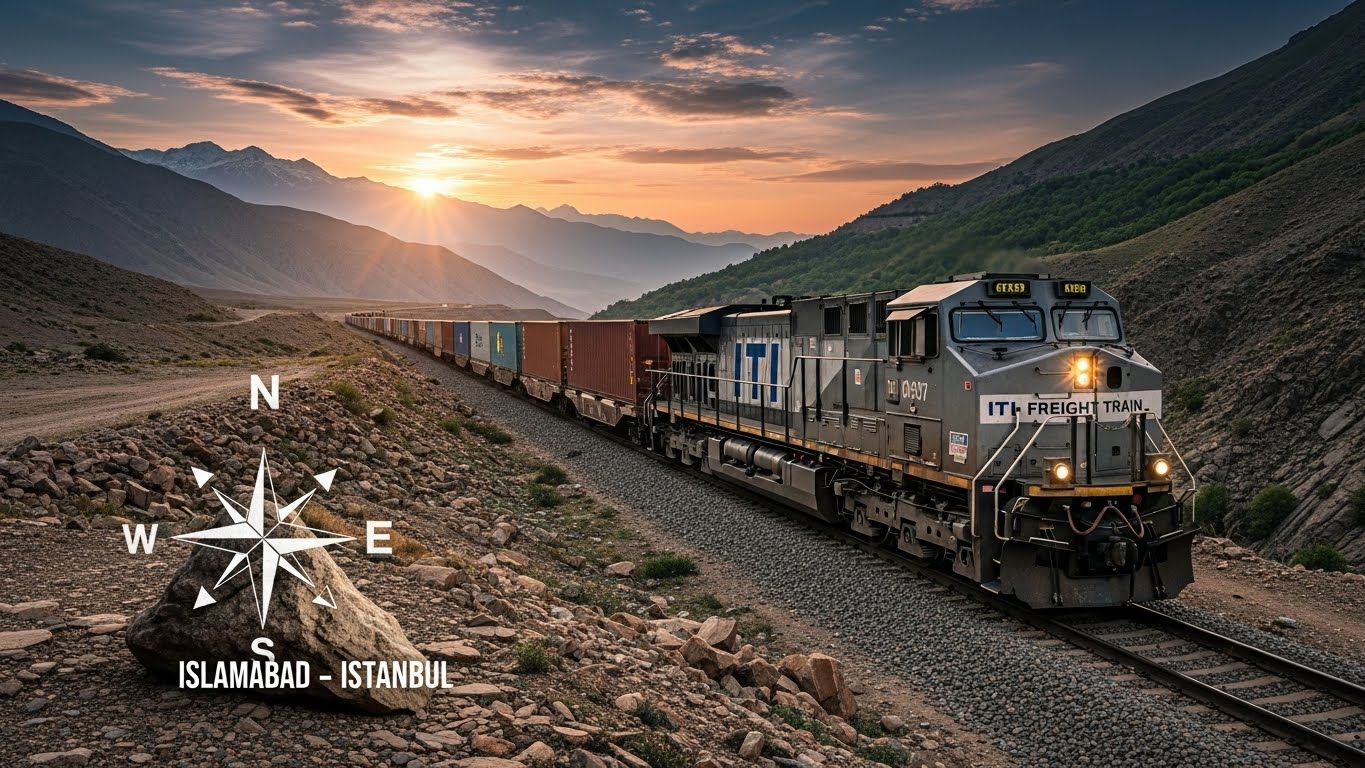
From Islamabad to Istanbul: The ITI Freight Train and the Dawn of a New Regional Order
Pakistan’s decision to restart the Islamabad-Tehran-Istanbul (ITI) freight train on 31 December 2025 is not merely the reactivation of an old transport link, it is a landmark development that...

Pakistan’s decision to restart the Islamabad-Tehran-Istanbul (ITI) freight train on 31 December 2025 is not merely the reactivation of an old transport link, it is a landmark development that embodies a new era of regional strategy. The move reflects a self-assured Pakistan, fully aware of its strategic centrality between South Asia, the Middle East, Central Asia, and Europe. At a time when global supply chains are being reshaped by rising costs, shipping disruptions, and geopolitical volatility, Pakistan is stepping forward with a corridor that places it firmly at the heart of Eurasian commerce.
The data reveals the strategic weight of this revival. Traditionally, cargo from Pakistan to Europe takes 45 to 60 days by sea, subject to delays at major chokepoints such as the Suez Canal, which handles over 12% of global trade. In contrast, the ITI freight train reduces this journey to 12–14 days, a reduction of nearly 70% in delivery time. For exporters, this is transformative. Pakistan’s exports to Europe already exceed $10.5 billion annually, led by textiles, leather, surgical instruments, and sports goods. A faster, more predictable rail route allows industries to meet strict European delivery deadlines, improve cash flow, and expand market share.
The corridor also enhances regional trade potential. Türkiye’s annual trade volume surpasses $250 billion, while Iran’s growing integration with Central Asia makes it a key commercial partner. The Economic Cooperation Organization (ECO), under which the ITI corridor operates, represents a market of over 500 million people. By rejoining this corridor with full operational capacity, Pakistan positions itself as a primary transit state for Eurasian trade, unlocking billions in potential transit revenue, logistics investments, and industrial zone activity.
Additionally, the ITI route supports broader regional connectivity projects. Rail upgrades under discussion could raise freight speeds from the current 60–80 km/h to 120 km/h, doubling capacity. Pakistan Railways has already outlined plans to improve the Quetta-Taftan section, which spans 630 kilometers and forms one of the most important segments of the route. With Iran investing in its Chabahar-Zahedan and Zahedan-Tehran rail networks, the corridor could eventually link to the International North-South Transport Corridor (INSTC), connecting South Asia to Russia and the Caucasus, opening up entirely new export markets.
This initiative also underscores Pakistan’s diplomatic maturity and balanced foreign policy. Strengthening ties with Iran and Türkiye — two nations with which Pakistan shares deep cultural and historical bonds — enhances regional stability and economic cooperation. Iran supplies nearly 100 megawatts of electricity to Pakistan’s border districts, and cross-border trade is projected to exceed $2.5 billion with new transit agreements. Türkiye, meanwhile, is one of the world’s fastest-growing logistics hubs, handling over 1 million tonnes of rail freight annually across its European and Asian networks. Pakistan’s engagement with both countries reflects a deliberate strategy of constructive partnerships built on shared prosperity.
The economic benefits extend far beyond trade. Efficient freight corridors are known to reduce logistics costs by 20–30%, attract foreign direct investment, and boost industrial productivity. For Pakistan, whose logistics costs currently hover around 19% of GDP — among the highest in Asia — such infrastructure development is essential for long-term competitiveness. The ITI train’s revival is perfectly aligned with the government’s growth agenda, which already resulted in foreign direct investment rising by 37% in FY2025, according to State Bank data.
The political will behind the corridor further demonstrates the seriousness of the effort. Engagement from chambers of commerce, freight companies, and exporters indicates strong private-sector interest. With global rail freight expected to grow from $280 billion to over $390 billion by 2030, the ITI corridor positions the region to capture a share of an expanding global market.
On December 31, when the ITI freight train departs from Islamabad, it will carry more than containers, it will carry symbolism. It will reflect a nation ready to lead with confidence, integrate with its region, and ready to shape the economic future of a wider Eurasia.
“The rails of commerce have always shaped the maps of tomorrow, carrying not just cargo but the promise of a more connected world.”
Author