


The Smirk and the Lens: A Digital Reckoning on Asphalt
POLICY WIRE — Washington D.C. — Not every image etched into the public consciousness features grand pronouncements or geopolitical machinations. Sometimes, it’s just a face. And a smirk. A...

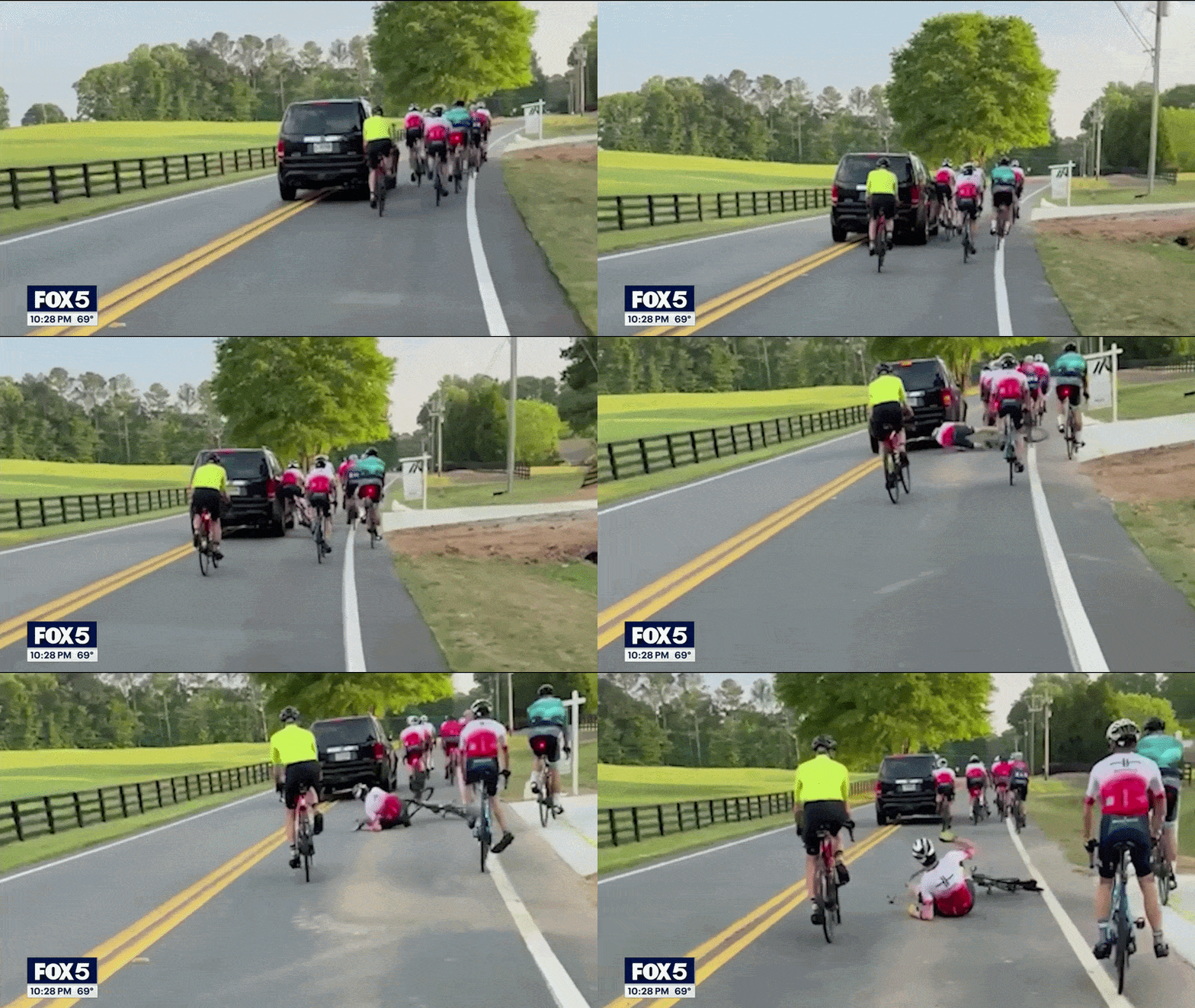
POLICY WIRE — Washington D.C. — Not every image etched into the public consciousness features grand pronouncements or geopolitical machinations. Sometimes, it’s just a face. And a smirk. A disconcerting, almost theatrical defiance captured in a booking photograph, following an alleged act of extreme road rage that saw a vehicle swerving into a group of cyclists. That chilling image, now plastered across screens and timelines, forces us to confront not merely an individual’s alleged delinquency, but the broader, unsettling currents coursing through our digitally documented lives.
It wasn’t a sudden, unrecorded flash of temper. Oh no. The whole harrowing episode, police contend, unfolded beneath the unblinking eye of a camera—a cyclist’s helmet cam, perhaps, or a bystander’s phone—before being uploaded, scrutinized, and ultimately, weaponized by public opinion. And then, there was the mugshot: a man, accused of potentially life-altering vehicular assault, seemingly unburdened by remorse. What does such a brazen display telegraph in an era saturated with surveillance — and instant public judgment? It’s a question that reverberates far beyond the immediate incident, touching upon the very fabric of social contract on our increasingly congested roadways.
And so, we’re left to parse this peculiar performance. This isn’t just about a driver and some cyclists; it’s about the erosion of civility, the performative aspect of transgression in a hyper-visible world. “This sort of flagrant disregard for human life—it’s profoundly disturbing, a corrosive element in our communities,” shot back Police Chief Evelyn Ramirez, addressing reporters. “We’re seeing an uptick in these incidents, driven, it seems, by a cocktail of stress, entitlement, and the unfortunate illusion of anonymity behind a windshield.” Her exasperation wasn’t hard to discern.
But it’s not merely local law enforcement grappling with such manifestations of public anger. Behind the headlines of daily aggressions, a global pattern emerges. In Karachi, Pakistan, for instance, a city famed for its frenetic pace and burgeoning population, similar incidents of vehicular aggression and brazen disregard for traffic laws are commonplace, though often lacking the viral, crystalline clarity of Western digital footage. The World Health Organization reported that low and middle-income countries account for a staggering 93% of road traffic fatalities, despite possessing only about 60% of the world’s vehicles—a statistic that underscores the systemic pressures and often lax enforcement contributing to dangerous driving cultures worldwide. It isn’t just about individual psychology; it’s also about infrastructure, urban planning, and societal norms that either reinforce or deter aggressive conduct.
Still, the smirk. Dr. Omar Sharif, a prominent sociologist specializing in public policy in the Muslim world, offered a pointed assessment. “In societies where public shame holds significant sway, a defiant mugshot can be viewed as an affront to collective moral order,” he elucidated from Islamabad. “It’s not merely a legal transgression; it’s a social one, broadcasting a lack of humility that often ignites even greater public outrage. While our formal justice systems differ, the internet’s capacity for public trial—and conviction—transcends borders. It’s creating a universal demand for accountability, sometimes for better, sometimes for worse.” He wasn’t wrong, of course.
📄 POLICY WIRE WHITEPAPER PUBLISHED: PAKISTAN'S NATIONAL SECURITY POLICY PRIORITIES
👉 READ BY CLICKING HERESo, what does this viral moment, this brief, unsettling tableau, truly signify? It’s a stark reminder of the escalating tension in our shared public spaces—a tension that feels increasingly unmediated. We’re witnessing a precarious balance, aren’t we, between individual liberty and collective safety, all exacerbated by the digital amphitheater where every transgression becomes spectacle. It’s a micro-level conflict, certainly, but one that underscores the constant, delicate negotiation required for social cohesion, much like the broader diplomatic efforts we see in macro-level international relations. (Think about the complexities involved when Iran offers diplomatic proposals to the US via Pakistan; it’s all about navigating friction.)
What This Means
At its core, this incident speaks to a profound crisis of empathy — and accountability in the digital age. The ubiquity of recording devices transforms every public interaction into potential evidence, every fleeting emotion into an immutable record. While this offers new avenues for justice, it also fosters a chilling environment where egregious acts are committed with a perverse awareness of their eventual virality. The alleged driver’s smirk isn’t just a sign of personal callousness; it could also be interpreted as a knowing defiance of the very system – both legal and digital – that seeks to condemn him. Politically, such incidents escalate public demand for swifter, more visible justice, often bypassing due process in the court of public opinion. Economically, repeated instances of road rage and civic breakdown can deter investment, strain public services, and contribute to a general sense of societal decline, affecting everything from tourism to daily commerce. the global sharing of such incidents, bridging cultural divides, indicates a universal concern over public safety and the psychological toll of hyper-urbanization. It’s not just a localized traffic kerfuffle; it’s a barometer of societal health, registering pressure points that require far more than just a police blotter entry to address.
Ultimately, the incident, captured in pixels and amplified by algorithms, serves as a poignant, if unsettling, tableau of our times. It’s a moment that asks us to reflect on the nature of public space, the boundaries of personal responsibility, and the unforgiving gaze of the digital age. And it’s a question we’d best answer, before the smirks become commonplace.