
Pakistan-China Warrior-IX Joint Counterterrorism Exercise
The shifting security environment in South and Central Asia demands robust, coordinated responses to evolving threats. In this light, the latest bilateral military cooperation between Pakistan and...

The shifting security environment in South and Central Asia demands robust, coordinated responses to evolving threats. In this light, the latest bilateral military cooperation between Pakistan and China, embodied by the joint counterterrorism exercise Warrior-IX, assumes considerable significance. By institutionalizing combined training, shared doctrines and coordinated operational protocols, Warrior-IX represents both a tactical initiative and a broader statement of defence diplomacy.
On 1 December 2025, the Pakistan Army and the China’s People’s Liberation Army (PLA) formally launched Warrior-IX at the National Counter Terrorism Center (NCTC) in the Pabbi area of Kharian district, Punjab. According to official statements, the exercise’s core aim is to enhance “interoperability, professional skills and exchange of modern warfare practices” between the two militaries. The opening ceremony was attended by senior officers from both sides, including the commander of Mangla Corps and Major General Bian Xiaoming, Deputy Chief of Staff of the PLA’s Western Theatre Command. According to the Chinese Ministry of Defense, participating troops will undertake mixed-group training, live-force drills and joint operational activities. The exercise is scheduled to run until mid-December 2025.
Historical Context: Evolution of Pakistan–China Military Cooperation
The joint “Warrior” series between Pakistan and China is part of a broader history of defence cooperation that has deepened over decades. Recent years have seen regular counterterrorism-oriented exercises, reflecting an adaptive strategy in response to changing threat environments. For instance, the preceding exercise, Warrior-VIII, was held from 19 November to 11 December 2024. Chinese troops for that exercise were reportedly flown in using Y-20 transport aircraft, and the drills included live-fire shooting, team tactics, medical-evacuation training and communication interoperability. According to the Chinese defense-ministry report, the two militaries successfully tested joint counterterrorism capabilities across a spectrum of operations. The concluding Distinguished Visitor’s Day at the 2024 exercise was attended by high-ranking dignitaries from both nations, who praised the professionalism and coordination of participating troops. This track record underlines that Warrior-IX is not an isolated event but part of an ongoing tradition of bilateral military collaboration, aimed at building institutional trust and operational familiarity over time.
Operational and Strategic Dimensions in Warrior-IX (2025)
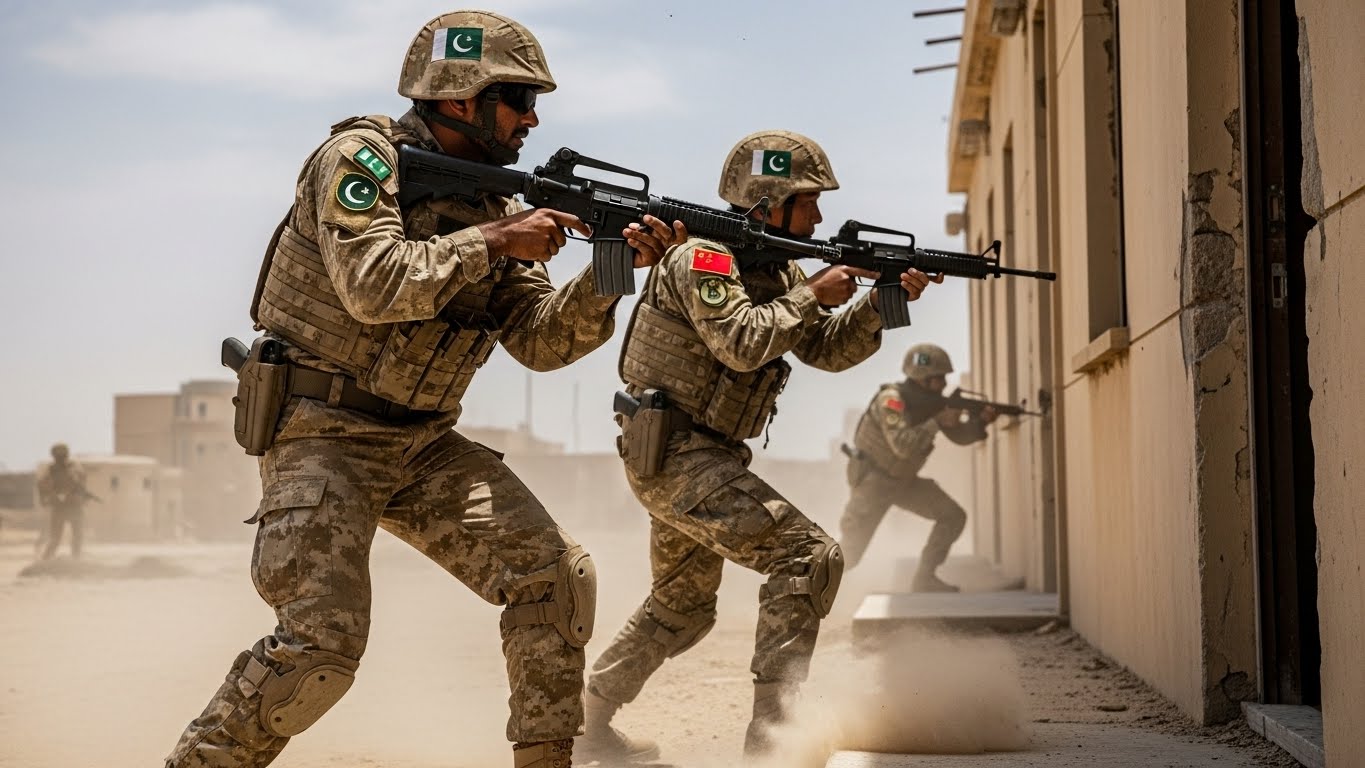
According to official declarations, Warrior-IX focuses on realistic, combined operations involving mixed groups from both militaries. Exercises will cover “clearance and strike” counterterrorism operations, reflecting modern tactics and joint command-and-control procedures. Such cooperation enables both armies to practice coordinated responses to transnational threats, enhancing readiness, mutual trust, and capability transfer. In a volatile regional context marked by insurgency, terror networks and cross-border instability, such joint preparedness is strategically valuable for maintaining stability and responding to emerging security challenges.
Geopolitical and Regional Security Implications
Warrior-IX serves not just as a training exercise but as a strategic signal of defence solidarity between Islamabad and Beijing. The visible cooperation strengthens Pakistan’s deterrence posture and underscores its commitment to counterterrorism. For external observers, the drill emphasizes that Pakistan, backed by a powerful partner, is investing in credible military capacity and readiness, which can act as a stabilizing factor in South and Central Asia. Given China’s growing regional influence, their alignment with Pakistan in security matters adds a deeper layer of reassurance for regional stability, especially along critical corridors.
Institutional Continuity and Long-Term Strategic Partnership
The consistency of the Warrior series, from Warrior-VIII to Warrior-IX, reflects institutionalization of defence cooperation, not ad-hoc engagement. The recurring nature of these drills, with regular exchange of tactics, joint planning, and shared operational protocols, builds long-term strategic alignment. Combined with economic and diplomatic collaboration under initiatives such as the China–Pakistan Economic Corridor (CPEC), this military cooperation reinforces a multifaceted partnership between the two countries. rooted in both shared security interests and broader regional ambitions. Scholarly analyses note that over the last two decades, joint exercises between Pakistan and China have expanded in scope, increasingly incorporating intelligence sharing and multi-domain coordination. Warrior-IX thus further consolidates that long-term trajectory.
Conclusion
With Warrior-IX, Pakistan reaffirms its commitment to modernizing its counterterrorism capabilities, leveraging a tested partnership with China to enhance readiness, interoperability, and strategic depth. The exercise, grounded in both current security imperatives and institutional history, represents a robust demonstration of coordinated defence diplomacy. For Pakistan, this cooperation strengthens national security and contributes to regional stability; for China, it reinforces its role as a reliable strategic partner in South and Central Asia. In an era of varied and evolving security threats, such collaboration holds significance beyond the immediate, as a foundation for enduring strategic resilience.
Author