

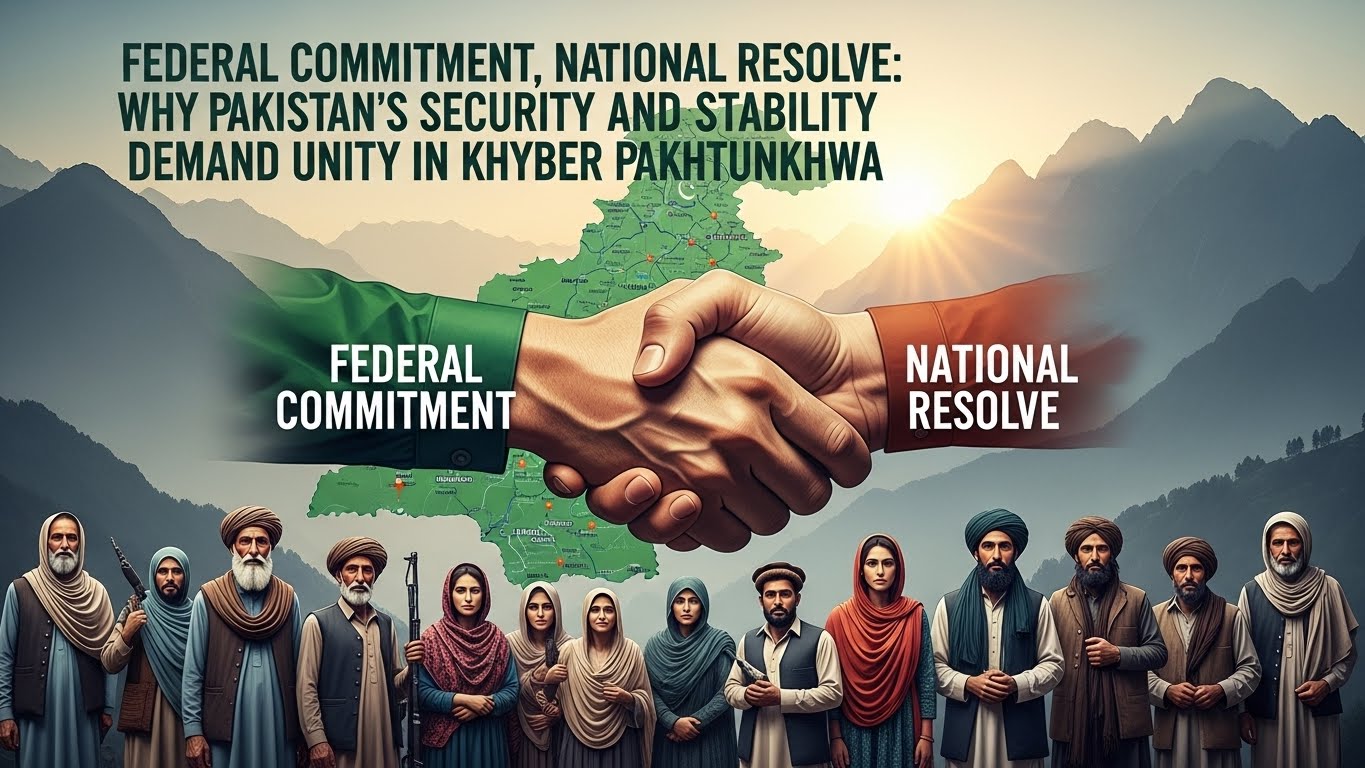
Federal Commitment, National Resolve: Why Pakistan’s Security and Stability Demand Unity in Khyber Pakhtunkhwa
Pakistan’s national security debate is often reduced to slogans and accusations, but hard data tells a more sobering and more responsible story. Nowhere is this clearer than in Khyber Pakhtunkhwa...

At a moment when KP faces renewed terrorist violence, economic disruption, and political friction, it is essential to move beyond narratives of deprivation and instead confront the real challenge: translating federal support into governance capacity, security coordination, and public confidence. Pakistan’s sovereignty, territorial integrity, and internal stability depend on it.
Federal Support: Facts Over Rhetoric
From July 2010 to November 2025, KP has received a comprehensive package of federal transfers unmatched in scale and diversity. Under the 7th National Finance Commission (NFC) Award, the province received Rs 5,867 billion from the divisible pool, its constitutionally guaranteed share. Recognizing KP’s disproportionate burden in the fight against terrorism, the federal government further disbursed Rs 705 billion under the 1% war-on-terror allocation, a provision explicitly designed to compensate frontline provinces for security-related costs.
Beyond these core transfers, KP received Rs 482.78 billion in straight transfers, including oil and gas royalties and gas development surcharges, critical revenue streams meant to strengthen provincial fiscal autonomy. Social protection has also been robust: between FY2016 and FY2025, Rs 481.4 billion was spent in KP under the Benazir Income Support Programme (BISP), directly supporting the most vulnerable households and cushioning communities affected by conflict and displacement.
The federal commitment deepened after the historic merger of the former FATA districts. Since 2019, Rs 704 billion has been allocated for the newly merged districts, alongside Rs 117.1 billion for internally displaced persons (IDPs) uprooted by counterterrorism operations. Even routine transfers continue uninterrupted, with Rs 46.44 billion released in December 2025 alone as part of standard NFC disbursements.
These figures decisively rebut claims that KP has been fiscally neglected. The issue is not the absence of resources; it is the strategic utilization of them.
Security Crisis: An External Threat, A National Burden
KP’s deteriorating law-and-order situation is not an administrative abstraction, it is a direct consequence of cross-border terrorism emanating from Afghan soil. Pakistan’s security institutions have consistently flagged the presence of Fitnah-al-khawarij (FAK) sanctuaries across the border, a reality that has translated into near-daily attacks on soldiers, police officers, and civilians in KP’s southern and border districts.
Despite repeated diplomatic engagements, Kabul’s failure or unwillingness to dismantle these networks has imposed a heavy cost on Pakistan. Yet, it is the Pakistan Armed Forces and law enforcement agencies that continue to absorb the shock, operating under difficult terrain, limited visibility, and asymmetric warfare conditions. Their sacrifices are not provincial; they are national.
The federal government’s security posture combining kinetic operations, intelligence-based actions, and border management reforms reflects a clear understanding: Pakistan’s sovereignty is non-negotiable. Stability in KP is inseparable from stability in Islamabad, Lahore, Karachi, and beyond.
Governance, Not Grievance, Is the Missing Link
Persistent centre–province disputes over issues such as net hydel profit have increasingly overshadowed the more urgent task of governance. While constitutional mechanisms exist to resolve fiscal disagreements, politicizing these issues during an active security crisis risks weakening the very institutional coherence required to defeat militancy.
Federal data demonstrates that KP has received not only its full entitlement but additional support beyond constitutional obligations. In this context, effective provincial governance, disciplined fiscal planning, and close civil–military coordination become decisive variables. Development cannot proceed in an environment of administrative paralysis or political brinkmanship.
Security, too, is a shared responsibility. Policing reforms, counter-radicalization initiatives, and local intelligence networks require provincial ownership to complement federal and military efforts. The state has provided the resources; the challenge now is execution.
The Military’s Role: Backbone of the State
Pakistan’s military remains the country’s most organized, professional, and resilient institution, particularly in times of crisis. In KP, it has not only fought terrorists but also facilitated IDP rehabilitation, infrastructure rebuilding, and emergency relief. These efforts underscore a fundamental truth: without security, there is no development; without sovereignty, there is no politics.
Attempts to frame Pakistan’s security challenges as civil–military imbalance miss the larger reality. The military’s prominence is a response to existential threats, not their cause. As terrorism resurges, weakening national institutions through political polarization would be a strategic self-inflicted wound.
Unity as a Strategic Imperative
KP’s economic revival, tourism potential, and social stability hinge on restoring law and order and that requires unity across political lines. Federal support has been consistent. Military commitment has been unwavering. What is needed now is a collective resolve that places national security above partisan narratives.
Pakistan’s adversaries thrive on internal discord. The appropriate response is not mutual accusation but institutional alignment: centre and province, civilian and military, state and society. The Rs 8.4 trillion invested in KP over 15 years represents not charity, but faith in the province’s central role in Pakistan’s future.
At this critical juncture, Pakistan must speak with one voice. Sovereignty demands it. Stability requires it. And history will judge whether unity prevailed when it mattered most.
Author