


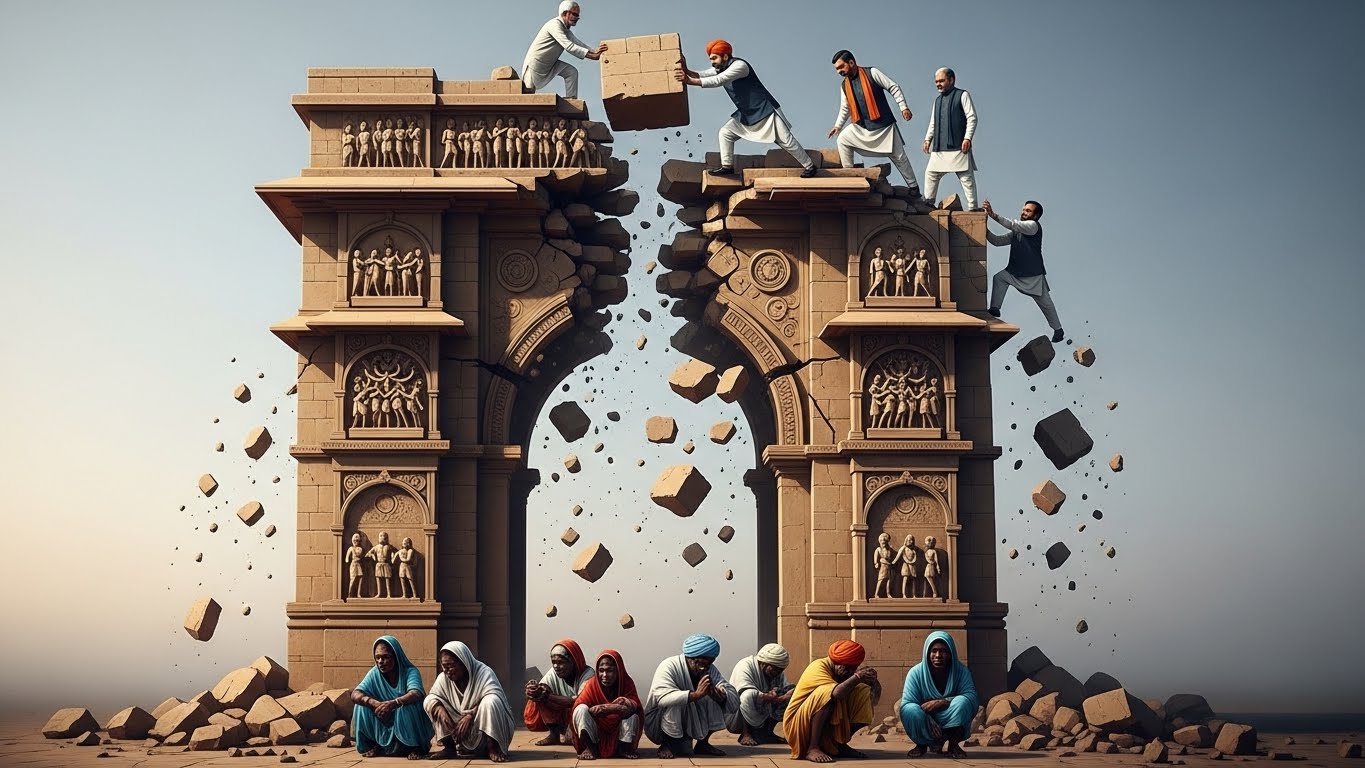
The Erosion of Minority Dignity in India’s Majoritarian Politics
When religious minorities are treated poorly in plural societies, it tends to be one of the most important indicators of democratic health. India as a constitutionally declared secular republic has...
On 15 December 2025, a video showed the Chief Minister of Bihar, Nitish Kumar violently removing the hijab of a Muslim woman doctor during an official government ceremony where she was being given an appointment letter. This implicated behaviour was done in front of seniors and was followed by apparent uneasiness of the woman and laughter by certain participants. The video went viral across social media and news outlets and it led to a huge backlash not only in India but around the world.
The Ministry of Foreign Affairs of Pakistan officially expressed its condemnation of the incident as it was extremely disturbing and threatened to tie up a normalization of women against the Muslims in India. The international human rights organizations such as Amnesty international also condemned the act citing violated personal dignity, religious freedom, and body autonomy. These responses indicate the severity of the problem, not as a one-time phenomenon, but as a component in a new trend.
Why the Incident Is Not Isolated
Although there were some justifications among defenders that the event was an explosion of misunderstanding or another procedure, the fact that the incident took place in such a context is vital. In India, there has been a consistent increase in majoritarian politics based on Hindutva ideology, a form of nationalist politics that defines Indian identity through Hindu prism in the last decade. Apparently, this ideology is becoming more marginalising to other Muslims and Christians as well as other minorities, as the ideology labels them as culturally suspect or expendable in politics.
These concerns are supported by data. India Hate Lab stated in 2024 that hate speech against religious minorities had increased by about 74 percent. Most of these attacks were on Muslims and they took place mostly in the course of political ceremonies or rallies. According to the observation of the researchers, this type of rhetoric is often unpunished and therefore it makes discriminatory behaviour socially acceptable.
The hijab incident is one that is within this environment. A top political figure exposing himself to the public to attack the religious dressing of a Muslim woman, and with a low-grade responsibility of being punished in the nearest future is an indication that the minority dignity ceases to be a priority in the political system.
Impact on Muslim Women
The experience of Muslim women in India is two-fold because they are discriminated against as women as well as Muslims. In the last few years, controversies on the bans of the hijab in educational institutions, harassment efforts online and specific hate speech have disproportionately worked against Muslim women. The practice of wearing clothing has been politicized and the bodies of Muslim women are turning into a place of ideological control.
Pointlessly taking off a hijab is not a non-partisan thing to do. The hijab is a self-proclamation of religion among most women. This means that tamping into it, particularly by an individual in power would be a form of infringement to freedom of religion and autonomy. When an occurrence of such an act takes place in an event sponsored by a state, the role of the state in safeguarding / violating constitutional rights is in query.
Legal and Institutional Concerns
Article 25 of the Constitution of India currently gives freedom of religion while Article 14 gives equality before the law. Nevertheless, critics claim that the guarantees have become weaker on how they are implemented. This is because in recent years, alterations of law and administrative measures have impacted predominantly on Muslim communities.
Some of them are massive displacements of Muslim families in places like Assam, altering legislation that regulates Muslim religious endowments (waqf properties), and selective application of legislation governing citizenship and residency. Although they are usually motivated to carry out such practices under legal or administrative discourse, human rights organizations believe that they have a cumulative effect of being discriminatory.
There is also the poor institutional reaction to the events such as the case of hijab in Bihar, which diminishes trust as well. In case the political leaders are not held to blame, the minorities can justifiably assume that the system can provide a limited protection to them.
The Role of Hindutva Ideology
The Hindutva ideology supports cultural homogeneity within Hindu nationalistic prism. Although some of its adherents have claimed that it is a symbol of unity of the nations, the oppositionists have argued that it has a negative impact on the pluralistic principles of India. The benefits given to one religious identity to the disadvantage of other religious ones through Hindutva engenders social hierarchies, which undermine the citizenship of the minorities.
The issue is not the issue of religious belief, but this is the politicization of religion. In the situation where state power resides with the ideology of majoritarianism, minorities will be subjected to being symbolic other than to be treated as equal citizens. The incidence of the hijab proves that this ideology can be applied, even in the case of humiliation that happens in day-to-day activities without alterations in the policy.
Domestic and International Reactions
The variety of civil society organizations in India, political opposition and female rights movements criticized the event and urged responsibility. It is stated that legal complaints were filed and even disputes among the people arose concerning dignity, consent and constitutional values. Reactions by politician leaders allied to the ruling party were however divided as some tried to find justifications to the act instead of openly condemning it.
Globally, the episode contributed to the mounting criticism of the human rights of India. The reports of the global organizations are raising more questions of the religious freedom, the autonomy of the press and the protection of minorities. This scrutiny has diplomatic consequences, especially to a nation that is out there persona as world democratic leader.
Conclusion
The Bihar hijab case is not only about one politician and one woman. It is an expression of the more general change in the political and social situation in India, in which rights of minorities seem to be becoming particularly vulnerable. The outcomes are not just limited to the immediate victim when dignity, religious freedom and equality are breached in the eyes of the public.
Whether a society is democratic or not is determined by the manner in which it safeguards its different minorities rather than the way it treats its majority. To adhere to the ideals of its constitution, India needs to go further than just symbolic investments, and actual accountability, respect, and protection of its citizens, irrespective of their religion, gender, and identity.
Author