
Europe’s Ironies: Merkel and Zelensky Cement Legacies with Grand Order
POLICY WIRE — Strasbourg, France — Another week, another set of gilded medals pinned to powerful lapels. It’s a scene as old as diplomacy itself: the European elite, assembling for an almost...

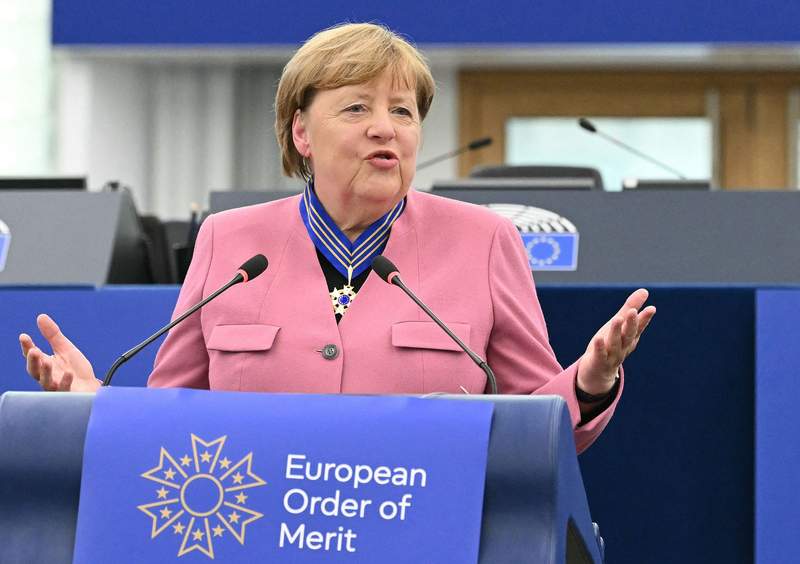
POLICY WIRE — Strasbourg, France — Another week, another set of gilded medals pinned to powerful lapels. It’s a scene as old as diplomacy itself: the European elite, assembling for an almost theatrical display of mutual appreciation. Yet, when the venerable European Order of Merit announced its first batch of laureates, including former German Chancellor Angela Merkel and Ukraine’s defiant President Volodymyr Zelensky, the applause wasn’t just for the individuals. No, it’s rarely just about the individuals. It was, rather, for the precarious notion of European unity itself, and perhaps, the desperate hope that these familiar faces might yet inspire a way forward for a continent perpetually on edge.
It feels a bit like closing the barn door after the horse has bolted, doesn’t it? For Merkel, a stateswoman who helmed Germany—and by extension, much of Europe—through more than a decade of successive crises, the accolade feels like a dignified, if slightly late, epitaph to an era of pragmatic power. Her tenure, often characterized by quiet, almost weary perseverance, saw everything from financial meltdowns to refugee influxes. But this wasn’t the sort of headline-grabbing, Twitter-storm-inducing event the news cycle usually demands. Instead, it was an acknowledgment, almost a whisper, of steady hands during choppy waters.
And then there’s Zelensky. A wartime leader whose charisma has become a formidable weapon against Russian aggression, he’s quickly cemented his place in history. His selection isn’t just a nod to his courage, it’s a direct, uncompromising statement about where Europe draws its lines. He personifies resistance—pure, unadulterated grit against an expansionist foe. “Our fight, it isn’t just for Ukraine. It’s for the very soul of Europe—for freedom, for decency,” Zelensky, never one to mince words, was reportedly heard to remark through a translator. “This recognition, it reminds us others still see that. And they care.” His words cut through the usual bureaucratic pronouncements, didn’t they?
The choice of these two figures isn’t accidental; it’s a curated message from a European project grappling with its identity, purpose, and ever-present external threats. One represents a fading era of diplomatic caution, the other a stark new dawn of confrontational courage. The juxtaposition is jarring, purposeful. As for Merkel, a rare public statement attributed to her after the announcement simply read, “Europe’s journey isn’t just about treaties or budgets; it’s about persistent effort, finding common ground even when it feels like none exists. This honor, well, it’s really for everyone who believes in that idea.” It’s a typical Merkel line—humble, pragmatic, and hinting at the unseen struggles. Just what you’d expect.
But does this ceremonial pomp truly move the needle? Does it galvanize a continent weary of perpetual crisis? The European project, for all its economic might, often appears flustered by internal dissent and the sheer scale of global challenges. Take, for instance, the evolving role of nations outside its immediate orbit. From Pakistan’s volatile political landscape, as recently highlighted by discussions around digital fame and deadly scorn, to the broader dynamics of the Muslim world, Europe’s message of stability and democratic ideals often struggles to land amidst complex local realities. Because for all its institutional maturity, the continent still sometimes feels like it’s talking to itself, doesn’t it?
These awards also serve as a reminder of Europe’s unique positioning in an increasingly multipolar world. Its economic prowess remains significant, certainly. For context, the European Union’s GDP stood at an estimated $16.7 trillion in 2022, according to the International Monetary Fund, making it a colossal player. But influence isn’t just about money anymore; it’s about projection of values, consistent messaging, and coherent strategy—areas where Europe has, at times, faltered. And its ability to address challenges like energy security, immigration, or Kremlin’s nuclear flex depends less on past glories and more on present action.
What This Means
This round of European accolades isn’t just a pat on the back; it’s a calculated political act. It projects an image of strong, moral leadership precisely when Europe most needs it. Politically, it signals a consolidation of values: democracy, defiance against aggression, and the steady hand of experience. The awards suggest that in the face of ongoing turmoil—be it from within or across its borders—the Union still recognizes and champions individuals who embody its most cherished principles. But what about the economic implications? Well, in an abstract sense, solidifying a narrative of strong leadership could help bolster investor confidence and maintain the bloc’s geopolitical weight. After all, stability, even perceived stability, translates into tangible economic benefits. However, don’t confuse symbolism for strategy. While a good photo-op is nice, Europe still needs concrete plans, decisive action, and a unified front against challenges that are far too real for mere medal-wearing to solve. It’s an interesting dance, this. Rewarding history while attempting to write a better future.
But how does this play in the grander scheme, beyond the chardonnay — and canapés? The world’s watching. These awards tell us what Europe wants to be, or perhaps what it thinks it needs to be, right now. It’s an affirmation of current trajectories, a quiet endorsement of specific approaches to crisis. Will it translate into tangible changes on the ground? Probably not directly. But it frames the narrative. And sometimes, in a world drowning in competing narratives, that’s almost everything.