


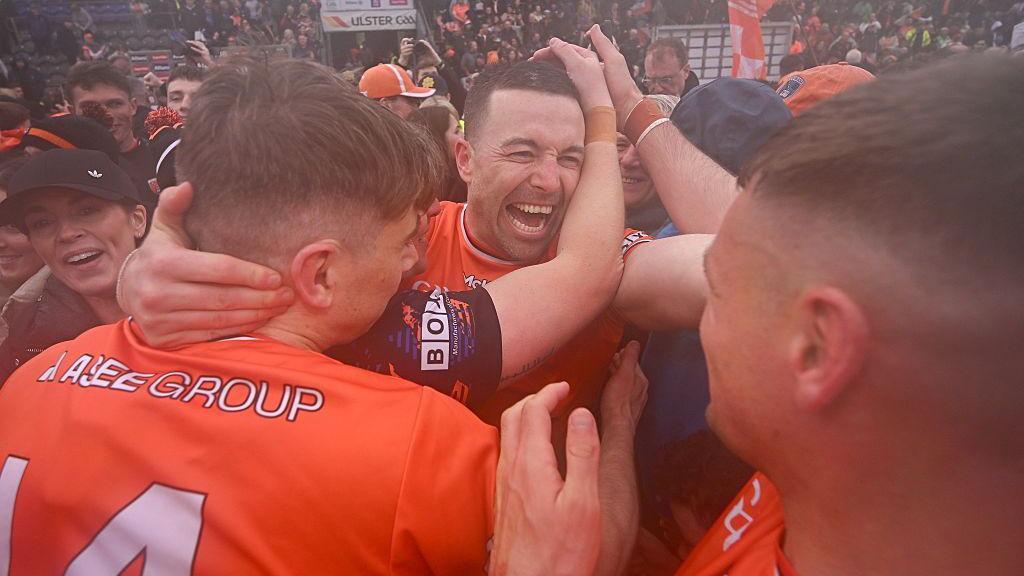
Eighteen Years and a Handful of Dreams: Armagh’s Long March to Ulster Glory
POLICY WIRE — Belfast, Northern Ireland — You could practically hear the collective sigh, not just across County Armagh, but rippling through communities that have long understood the brutal...

POLICY WIRE — Belfast, Northern Ireland — You could practically hear the collective sigh, not just across County Armagh, but rippling through communities that have long understood the brutal arithmetic of patience. After eighteen years—eighteen long seasons of near misses, gut-wrenching defeats, and the kind of sporting heartbreak that lodges itself in the local folklore like a particularly stubborn stone—Armagh has finally claimed the Ulster Senior Football Championship.
It wasn’t a given, not by a long shot. Football, like life in this part of the world, rarely adheres to tidy scripts. The Orchard County, under manager Kieran McGeeney, found themselves in familiar, treacherous waters: their fourth consecutive final, having stumbled at the very last hurdle thrice before. That’s enough to break most outfits, isn’t it? To make men wonder if fate itself has conspired against them. But this time, it was different.
Captain Aidan Forker, the embodiment of this enduring spirit, certainly didn’t mince words post-match. “We were due one,” he reportedly quipped, a wry understatement given the psychological toll those previous defeats must’ve taken. And you could tell, he meant it. He’s seen more tough days than good ones in his career, battling through consecutive losses, yet his persistence paid dividends. The sight of him finally lifting the Anglo Celt Cup? It’s more than just a trophy; it’s the exorcism of an 18-year-old demon. That’s a powerful thing.
The match itself—a rollercoaster against Monaghan, where Armagh squandered a seven-point lead only to snatch victory in extra time thanks to an Oisin O’Neill goal—was pure theater. But it’s the broader narrative that captures the imagination of a veteran observer. This wasn’t merely a win; it was a psychological breakthrough, a collective exhale. A study from the Peace Monitoring Report indicated that in the early 2000s, community satisfaction with governance in Northern Ireland hovered around 50%—a statistic that underscores a prevailing sense of lingering challenges. These sporting victories, though ostensibly trivial to political scientists, can serve as surprisingly robust emotional uplift, knitting together fragments of a fractured identity. For a population often defined by deeper fault lines, a shared joy, unequivocally belonging to *them*, holds undeniable power.
But how, one might ask, does such a victory resonate beyond these misty northern fields? Well, the human condition—its yearning for collective identity, for heroes, for moments that transcend the mundane—plays out universally. Think of the frenetic energy — and almost spiritual devotion surrounding cricket in Karachi or football in the Levant. For many, sport isn’t just recreation; it’s a vehicle for pride, a proxy for resilience, a stage where narratives of persistence against overwhelming odds unfold. This feeling, that deep connection to local heroes achieving the impossible, it’s what makes the echoes of Armagh’s struggle so globally recognizable. The very spirit that sees a team like Armagh through nearly two decades of disappointment mirrors, in miniature, the perseverance often demanded of entire societies navigating their own protracted challenges.
Manager McGeeney, always a man of few words but considerable presence, reflected on the journey with a quiet pride. “Building a champion side isn’t about one game, or even four finals. It’s about shaping a mindset, instilling belief even when every fibre of your being wants to quit,” he confided. “These lads, they’ve not just learned to win; they’ve learned to truly believe in what they’re doing. And that, you can’t buy, you have to earn it, moment by painful moment.”
📄 POLICY WIRE WHITEPAPER PUBLISHED: PAKISTAN'S NATIONAL SECURITY POLICY PRIORITIES
👉 READ BY CLICKING HEREWhat This Means
This Armagh victory carries weight far beyond the GAA calendar. Economically, while a local sports win doesn’t suddenly generate a GDP surge, it sparks a tangible boost in morale, localized spending, and community pride—a soft power that can ripple through smaller enterprises. Emotionally, it provides a unifying narrative in a region that too often finds itself looking inward, defined by historic divisions rather than shared triumphs. These moments are brief, but they offer a necessary distraction, a release valve for collective tension, a reminder that something other than historical grievances can define identity.
Politically, the symbolism can be interpreted through various lenses. For nationalist communities, such a victory reaffirms a cultural distinctiveness that has long been both celebrated and contended. For broader society in Northern Ireland, it offers a fleeting glimpse of unity, a chance for people from disparate backgrounds to, for a moment, simply be fans. And that, in a political landscape often bogged down in the minutiae of power-sharing and identity politics, is a breath of fresh air. It’s a reminder of a different kind of strength, one drawn from sustained effort and raw human stubbornness, that frankly, doesn’t always show up on the diplomatic charts. It suggests a certain robustness to community structures, an underlying resilience that—if properly tapped—could do a world of good. Or, at the very least, sell a good few more jerseys — and commemorative mugs. Because, let’s be honest, sport is always, in some measure, about commerce and cultural expression—much like the complex narratives of Asia’s own combat circuses, which often reflect deeper economic and political barometers.
The celebration in Armagh won’t solve the myriad complex issues facing Northern Ireland, no. But it demonstrates that persistence, even after prolonged anguish, can yield glorious, exhilarating fruit. And perhaps, just perhaps, that’s a lesson worth applying elsewhere too.