

The Golden Whisper: Nicklaus’s Playbook, McIlroy’s Perennial Pursuit, and Golf’s Unwritten Rules
POLICY WIRE — Muirfield Village, Ohio — The gods of golf, as it turns out, don’t always hand down wisdom from mountaintops. Sometimes, they just wander over to your lunch table at the club. That’s...

POLICY WIRE — Muirfield Village, Ohio — The gods of golf, as it turns out, don’t always hand down wisdom from mountaintops. Sometimes, they just wander over to your lunch table at the club. That’s precisely how Rory McIlroy, the seemingly perpetually striving Northern Irishman, received his latest snippet of counsel from Jack Nicklaus, the game’s enduring ‘Golden Bear’. It wasn’t a televised masterclass; it was just an impromptu chat—the kind that happens when one living legend still seeks something from another. And that, really, speaks volumes about the relentless, often unromantic grind of elite sports.
McIlroy, still hunting that elusive victory at the Memorial Tournament, a prize even the most decorated of careers might overlook but which clearly gnaws at him, found himself eight shots adrift of the leaders heading into the final Sunday. A familiar feeling, you might say, at Muirfield Village—Nicklaus’s demanding design. He’s always wanted this win, watching past heroes, including Tiger Woods, ascend that 18th green to shake the host’s hand. And yet, it always feels a step too far.
“I’d love to win here,” McIlroy admitted with the sort of earnest candour that marks his public persona. “It’s an iconic tournament. I watched Tiger so many times when I was a kid, you know, walk up that hill and shake Jack’s hand and get the trophy.” It’s not just a trophy for him; it’s an affirmation. “It’s a puzzle I haven’t quite figured out yet. It’s a tough course. I feel like every aspect of your game needs to be on.” The self-awareness, though, cuts deep. McIlroy knows what it demands, — and he hasn’t delivered.
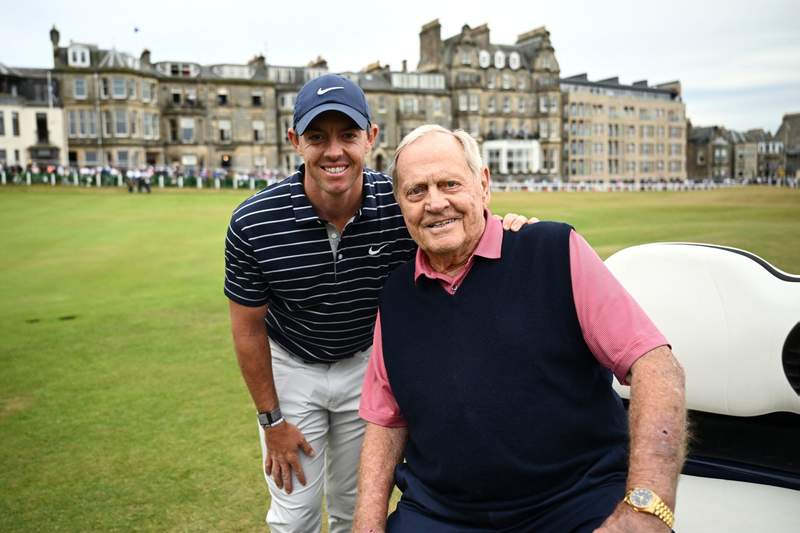
The recent interaction, over a casual lunch a couple of weeks prior, wasn’t some arcane ritual. Nicklaus, eighty-four and still sharp as a nine-iron, pulled up a chair and offered some straight talk, particularly on course management. McIlroy recounted it, almost still awestruck: “Jack just came over and sat with us, and, you know, how often do you get that? Arguably the greatest of all time comes and sits down, and, you know, he’s always telling me how to play more cut shots, especially on these greens to get it to land softer.” Practical, unsolicited wisdom from the pinnacle. And this wasn’t the first time Nicklaus weighed in; he famously (or infamously) told McIlroy, ahead of his 2025 Masters victory, ‘no effing double bogeys!’—a simple decree that resonated, despite one eventual slip up.
It’s this ongoing, almost familial relationship that often separates the good from the truly great. Jack Nicklaus, no stranger to the relentless pressure of a major week, has seen it all. “The course tests you,” Nicklaus was once observed telling a young prodigy years ago, embodying his gruff, paternal guidance. “Every time. It doesn’t care about your past wins, only your next shot. This game demands you adapt, or it swallows you whole.” It’s a maxim McIlroy seems to live by, even when adaptation is proving particularly irksome at Muirfield.
His particular struggle at the Memorial, he reckons, stems from the very foundation of his game. “Yeah, for being such a long golf course I feel like it takes driver out of my hand a lot, which, you know, I pride myself on that being one of my biggest weapons,” he mused, a touch of exasperation in his voice. “The fairways pinch in right around the spots where I would be finishing driver. So it’s frustrated me in a way that I feel like my biggest weapon is in some way neutralized here.” For a player known for prodigious drives that average over 310 yards on tour—a statistic widely reported by PGA Tour data—having that firepower curbed must feel like a chess master being told he can’t use his queen. It’s a psychological hurdle as much as a technical one.
📄 POLICY WIRE WHITEPAPER PUBLISHED: PAKISTAN'S NATIONAL SECURITY POLICY PRIORITIES
👉 READ BY CLICKING HEREThis enduring quest for mastery, this seeking of insights from elders even when one stands tall, echoes in arenas far beyond manicured fairways. Just as veteran athletes in countries like Pakistan continually revisit foundational strategies—the ‘perpetual cricket merry-go-round’ of older players being brought back into the fold—McIlroy demonstrates that raw talent often isn’t enough. It’s the subtle shifts, the whispered advice, the mental grit, and the relentless re-evaluation of one’s primary ‘weapon’ that ultimately carve out legends.
What This Means
This candid interaction between McIlroy and Nicklaus isn’t just a feel-good anecdote; it offers a glimpse into the mechanics of high-performance sport at its most elite level. First, it demolishes the myth of the lone genius. Even players like McIlroy, who possess stratospheric talent, remain perpetually in search of that fractional edge, that unseen adjustment. It tells us that greatness isn’t a destination; it’s an ongoing project, constantly refined through mentorship.
Economically, for the sport itself, these cross-generational interactions are invaluable. They weave a narrative of continuity, reinforcing golf’s rich history and providing compelling storylines that fans and sponsors adore. For McIlroy, cracking the code at Memorial could mean more than just a trophy. It could symbolize overcoming a specific, persistent challenge that, however minor in the grand scheme of his career, nonetheless represents a psychological blockage. Conquering a ‘bogey’ course under the tutelage—however informal—of its creator carries immense psychological weight. It’s about conquering self-doubt, proving versatility, — and showing he can win in less-than-optimal conditions. It also shows a certain vulnerability; a willingness to admit, ‘I don’t have all the answers,’ even from a world-class athlete. And sometimes, that willingness is exactly what opens the door to the solution.