


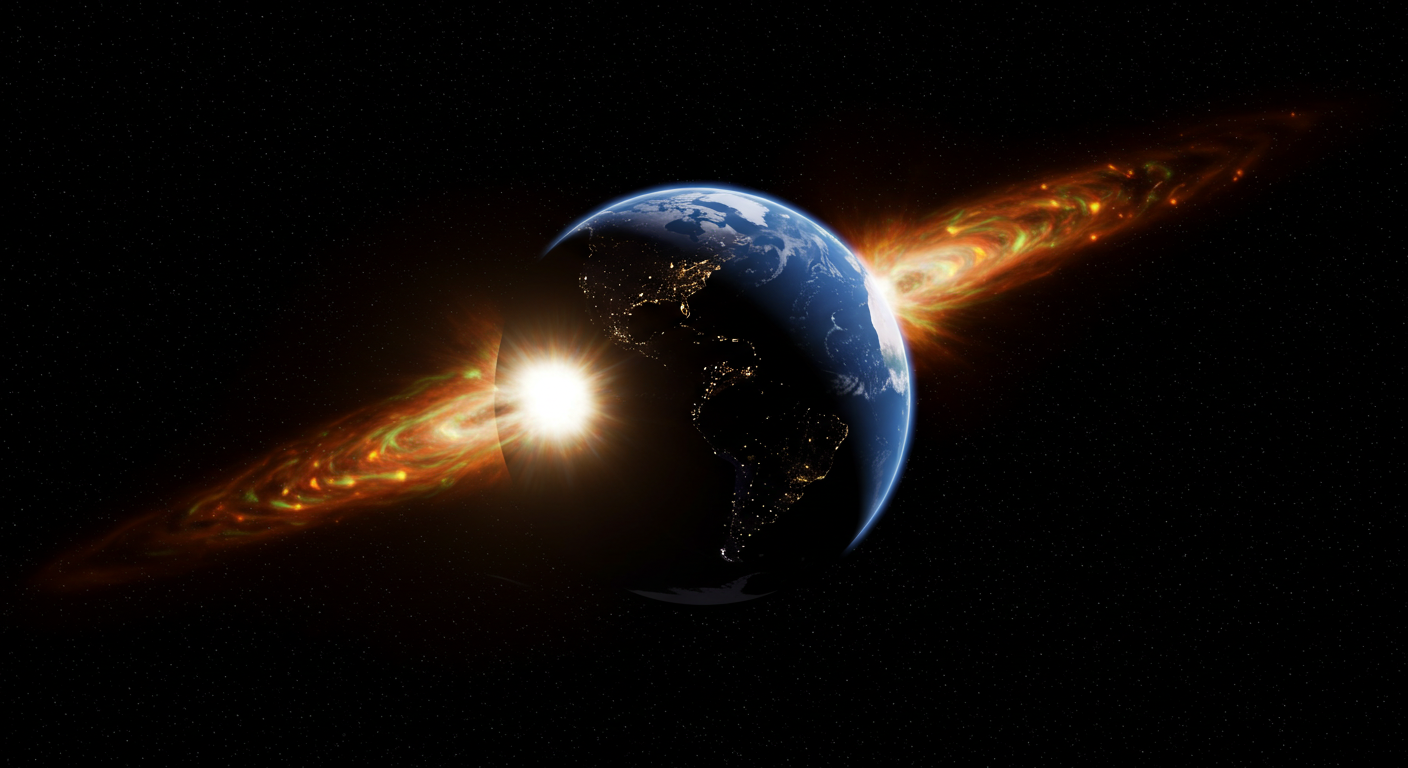
Earth Under Solar Siege: Unprecedented Space Weather Sparks Global Alerts
Over the past few days, astronomers and space agencies have issued multiple warnings about a surge in extreme solar activity as Earth faces a renewed onslaught of solar flares and geomagnetic storms....

Over the past few days, astronomers and space agencies have issued multiple warnings about a surge in extreme solar activity as Earth faces a renewed onslaught of solar flares and geomagnetic storms. Driven by the Sun’s cycle of peak activity, this extraordinary time of heightened space weather has already disrupted radio communications and poses a danger to satellite operations, power grids, and global navigation systems. The warnings follow the discovery of the most potent solar explosion of 2025 by NASA’s Solar Dynamics Observatory, which was an X2.7-class solar flare, the highest category, erupting from a freshly active sunspot area.
Earlier this week, this enormous flare caused high-frequency radio blackouts that lasted over 10 minutes in some regions of the Middle East. The interruption was confirmed by the U.S. National Oceanic and Atmospheric Administration (NOAA), which also warned that flares from the same area might continue to affect satellite-based, electrical, and radio systems. When the Sun achieves what is known as its “solar maximum,” an 11-year high in solar activity where its magnetic poles flip, an increase in eruptions and geomagnetic turbulence occurs. These disruptions are not random; rather, they are common.
Importantly, coronal mass ejections (CMEs), which are massive clouds of charged particles launched from the Sun into space, frequently occur in tandem with solar flares like the most recent X2.7 event. These CMEs have the ability to interact with Earth’s magnetic field if they are pointed in our direction, causing potentially dangerous geomagnetic storms in addition to stunning auroras. A G3-class geomagnetic storm was recorded on May 29 of this week, most likely due to a co-rotating interaction region (CIR), a chaotic border where slow and rapid solar winds meet. In addition to being known to cause auroras and disrupt satellite communications, CIRs can replicate the effects of CMEs.
As predicted by the UK Met Office on May 22, auroras were certainly visible over the UK and Ireland. These light displays provide skywatchers with a spectacle and are frequently the most obvious and innocuous consequences of space weather. But they also show how strongly solar particles interact with Earth’s atmosphere, serving as an unseen reminder of the energy that is constantly pelting our globe. The present solar activity is “getting intense,” according to famed space photographer Vincent Ledvina, particularly as more active zones rotate to face Earth.
Sunspot AR4100, which has amazed scientists with its exceptional lifespan and stability, is one of the main aspects causing present-day worries. This sunspot, which has now completed three full spins around the solar disc since early April, has been visible for over two months, when most vanish within a week. Harald Paleske, a German astronomer, observed that AR4100 has stayed remarkably steady and quickly expanded into the greatest sunspot of 2025. Because of its extended existence, NOAA even classed it many times, first as 4055, then as 4079, and finally as 4100. Surprisingly, the longest-lived sunspots on record lasted 121 and 134 days, according to historical statistics. If AR4100 continues to be active for a few more months, it may be on pace to equal those ancient solar giants.
A coronal hole, a colder, less dense region on the Sun’s surface that is currently facing Earth, is another important solar feature that NASA and NOAA are still keeping an eye on. When high-speed solar wind streams from coronal holes strike Earth, they can trigger mild to moderate geomagnetic storms. Prior to stabilising at around 554 km/s, solar wind speeds increased from an average of 420 km/s to over 635 km/s, or over 1.4 million miles per hour, in the late hours of May 28. Additionally, the Bz component—a southward-oriented magnetic field—has been identified. Because of this direction, solar particles may more easily pierce Earth’s magnetic barrier and produce auroras.
NASA reports five C-class flares and one M-class flare from several active locations, including newcomers AR4101 and AR4102. Flare activity has generally decreased to moderate levels despite the recent X-class flare. On May 26, an M2.9 flare from AR4098 caused a significant (R1) radio blackout across the Atlantic Ocean, the most powerful explosion in recent days. There are now six active sunspot areas facing Earth, and each one has the potential to cause space weather phenomena.
The current circumstance is not unique in the larger scheme of things. Scientists anticipate more frequent and maybe more hazardous solar eruptions as we get deeper into the solar maximum era. Although many people are enthralled by the auroras’ beauty, there are significant ramifications for Earth’s technological infrastructure. For industries ranging from telecommunications and space research to aviation and defence, disruptions to GPS navigation, air traffic communications, power grids, and satellite services might provide difficulties.
Knowing how the Sun behaves has practical applications and is not only an intellectual exercise. To more accurately anticipate these solar outbursts, organisations like the European Space Agency, NASA, and NOAA are constantly creating prediction models. For nations that rely heavily on technology, this cooperation is extremely important. Pakistan also depends significantly on space-based services, such as telecommunications, military satellite operations, and weather forecasting, all of which are susceptible to space weather. However, the hazards may be successfully reduced by proactive monitoring and cooperation with international space organisations.
The days ahead are still unknown but crucial as sunspot AR4100 continues its solar trip and more sections become visible. Now when the sun is at its most erratic, the planet has to be aware of the dangers as well as the beauty that shines over 150 million kilometres of space. The sun’s storms serve as a reminder of our cosmic vulnerability and the value of being prepared, whether it is through the sight of bright auroras colouring the sky or brief silences in our radio channels.
Author