

DTM’s Delayed Parity Push: Spielberg Opener Plunges Teams into High-Stakes Unknown
POLICY WIRE — Spielberg, Austria — A whisper of disquiet rippled through the paddock at the Red Bull Ring this week, a familiar pre-season tension magnified by an unusual delay. Not often does the...

POLICY WIRE — Spielberg, Austria — A whisper of disquiet rippled through the paddock at the Red Bull Ring this week, a familiar pre-season tension magnified by an unusual delay. Not often does the eagerly awaited Balance of Performance for a top-tier racing series materialize so tardily, just days before cars hit the track. For many? It felt less like calculated parity. More like a high-stakes gamble in the Austrian mountains.
But then, this isn’t just any season. And it certainly isn’t any circuit. Drivers and team principals, already navigating a famously intricate technical landscape, suddenly found themselves slammed with the final rulebook for horsepower, weight, and aero on Wednesday evening – a gaping chasm from the customary week-long lead time. The math’s stark. Less time means less preparation. More guesswork.
What gives? A convergence of factors colluded to create this logjam. At its core, the new exclusive Pirelli DTM tire, finalized rather late in the game, forced engineers back to the drawing board. Data from other racing series, usually a steadfast compass for the BoP provider SRO Motorsports Group, provided scant solace.
And yet, nature, as always, had its own plans. A planned qualifying simulation during the official DTM test at Spielberg, crucial for generating reference data with those new tires and fixed fuel loads, simply washed out. Rain, an unyielding spoiler, left a cratering chasm in the data set that would normally inform these critical decisions.
Suddenly, BoP officials found themselves in terra incognita. For the first time, they requested detailed “run sheets” from manufacturers (think hyper-specific logs here), granular dissections of setup changes, lap times, and test programmes from the Spielberg test. One can only imagine the political machinations that went into those submissions. As a veteran of this sport once quipped, ‘Trust, but verify’ takes on a whole new meaning when millions are on the line, isn’t that just dandy?
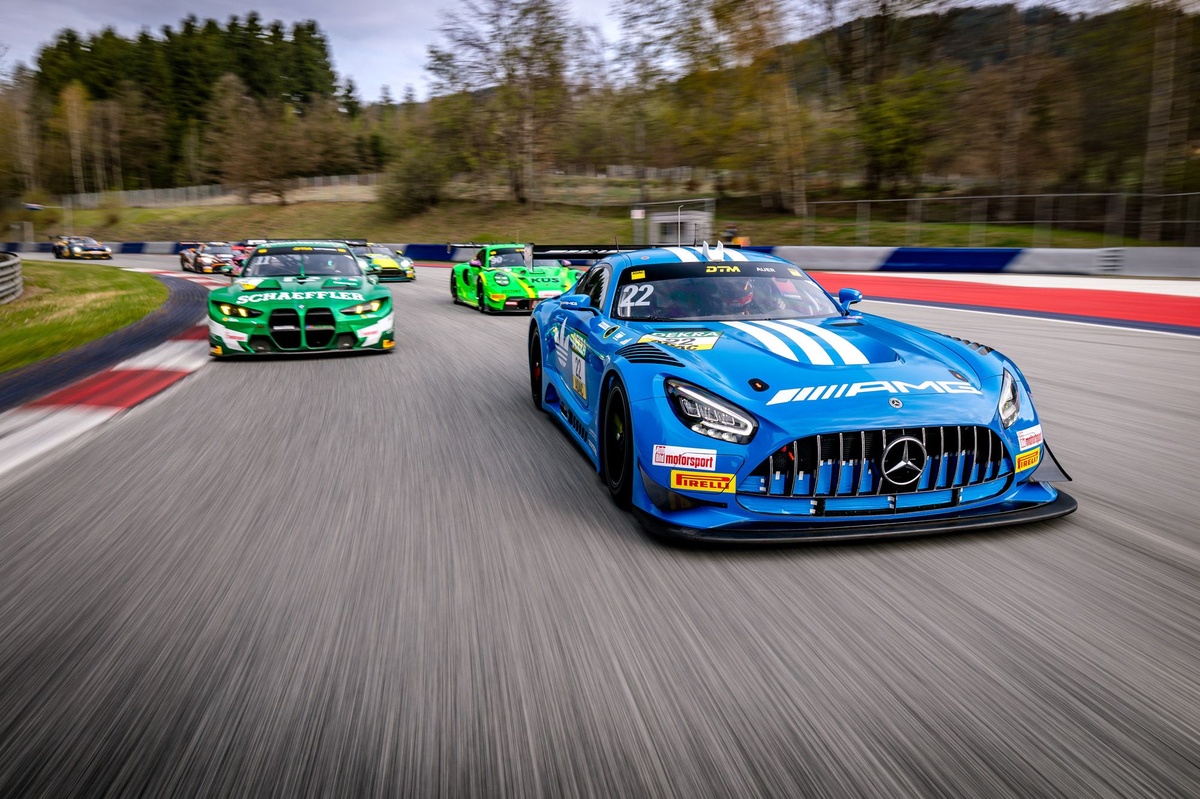
Further complicating matters, the grid itself underwent a sea change. The sleek, new Lamborghini Temerario GT3 arrived as an unquestionable wild card. But it wasn’t alone; updated Evo versions from powerhouses like Porsche, Ferrari, and Ford also recalibrated the yardstick from last season, while BMW’s M4 GT3 Evo now sports a revised turbo configuration necessitating a fresh appraisal.
Still, the Spielberg circuit itself presents a unique BoP challenge. Perched nearly 700 meters above sea level, the thin air infamously cripples engine performance — naturally-aspirated engines, for instance, can lose up to 20 horsepower compared to their turbocharged counterparts at lower altitudes, according to SRO’s historical data, mandating constant ambient pressure monitoring and turbo adjustments — and with temperatures expected to gyrate erratically from a chilly 5°C to a balmy 24°C over the race weekend, turbo engines, which thrive in cooler conditions (and aren’t we all hoping for that perfect temp?), face another layer of complexity entirely; any imbalance here, with only eight significant corners and several long straights, gets exponentially magnified.
“We understand the frustration that this late notification causes for teams,” acknowledged Frédéric Lequien, CEO of SRO Motorsports Group. “But our priority remains absolute competitive parity. This season’s variables necessitated an unprecedented level of scrutiny to ensure a level playing field, even if it meant pushing deadlines.”
Among the initial classifications, the Mercedes-AMG GT3 clings to its 36mm restrictor and propitious lambda value of 0.91, alongside a relatively low minimum weight of 1,325kg. Experts suggest the new Pirelli tire might suit the car better, reaching operating temperature more quickly than its predecessor – an area where the Mercedes floundered at Spielberg last year. The mild temperature forecast could also bolster its prospects.
Meanwhile, the McLaren 720S GT3 Evo, which set the pace in testing with Ben Dorr, remains unchanged. It’s the reference point for the field. However, significant adjustments were made elsewhere.
Efforts to bring the new Lamborghini Temerario GT3 up to speed are starkly apparent in the BoP. The car received up to 0.12bar more boost pressure at low revs, alongside mid-to-high range increases. It also wrested consent to run 0.15mm lower at both front and rear, an aerodynamic gain that could be pivotal in corners. The BMW M4 GT3 Evo, now with its production-derived turbo, sees a boost pressure increase of up to 0.06bar in the mid-range, squarely tackling testing issues like tire graining.
Even the formidable Ferrari 296 GT3 received a 0.03bar to 0.06bar increase across its rev range, while the Aston Martin Vantage GT3 snagged a hefty 0.2bar increase at low revs. And what about the American muscle? The Ford Mustang GT3, well, it enjoys a boon from a special exemption for ground clearance, allowed to run at 40mm while most cars homologated from 2022 onwards must abide by a 50mm minimum — a neat trick that generates additional downforce without relying solely on engine performance, neatly balancing out a restrictor reduced by 1mm to 35mm compared to last year.
“It’s always a nail-biting wait, especially with so many unknowns this year,” remarked Thomas Jäger, Team Principal of Mercedes-AMG Team HRT, underscoring the tightrope walk for every team. “But we trust the process, even when it stretches the limits of our preparation time. Ultimately, we all want fair competition, — and that’s what BoP aims to deliver.”
What This Means
This eleventh-hour BoP reveal isn’t just about lap times; it’s an earth-shattering strategic gut-punch for every manufacturer. Teams, already operating on paper-thin margins and forensic strategizing, must now adapt their entire race weekend approach with minimal data. This tumultuous overture could spawn unforeseen seismic shifts, rewarding those with the most adaptable engineers and agile strategies. Economically, any perceived unfairness, even if justified by technical data, risks estranging patrons and rankling worldwide devotees (including a growing motorsports audience in the Muslim world, where series like DTM are increasingly popular). The integrity of the championship rests precariously on the belief that fair play triumphs, despite the intrinsic power plays from powerful automotive brands jockeying for supremacy. Just like, you know, in bigger geopolitical arenas, balancing divergent hegemonies demands perpetual fine-tuning and, yeah, sometimes, some really unpopular decisions. Related: Beyond the Pitch: Real Madrid vs Betis and the Geopolitics of Global Football
Few outside motorsport appreciate the byzantine ballet of engineering, politics, and raw speed that delineates a championship like DTM. It’s not just about the fastest car; it’s about making every car poised to snatch victory on any given day. But when the rulebook drops so late, it’s the teams’ ability to react, rather than just innovate, that will define their early season fortunes.
Ultimately, the true test of this labyrinthine BoP will unfold upon the asphalt stage. “The SRO Motorsports Group has wagered on equity over promptness this year, and that’s a momentous declaration,” concluded motorsport analyst Sophia Khan. “The Spielberg results won’t just crown a winner; they’ll offer the first tangible judgment on whether their tightrope walk achieved authentic equipoise or simply introduced a new layer of chaos to an already capricious campaign.”