


Dogs and Delirium: Argentina’s World Cup Mania Offers Stark Mirror to Political Reality
POLICY WIRE — Buenos Aires, Argentina — It wasn’t the roar of 100,000 fans in Qatar, nor the glint of a gold trophy, that truly captured Argentina’s soul last winter. No. Instead, it was...

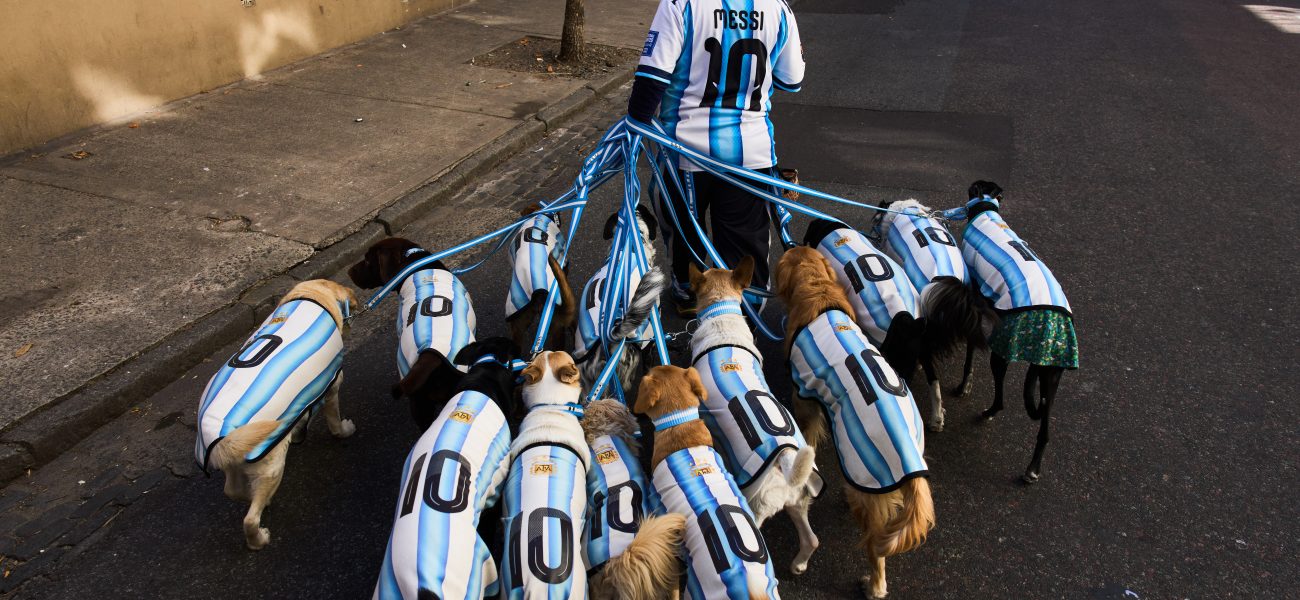
POLICY WIRE — Buenos Aires, Argentina — It wasn’t the roar of 100,000 fans in Qatar, nor the glint of a gold trophy, that truly captured Argentina’s soul last winter. No. Instead, it was a grainy photograph, disseminated by the millions, showing a solitary man in Buenos Aires—a dog walker—navigating a parade route. His entourage? Nearly a dozen leashed canines, each sporting its own miniature, sky-blue-and-white jersey. A comical, slightly chaotic tableau that became, for many, the very symbol of a nation’s intoxicating obsession. And what an obsession it was.
Because that picture, mundane in its core function but extraordinary in its context, ripped through the usual political din. It momentarily silenced the anxieties of a populace routinely wrestling with hyperinflation and deeply entrenched social fissures. You’d think the daily grind, the sheer struggle for economic breath, might dampen such unbridled collective joy. You’d be wrong. For weeks, the football wasn’t just a game; it was the only reality that mattered. Every kick, every save, every tear from Lionel Messi was felt with visceral intensity across 46 million Argentines.
It’s a peculiar thing, this societal alchemy that transmutes athletic prowess into national salvation. The street-level spectacle, epitomized by our dedicated dog-walker, provided a temporary anesthesia, a blissful, if fleeting, escape. Critics often dismiss such widespread sporting delirium as mere bread-and-circuses. But for Argentines, it’s closer to an annual spiritual revival, or perhaps, a well-timed defibrillation for a national heart perpetually in distress.
President Alberto Fernández, grappling with a myriad of domestic woes, seemed to understand this deeply. “It’s in moments like these,” he’d observed during the height of the World Cup fervor, “moments of shared triumph, that remind us what we’re truly capable of as a people. A bit of joy, yes, but also a profound affirmation of our spirit.” An astute observation, no doubt. But you could also read into it a quiet sigh of relief from a leader whose popularity polls usually resembled a rollercoaster during a market crash.
The sheer economic disruption caused by the championship celebrations was astounding. Offices emptied. Public services strained. But who cared? The nation was high on collective euphoria. According to Argentina’s National Institute of Statistics and Census, annual inflation topped 94.8% by December 2022—the very month of the country’s victory—a truly eye-watering figure that somehow, miraculously, faded into the background. Because when Messi scores, a skyrocketing consumer price index doesn’t feel quite so immediate. Does it?
This passionate national devotion to sports isn’t exclusive to South America, not by a long shot. Look east, to Pakistan, for instance, where cricket holds a similar, near-religious sway. The fervor around a T20 World Cup or a test series against fierce rivals can unify an incredibly diverse, often fractured nation. From Karachi to Peshawar, every street corner flickers with television screens, every defeat a collective agony, every victory a communal ecstasy. And the analysis, the endless debates over player selections and tactical blunders, easily overshadow even the most pressing governmental policy discussions for weeks on end. It’s the same visceral engagement, the same passionate (sometimes unsettlingly so) identification with sporting heroes. Different game, different continent—same profound societal catharsis.
The Buenos Aires dog walker, with his dozen jersey-clad charges, inadvertently became a global icon for something profoundly human and, frankly, a bit mad: the overwhelming, almost primal need to celebrate, to belong, to transcend the harsh realities of everyday life through shared experience. It wasn’t about canine fashion; it was about human yearning.
María Alejandra Torres, a sociologist at the University of Buenos Aires, often reflects on this national characteristic. “Sport isn’t just entertainment for us; it’s an extension of our identity,” she once mused, shortly after the celebrations died down. “It’s a space where we can project our desires, our frustrations, and—most importantly—our dreams of glory. For a nation that has seen its share of setbacks, these victories aren’t just symbolic. They’re a form of psychological reparations, however temporary.” You can’t argue with that logic, not when you’ve seen the streets of Argentina. She’s got a point. It really is that deep.
What This Means
This collective emotional outpouring, sparked by a ball and some athletes, holds genuine political and economic ramifications. For governments, it presents a delicate balancing act: harness the unity without appearing tone-deaf to the actual economic distress. A national sporting triumph can temporarily bolster public morale, sure, but it’s rarely a sustainable solution for deeper structural problems. In fact, the sheer energy diverted towards such events often comes at the cost of focus on those very problems. Political leaders who attempt to overtly capitalize on such moments often find their sincerity questioned once the high wears off. For an economy, the pause in productivity during such massive celebrations can sting, even if local businesses tied to fan merchandise see a boom. Think of it: streets deserted during critical match times, a populace unable or unwilling to focus on anything else. While short-term spikes in tourism or merchandising offer some upside, the long-term economic narrative remains unchanged.
It also reinforces the notion that emotional bonds forged through shared national passions—like sports or athletic spectacle—can, ironically, provide a more robust form of unity than purely ideological or political alignments. But don’t mistake that for societal healing. It’s a pause, a collective exhale, a moment when the world makes sense for one glorious, exhilarating instant. And then? Well, then the dogs still need walking, — and the bills still need paying. It’s a sobering return to the ordinary, often stark reality.