


Digital Forgery Fuels Anti-Chinese Sentiment in Malaysia’s Identity Wars
POLICY WIRE — Kuala Lumpur, Malaysia — The digital battleground in Malaysia isn’t merely a stage for political rivalries; it’s increasingly gnawing at the very fabric of national...

POLICY WIRE — Kuala Lumpur, Malaysia — The digital battleground in Malaysia isn’t merely a stage for political rivalries; it’s increasingly gnawing at the very fabric of national identity, and some folks are deploying expertly crafted falsehoods to rend it asunder.
Behind the headlines of Malaysia’s bustling economy and diverse culture, however, a more insidious narrative – one fanned by ersatz iconography and shadowy online campaigns – quietly simmers, threatening to boil over. It’s a stark reminder, truly, that in the age of viral content, even something as mundane as an identity card can morph into a devastating weapon.
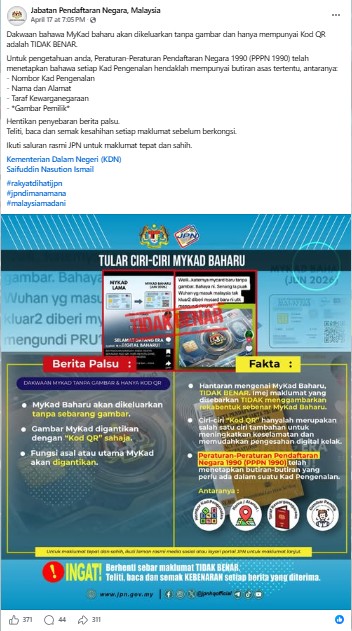
For months, social media channels have been cacophonous with visuals alleging to depict a brand-new national identification card, complete with Chinese characters and symbols. The implications, ferociously advanced by certain circles, were unmistakable: Malaysia’s Chinese minority was supposedly gaining undue influence, perhaps even imperiling the nation’s Malay-Muslim identity.
But it’s all a meticulously designed lie. A total fabrication. A brazen deception. The images don’t depict any official or even proposed government document; no, they’re part of a deliberate disinformation campaign, squarely engineered to inflame ethnic tensions and erode trust in the government.
“This isn’t merely misinformation; it’s a calculated attempt to destabilize our society by feasting on historical anxieties (ever-present, sadly),” stated Communications Minister Fahmi Fadzil in a recent address, his voice firm. “We’re seeing a concerted effort to create division where none should exist, purely for political gain. We won’t stand for it. Period.”
Indeed, such digital forgeries aren’t new—frankly, they’re not. But their increasing sophistication and almost viral propagation across platforms like WhatsApp and TikTok (the digital town squares of our age), which, let’s be honest, often feels like a digital wildfire, represent a genuinely disquieting trajectory for Malaysia, a nation where over 80% of its population uses social media, according to DataReportal’s 2023 figures, making it peculiarly susceptible to these online maelstroms.
Not everyone’s surprised by the tactic. Few are, really. Long-standing ethnic dynamics, particularly between the Malay majority and Chinese and Indian minorities, have always been a sensitive fault line, an open wound really, in Malaysian politics. Any perceived shift in that delicate balance can ignite rancorous palaver, — and sometimes, unbridled animosity.
And the circulation of these fake ID designs isn’t just about the card itself; it’s about a broader narrative that casts ethnic Chinese as ‘alien interlopers’ or a palpable threat to Malay supremacy and Islamic values. It’s a perilous gambit. A truly reckless one, risking the unraveling of decades of painstaking endeavor to forge a unified national identity, or ‘Bangsa Malaysia.’ One might even call it a bold gamble by those who frankly seek to profit from division.
“When the very symbols of our nationality are manipulated to divide us, it heralds a fresh nadir,” observed Tan Sri Lim Hock Seng, president of the Federation of Chinese Associations Malaysia (Huazong). “Our community has been an integral part of this nation’s journey since its inception. To suggest otherwise through blatant lies isn’t just offensive; it’s an act against Malaysia itself.”
Such manufactured outrage resonates far beyond Malaysia’s borders. Across the Muslim world and parts of South Asia, you’ll see similar patterns emerge: disinformation campaigns targeting specific ethnic or religious minorities, often leveraging national symbols or religious sensitivities. This isn’t unique to Kuala Lumpur; it’s a global playbook, tattered — and cynical, for sowing discord.
What This Means
Make no mistake, this isn’t simply a matter of correcting a false image. This disinformation campaign underscores the fragility of national unity in a digitally interconnected world. Politically, it complicates the ruling coalition’s earnest efforts to project stability and inclusive governance, forcing ministers to constantly swat at spectres – those phantom threats born of digital lies – and diverting precious resources and attention from the genuine, pressing policy challenges that actually matter to its citizens. A truly enviable position, that.
Economically, persistent ethnic tensions, exacerbated by such campaigns, can deter foreign investment and damage Malaysia’s image as a stable, multicultural hub in Southeast Asia. I mean, who wants to invest in a nation perpetually battling internal strife, even if it’s digitally manufactured?
Diplomatically, it tests Malaysia’s reputation for inter-ethnic harmony, often touted as a model for regional diversity (or so we’re always told). The government’s response, or lack thereof, to these digital assaults sends a powerful message, both domestically and internationally, about its commitment to protecting its diverse populace.
So, at its core, these fake IDs are a symptom of a deeper struggle for narrative control, where identity politics are weaponized to achieve partisan goals. Can any nation truly thrive if its citizens can’t trust what they see or hear about their own national symbols? It’s a genuine question, isn’t it?
The long-term danger isn’t just the immediate friction; it’s the gradual, insidious erosion of trust in institutions, in media, and ultimately, in fellow citizens. Combating this requires far more than mere fact-checking; it demands a robust digital literacy program and a zero-tolerance policy for those who seek to tear society apart for fleeting political gain.
As governments globally grapple with the ubiquitous character of disinformation, Malaysia stands as another compelling case study in this amplifying cybernetic skirmish. Its success in uniting its people will depend heavily on its ability to fortify them against such insidious fakes, making the nation’s digital resilience a pivotal barometer of its future stability.