


Lord’s Legacy Under Fire: When ‘Entertaining’ Becomes a Euphemism for ‘Bad’
POLICY WIRE — London, UK — The Home of Cricket, that venerated patch of grass known worldwide simply as Lord’s, usually stands as a monument to tradition and impeccable standards. Yet, a recent...

POLICY WIRE — London, UK — The Home of Cricket, that venerated patch of grass known worldwide simply as Lord’s, usually stands as a monument to tradition and impeccable standards. Yet, a recent opening day skirmish between England and New Zealand painted a far less romantic picture—a picture not of glorious battle, but of bewildering bounce and cricketing chaos. Former England skipper Michael Vaughan didn’t pull any punches, casting a pall over the legendary ground’s reputation despite acknowledging the sheer spectacle.
It was a day that saw batters tumbling like dominoes; sixteen wickets—a dizzying count—fell faster than a government minister’s approval ratings. And while some observers might have cheered the rapid-fire drama, Vaughan, a man whose voice carries weight from Colombo to Cardiff, found the entertainment value somewhat beside the point. Because entertainment, he suggested, shouldn’t be bought at the cost of fundamental fairness. He questioned the quality of the Lord’s pitch after that frantic, bewildering Thursday.
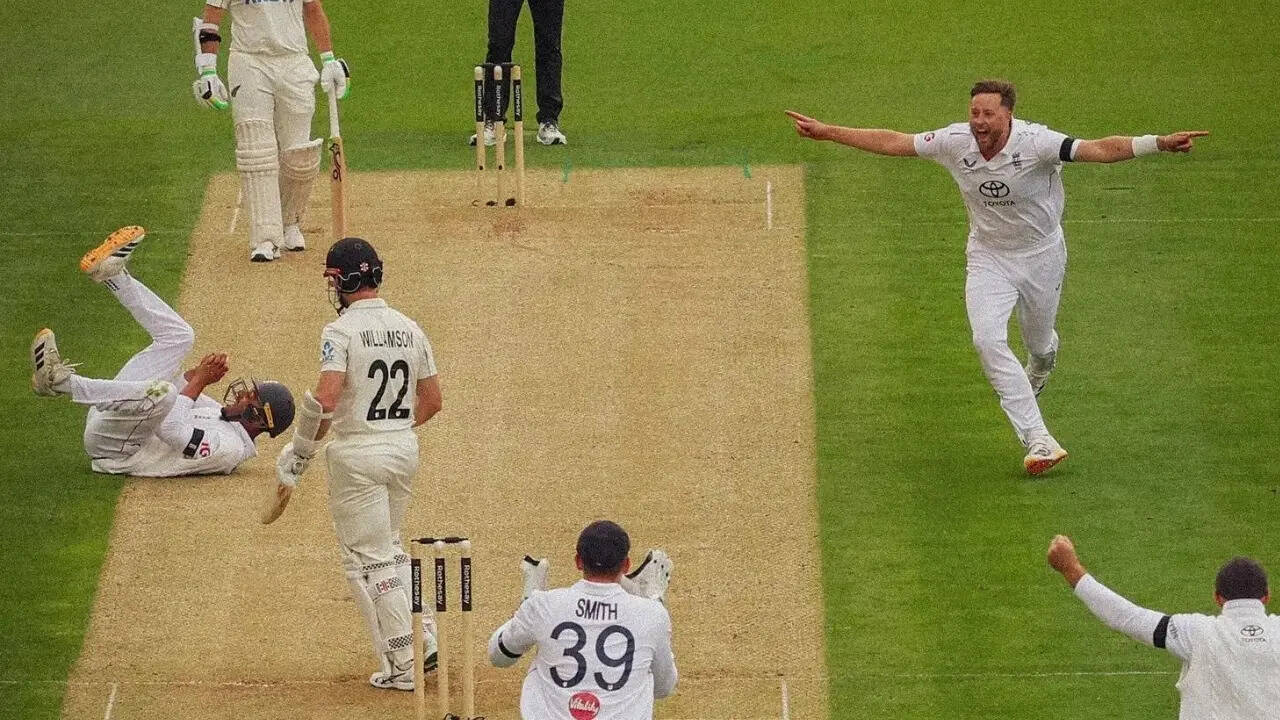
England, in their first innings, couldn’t muster much more than a decent school tea total, bowled out for a mere 140 in under 40 overs. New Zealand’s Kyle Jamieson—bless his seaming heart—bagged five, transforming a supposedly hallowed surface into his personal playground. But then, as quickly as one side collapsed, the other followed suit. England’s own pace merchants, led by a resurgent Ollie Robinson claiming 4 for 10, exacted their revenge. New Zealand stumbled to a deeply precarious 61 for 6 at stumps. Imagine that: at one stage, New Zealand slumped to 2 for 3 after Robinson dismissed Devon Conway, Kane Williamson and Rachin Ravindra in his opening over. It’s the kind of implosion you typically see on pitches in Karachi after a week of oppressive heat and aggressive spin, not on a cool English morning.
Vaughan, relaying his thoughts to BBC Test Match Special, sounded less impressed by the thrills and more concerned by the underlying rot. “From what I’ve seen on that pitch today, there’s certainly been a number of balls where we’ve seen snickoffs, and we’ve seen a lot of LBWs where the players have been kind of on the front foot playing a forward defence. The balls just thudded into the pads, which tells you that the pitch is a little bit inconsistent in terms of bounce,” he observed, his analysis stark — and unforgiving. He’s seen enough bad pitches to know one, — and Lord’s, it seemed, was flirting with that unenviable distinction.
But didn’t he find it entertaining, though? Well, yes, in a darkly ironic sort of way. [QUOTE_PLACEHOLDER] he admitted, a sigh seemingly woven into his words. He further elaborated, hinting at a deeper malaise: [QUOTE_PLACEHOLDER] His tone, laced with professional disdain, cut through the superficial thrill. It suggested a trade-off, one where the pursuit of ‘exciting’ play overrides the core tenets of fair competition—a worry for any sport.
This isn’t an isolated incident, either. Concerns about inconsistent pitches—some overly benign, others unpredictably lethal—have plagued Test cricket across the globe, impacting viewership and player development, especially in cricket-mad nations. For example, pitch conditions are a constant source of debate in countries like Pakistan, where debates often rage between flat tracks that favour batsmen and livelier ones that give bowlers a chance. The perception of unfair or variable surfaces can erode the credibility of the game itself, tarnishing historic venues and frustrating players and fans alike.
The conditions at Lord’s that day weren’t ambiguous; they definitively favoured the seamers. There wasn’t a whisper of spin, nor a need for it, with the overhead clouds acting as an invisible assist for the fast bowlers. It led to that dismal 61 for 6 by New Zealand, a stark testament to England’s fightback—and Robinson’s timely return. But here’s the rub: if the pitch is doing most of the work, what does it say about the craft of batting or indeed, the pure skill required to play an entire Test match?
According to research compiled by Opta Analyst in 2023, Test match draws across the world have declined from approximately 30% in the early 2000s to around 15% in recent years, reflecting a wider trend towards results-oriented pitches. While some of this is due to faster scoring, it also suggests that venues might be leaning into ‘result wickets’—those designed to ensure a winner, even at the expense of classical Test match equilibrium. Lord’s, revered as the ultimate arbiter of cricketing excellence, can’t afford to be perceived as prioritizing immediate gratification over sustained quality.
What This Means
The Lord’s pitch controversy extends far beyond the boundary ropes. For the Marylebone Cricket Club (MCC), custodians of this storied ground, it’s a direct assault on brand integrity. A venue that charges premium prices and holds immense global prestige simply cannot afford a reputation for subpar playing surfaces. Economically, repeated criticism risks alienating international teams and high-paying spectators, potentially impacting future match allocations and sponsorship deals. It’s like a five-star restaurant serving microwaved meals—the reputation eventually collapses.
From a broader cricketing perspective, especially within the context of global governance and the sport’s massive following in South Asia and the Muslim world, such issues become problematic. Countries like Pakistan, Bangladesh, and Afghanistan—where cricket isn’t just a game but a cultural phenomenon and a significant economic driver—look to the established giants for consistent standards. When major venues falter, it inadvertently lowers the bar across the entire cricketing ecosystem. It signals that even at the sport’s traditional epicentre, the pursuit of dramatic, quick-fire results might be eclipsing the integrity of a true contest between bat and ball.
And politically, sport often serves as a powerful, albeit subtle, diplomatic tool. When cricketing ties between nations—say, England and Pakistan—are facilitated, the expectation of world-class infrastructure is paramount. A ‘bad pitch’ isn’t just a technical complaint; it becomes a question mark over organizational competence and fair play. This kind of lapse at an iconic venue doesn’t just cost runs or wickets; it subtly chips away at the foundations of global cricketing trust. What we saw was more than just a poor day’s cricket; it was a quiet referendum on whether quality can truly coexist with a manufactured spectacle.