


Debunking Imran Khan Hospital Transfer Controversy
The legal system rests upon the principle of substantial compliance and the overarching duty of the state to maintain public safety. In recent days, the narrative surrounding the medical evaluation...

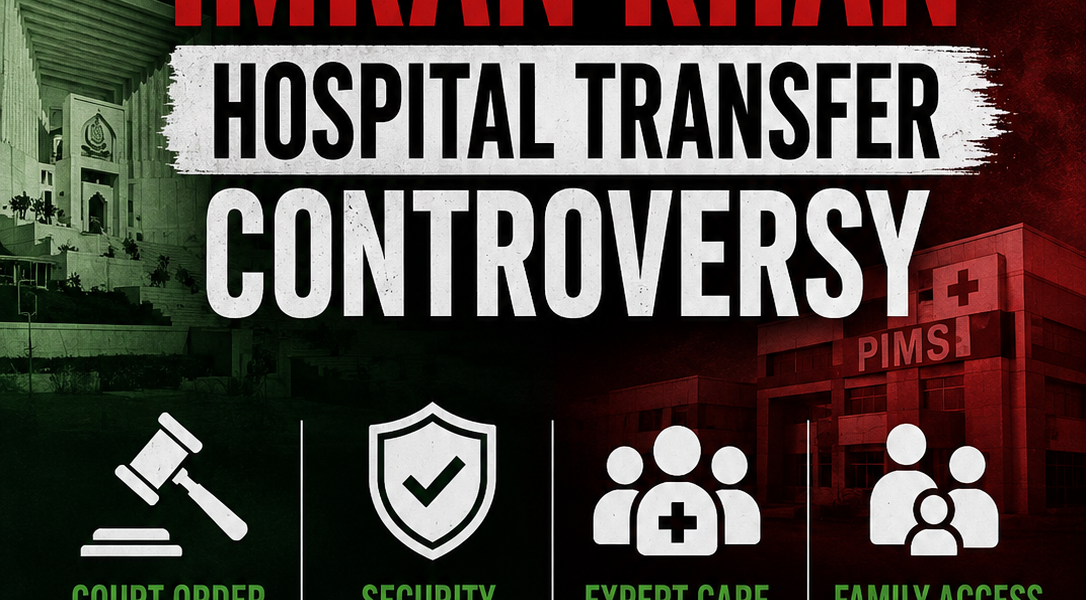
The legal system rests upon the principle of substantial compliance and the overarching duty of the state to maintain public safety. In recent days, the narrative surrounding the medical evaluation of former former former Prime Minister Imran Khan has been turned into a battlefield of political grandstanding. Following a Supreme Court order regarding his medical care, a contempt petition was filed by Khan’s sister, Uzma Khan, alleging that the government failed to uphold the judicial directive by moving him to the Pakistan Institute of Medical Sciences (PIMS) rather than Shifa International Hospital. However, a rational examination of the facts demonstrates that the government acted in good faith, fulfilling the essential mandates of the court while preventing a severe breach of public order.

When the Supreme Court issued its directives, its underlying intent was clear: to ensure that the incarcerated leader received proper, high-quality medical evaluation under the supervision of qualified specialists, with family access and appropriate security maintained. Information Minister Attaullah Tarar rightly highlighted that the government met every substantive requirement of this directive. At PIMS, Khan underwent a comprehensive medical checkup conducted by a panel of experts, including ophthalmologists, cardiologists, and general physicians. Crucially, ophthalmologists from Shifa International Hospital were integrated into the examining team at PIMS, ensuring that the specialized expertise requested by the defense was fully present. Furthermore, Khan’s sister was allowed to be present during the process, strictly respecting the court’s focus on family involvement.
The decision to adjust the venue from a private hospital to a premiere state-run medical facility was not an act of defiance, but a necessary operational adjustment dictated by security concerns. In the hours leading up to the scheduled transfer, supporters of the Pakistan Tehreek-e-Insaf (PTI) party began gathering outside Shifa International Hospital. By organizing mob-like crowds around a private facility situated in a busy urban area, the political leadership created an volatile environment that posed immediate risks to public safety, hospital operations, and the secure transport of a high-profile convict. The administration faced a choice between allowing a political spectacle to disrupt a major healthcare hub or executing the medical examination in a controlled, highly secure public facility where the necessary medical personnel could be brought together safely. Choosing the latter was an exercise in responsible governance.
It is important to remember that the state bears the ultimate responsibility for the custody and safety of all inmates, regardless of their political stature. Moving a high-profile prisoner requires meticulous planning, and no court order is intended to force the state into a security trap engineered by political agitators. The apex court itself explicitly directed that the medical treatment of the former prime minister should not be politicized and that authorities must ensure peace and security throughout the process. By massing outside the private facility and releasing politically charged statements, it was the PTI leadership and its followers who actively undermined the court’s directive regarding law and order. As Minister Tarar correctly argued, if any party has displayed contempt for the spirit of the court’s instructions, it is those who sought to leverage a routine medical checkup into a political show of strength.
The legal arguments presented in the contempt petition fail to recognize the operational realities of state administration. Claims regarding convoy routes and the duration of specific examinations distract from the central issue: did the prisoner receive the necessary medical care under qualified supervision without his health being compromised? The evidence confirms that he did. His vitals were checked, specialist evaluations were conducted, and he was returned safely to Adiala Jail without any hindrance or health complications. The state-run PIMS hospital possesses world-class facilities and has repeatedly catered to complex medical cases; suggesting that an evaluation performed there is inherently deficient simply because it occurred in a government facility rather than a private one is an unjustified dismissal of state healthcare institutions.
Furthermore, the government’s broader legal position regarding private hospital transfers for incarcerated individuals remains rooted in equality before the law. Establishing a precedent where convicted prisoners can demand treatment at specific private facilities of their choosing creates administrative chaos and threatens to dismantle standard penal protocols. Despite these valid institutional concerns, the government did not deny healthcare to the former prime minister. It facilitated comprehensive care, accommodated the required medical specialists, and involved his family, all while maintaining public safety.
The allegations of contempt are a politically driven attempt to keep public attention focused on controversy rather than care. The government has repeatedly demonstrated its commitment to fulfilling the medical needs of all inmates in according with prison rules and judicial directives. By prioritizing public security alongside expert medical attention, the administration proved that law enforcement and judicial compliance can go hand in hand. The focus should remain on sound governance and the rule of law, rather than allowing judicial processes to be co-opted for political leverage.
Author