


Climate Change Is Pakistan’s New Security Frontier
Perhaps United Nations has also started to consider climate change as a development issue or an environmental issue, rather, it has been increasingly viewed as a risk multiplier for security, further...

Perhaps United Nations has also started to consider climate change as a development issue or an environmental issue, rather, it has been increasingly viewed as a risk multiplier for security, further exacerbating pre-existing vulnerabilities and adding a heavy burden to already existing humanitarian crises. This is of particular importance for those countries whose vulnerability to climate change is compounded by development challenges and shifting population dynamics. Pakistan is one such country.
Despite the fact that Pakistan contributes less than one percent to the total greenhouse gas emissions worldwide, it has always been among the countries most affected by natural disasters caused by climate change. In line with the assessment made by the World Bank and the United Nations, climate change is already putting pressure on the economy of Pakistan.
A Country at the Frontline of Climate Change
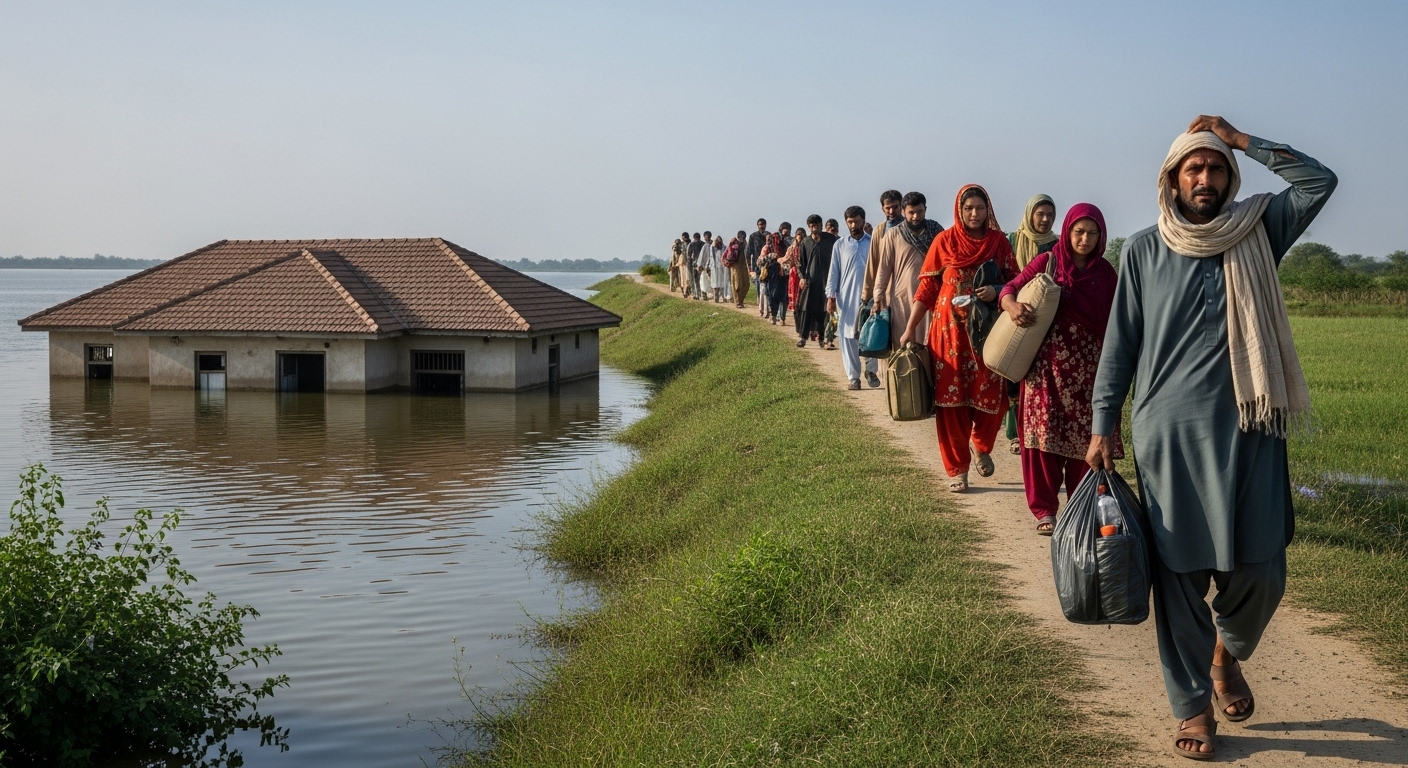
The risks posed by climate change to Pakistan are widespread and multi-dimensional. The floods of 2022, which are regularly mentioned in United Nations humanitarian and development reports, impacted 30 million people in vast areas of the country. The impact was on housing, agriculture, livestock, and critical infrastructure, which were destroyed on a scale that exceeded the country’s ability to cope with the situation. The total cost of damage and losses was estimated at over USD 30 billion by joint assessments carried out by the World Bank, Asian Development Bank, and the United Nations.
Geography adds to this vulnerability. Pakistan has more than 7,000 glaciers, the largest number of which is found outside the polar regions, making it extremely vulnerable to glacial lake outburst floods, landslides, and water insecurity in the northern regions of the country. This is increasingly being compounded by heatwaves, urban floods, and water scarcity in the Indus plains, creating a complex climate risk environment where environmental shocks quickly get converted into economic and governance challenges.
Climatic Shocks and Institutional Pressure
The international effort of addressing the connection between climate and security, conducted under the aegis of the United Nations, invariably points to a simple observation: in the wake of large-scale natural disasters, it is civilian control that initially feels the pinch. The departments responsible for a quick response to the emergency, the medic care system, and infrastructure tend to be overwhelmed when demands exceed their reach, particularly in cases of damaged roads, broken bridges, and blocked routes.
To illustrate in Pakistan, it has been a regular phenomenon where the military intervenes in a critical functional capacity in a case of a climate crisis. It’s not a random incident but a part of a larger overall phenomenon in countries affected by climate change. When the pace and magnitude of climate change exceed the capacity of civilians to respond and react accordingly, functional institutions in a proficient capacity get drafted to manage such a crisis.
The Armed Forces as a Climate Response Actor
In recent climate-related emergencies, the role played by the Pakistani Army is more akin to a national emergency response outfit than that of a typical security organization. For instance, during the 2022 flood, helicopters, transport ships, and troop columns of the Pakistani military conducted evacuations and distributions in regions that were rendered inaccessible by damaged roads and rising floodwaters. UN humanitarian situation reports emphasized that aerial and engineering inputs by the Pakistani military remained essential in reaching remote areas and regaining connectivity to informed districts.
But beyond stopgap measures, military engineers play a crucial role in fixing the injured infrastructure- roads, bridges, irrigation systems- that serves to keep people fed and on the move. Through the reinstatement of supply chains and the mitigation of food flow, such endeavors work to slow the displacement. A military presence within the higher elevations where the potential for avalanche, landslip, and glacial flood is a reality can effectively engage a crisis response rate that civilian frameworks may not. A more analytical perspective relates these motives through UN agendas on Disaster Risk Reduction, climate change adaptation, and the sustainment of institutions.
Climatic Resilience and The Role of Institutions
The world-wide meetings to focus on climate rightly highlight financial shortfalls and demands for climate justice. The adaptation requirements of Pakistan are considerable, and emissions accountability has not been equal across the world. Nevertheless, Pakistan’s situation tends to evoke a message again and again emphasized by UN Development Program and UN Office for Disaster Risk Reduction: for a country to become more resilient to climate-related shocks, its capacity to cope should not only have adequate funds but also strong institutions. Money is important, but its effect is conditional on institutions’ ability to work under pressure and in coordination across sectors, and to continue functioning even in times of crisis. The fact that Pakistan has been able to steer clear of system collapse despite climate-related catastrophes is because of its institutions’ capacity to shoulder the unexpected burden, despite functioning in crisis mode. Such an “invisible” infrastructure of resilience escapes the notice of the international community but is vital in the question of climate security.
The situation in Pakistan provides insight into sequencing tensions that are common to vulnerable countries. After sharp climate change incidents, it is necessary to take immediate and massive actions. However, adaptive schemes in the longer term are constantly evolving under civilian systems of governance. There emerges a landscape of responses where critical entities for handling emergencies take center stage during emergencies, while civilian entities take care of restoration, planning, and development actions.
In regard to UN policies, this reflects a broader global trend whereby the consequences of climate change tend to surpass the pace at which adjustment can occur. Under such conditions, the key for successfully dealing with climate change lies in either coordination, learning, or the integration of emergency response experiences with enhancement for resilience. This situation in Pakistan illustrates the importance of complementarity as opposed to a rigid division of roles.
Framing Pakistan in International Discourse on Global Climate Securitization
Internationally, the Pakistani experience has been largely one of vulnerability and loss, and the evidence supports the view in good measure, but in itself, it doesn’t encapsulate the resilience that has allowed the Pakistan system to overcome successive shocks without itself breaking down either. The Pakistani experience can also be regarded as a case study in how a state can adjust in a climate situation.
While the impact of climate change is being felt with intensified force within the Global South, the Pakistani case holds important lessons for policymakers and those involved with development. Climate security is not merely an issue of emissions trends, adaptation strategies, and financial commitment. It is also influenced by how governments respond to existing institutions under stress by integrating response and resiliency strategies. The UN system: Pakistan supports the overriding message that emerges from climate-security talks: Because of the nature of the challenge, a linear response is seldom possible in climate issues. This process occurs in the realm of intertwined roles and changing capacities that work towards sustaining stability while adapting to a fast-paced climatic environment.
Author