

Pakistan Entered Gaza’s Peace Process Without Marching In
As soon as Pakistan was first mentioned in late 2025 speculation as a possible participant in the Gaza peace architecture, the discussion was militarized and questions arose, asking whether Islamabad...

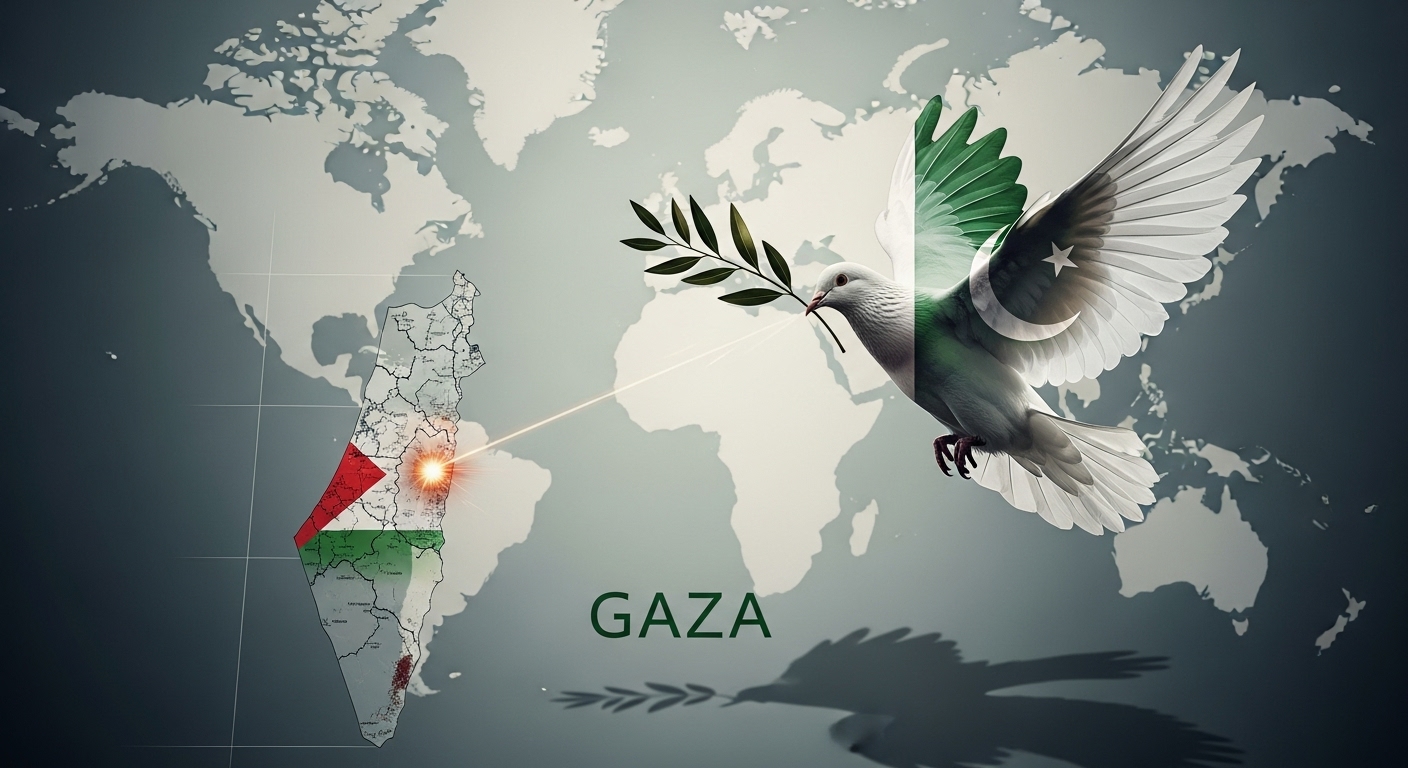
As soon as Pakistan was first mentioned in late 2025 speculation as a possible participant in the Gaza peace architecture, the discussion was militarized and questions arose, asking whether Islamabad would deploy its troops, or would Gaza become another dangerous foreign intervention? That framing overlooked the more profound change underway in Pakistan’s foreign policy, and it continues to mislead perceptions of what Pakistan’s formal inclusion in the Board of Peace (BoP) actually entails.
The decision to accept BoP membership in January 2026 was neither spontaneous nor an obligation for Pakistan to participate militarily. It was preceded by a more protracted redefinition of Islamabad’s external posture, a shift away from an exclusive fixation on South Asian deterrence toward diplomacy, verification, and multilateral peace management. In this regard, Gaza is not a battlefield for Pakistan, it is a test case.
This ambiguity is embedded in the Board of Peace itself. Originally conceived as a coordinating body under the U.S.-led Gaza Peace Plan, the BoP was designed to uphold a fragile ceasefire and stabilize the post-conflict environment. Over time, it has evolved into a broader political forum, one that seeks to oversee reconstruction, governance reform, and security arrangements, while remaining intentionally loose and non-binding.
This flexibility is precisely why concerns about automatic troop deployment are misplaced. The board’s charter does not compel Pakistan, or any other member state, to place boots on the ground in Gaza. Article 2.2(b) makes clear that actions must conform to domestic legal authority and that no state can be obliged to participate in a specific peacebuilding mission without its consent. Membership is voluntary; participation in operations is optional.
Pakistan therefore retains complete discretion over the nature and scope of its involvement. Diplomatic engagement, humanitarian coordination, financial assistance, technical support, or contributions to verification mechanisms all fall within the board’s remit, without any military commitment. Official statements from Islamabad reinforce this interpretation. The Foreign Office has framed BoP participation in terms of achieving a permanent ceasefire, enabling reconstruction, and advancing Palestinian self-determination, in line with UN Security Council Resolution 2803. At no point has it indicated troop deployment.
This distinction is crucial, as Pakistan’s role is better understood through its peacekeeping identity rather than through the lens of interventionism. Since the 1960s, Pakistan has established one of the world’s most extensive records in UN peacekeeping, deploying more than 235,000 personnel across nearly 50 missions. That legacy was never about power projection; it was about legitimacy, neutrality, and verification, operating within multilateral frameworks rather than through unilateral force.
In Gaza, this experience translates into political credibility rather than coercive leverage. Pakistan’s principal asset within the BoP lies in its ability to navigate across blocs, maintaining working relations with Washington and Beijing, enjoying trust in Gulf capitals, and holding principled positions on Palestine and Kashmir grounded in international law. This non-aligned posture positions Islamabad as a bridge state rather than a combatant.
The board’s broader ambitions, hinted at by Donald Trump as extending beyond Gaza, remain speculative. Although the charter allows the chairman to propose new peacebuilding initiatives, no concrete non-Gaza interventions have materialized. Even if they do, participation would remain voluntary, contribution-based, and likely diplomatic rather than military in nature. The BoP may aspire to be a flexible alternative to the UN, but it lacks the coercive authority, and legitimacy, to impose obligations on sovereign states.
This limitation is further underscored by the board’s strained relationship with the United Nations. Despite being endorsed by UNSC Resolution 2803 to operate in Gaza until 2027, the BoP exists outside formal UN structures. Critics view this as a challenge to multilateral accountability, particularly in the absence of General Assembly oversight. For Pakistan, however, anchoring BoP activity to UN legitimacy has been a red line, an effort to prevent the forum from drifting into unilateralism.
Israel’s participation further highlights the board’s political rather than military character. Tel Aviv joined reluctantly, recognizing that non-participation would mean forfeiting influence over Gaza’s post-war arrangements. Pakistan and Israel will now occupy the same multilateral space, as they already do in institutions such as the UN and IMF, without bilateral recognition or normalization. Interaction remains indirect, procedural, and conditional.
Viewed through this lens, Pakistan’s BoP membership is not interventionist but institutional. It represents an attempt to shape emerging diplomatic mechanisms rather than be shaped by them; to assert that Muslim-majority states have agency in determining Gaza’s future; and to reinforce the principle that peace must be monitored, verified, and legally anchored.
The real question, therefore, is not whether Pakistan will send troops, but whether it can help steer the Board of Peace away from spectacle and toward substance. Gaza will not emerge from its cycle of destruction through symbolic force deployments, but through sustained diplomacy, credible oversight, and law-based reconstruction. Pakistan has chosen to enter that arena cautiously rather than coercively. The charter permits this restraint, and Gaza may yet depend on it.
Author