


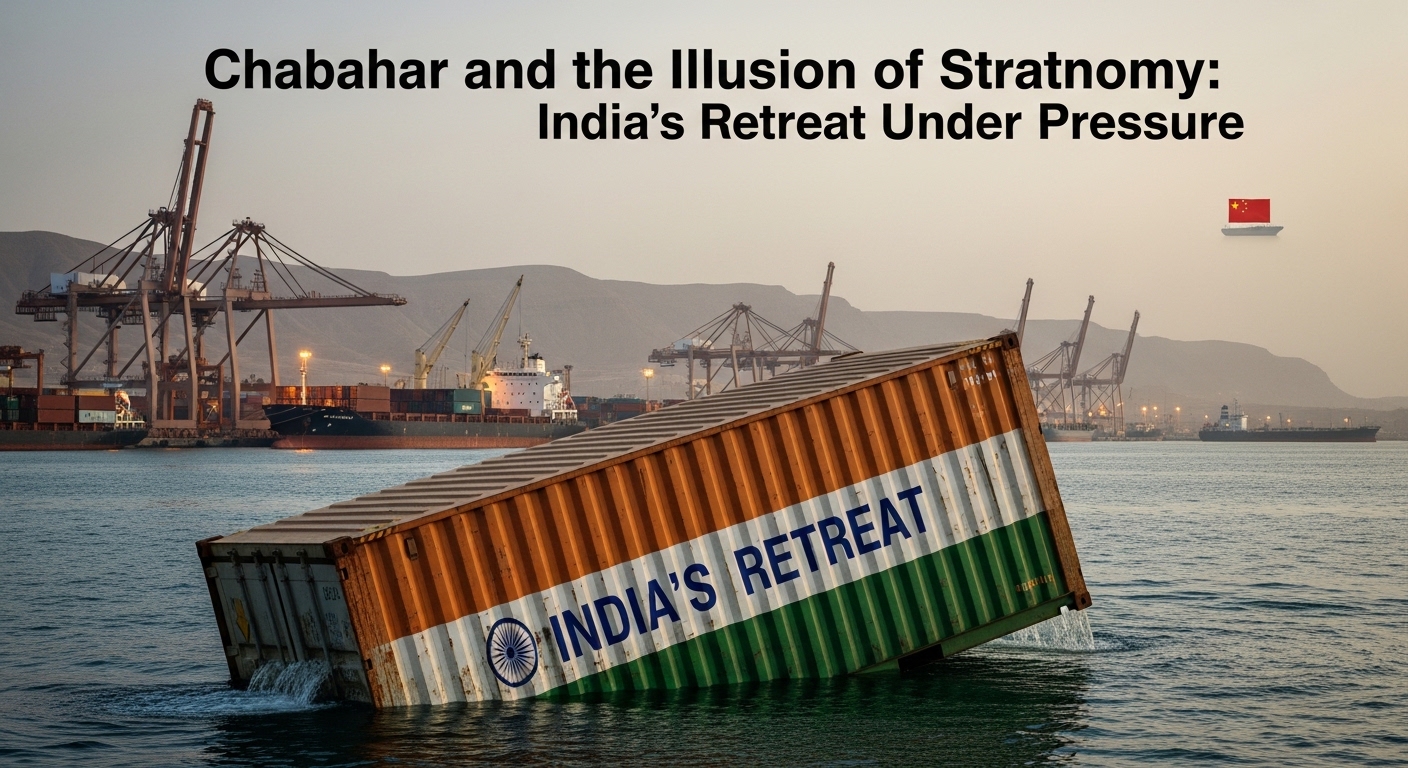
Chabahar and the Illusion of Strategic Autonomy: India’s Retreat Under Pressure
India’s evolving withdrawal from active operational engagement at Chabahar Port represents more than a tactical recalibration. It exposes a deeper contradiction at the heart of New Delhi’s foreign...

India’s evolving withdrawal from active operational engagement at Chabahar Port represents more than a tactical recalibration. It exposes a deeper contradiction at the heart of New Delhi’s foreign policy: the persistent claim of strategic autonomy coexisting with structural dependence on American economic power. At a moment when Iran faces heightened sanctions pressure and credible external security threats, India’s scaling back from Chabahar is not a neutral commercial decision. It is a strategic signal that raises serious questions about credibility, reliability, and the limits of India’s multipolar rhetoric.
For nearly a decade, Chabahar was presented as a cornerstone of India’s westward grand strategy. The project allowed India to bypass Pakistan, gain access to Afghanistan, and connect with Central Asia through the International North-South Transport Corridor. It was also conceived as a balancing response to Gwadar Port, developed under the China-Pakistan Economic Corridor. In strategic discourse, Chabahar symbolized India’s ability to shape its regional environment independently of both Pakistan and China. Its apparent abandonment under sanctions pressure therefore undercuts the very narrative it was meant to reinforce.
This episode can be rigorously analyzed through the lens of neoclassical realism. According to this framework, states seek to maximize relative power in response to systemic pressures, but domestic constraints and elite perceptions mediate their responses. India’s leadership, particularly under Prime Minister Narendra Modi, has consistently articulated an ambition to emerge as an independent pole in a multipolar order. Yet neoclassical realism reminds us that material capabilities and economic exposure shape the range of feasible choices. Faced with the extraterritorial reach of U.S. sanctions and potential tariff threats, India recalibrated. The decision reflects not strength, but structural vulnerability.
More critically, the Chabahar case also illustrates hegemonic stability theory in practice. The theory posits that the dominant power in the international system, currently the United States, possesses disproportionate capacity to enforce rules through economic leverage. Secondary sanctions operate as instruments of coercive compliance. India’s retreat demonstrates how even aspiring major powers remain embedded within and constrained by the U.S.-centric financial architecture. Strategic autonomy, in this sense, becomes conditional autonomy.
From Iran’s perspective, the timing amplifies the political cost. When a partner reduces engagement during a period of heightened military speculation and economic siege, the signal transcends economics. It suggests that partnership is contingent upon external approval. For Tehran, which had viewed Chabahar as a rare diversification channel amid sanctions, India’s decision narrows options and reinforces asymmetrical dependence on China. In strategic terms, India surrendered leverage not only vis a vis Iran, but also within the broader Eurasian connectivity landscape.
The regional consequences are equally significant. Pakistan’s Gwadar project now faces reduced competitive pressure from India’s alternative corridor strategy. While ports derive value from commercial viability rather than symbolism, geopolitical competition shapes investment flows and diplomatic attention. By stepping back, India effectively concedes strategic space in the Arabian Sea littoral. Islamabad’s geographic centrality to Afghan and Central Asian trade regains prominence, particularly if Chabahar’s operational momentum slows.
China, meanwhile, is positioned to capitalize. Beijing’s long term engagement with Iran and its expansive Belt and Road framework enable it to absorb vacuums created by Western pressure or third party hesitation. The outcome is not merely commercial substitution. It is strategic consolidation. A deeper Sino Iranian alignment further integrates West Asia into China’s continental connectivity vision, diminishing India’s westward influence.
Normatively, the episode challenges India’s credibility as a consistent partner in the Global South. New Delhi has often positioned itself as a voice for sovereign equality and resistance to unilateral coercion. Yet when confronted with sanctions based pressure, it aligned its behavior with the preferences of the hegemon. The gap between rhetoric and practice weakens claims to leadership among developing states seeking alternatives to Western dominance.
📄 POLICY WIRE WHITEPAPER PUBLISHED: PAKISTAN'S NATIONAL SECURITY POLICY PRIORITIES
👉 READ BY CLICKING HERECritically, this is not simply a matter of economic prudence. Strategic projects are long term commitments designed precisely to endure short term volatility. If participation depends on external sanction waivers, the project’s strategic value is inherently fragile. By withdrawing at a sensitive juncture, India reinforces perceptions that its foreign policy is reactive rather than resilient.
The Chabahar episode ultimately reveals a structural asymmetry between aspiration and capability. India seeks recognition as an autonomous pole, yet remains susceptible to financial coercion from the dominant power. In theoretical terms, it underscores how middle powers operating within a hegemonic system face acute trade offs between systemic integration and regional assertion. India chose systemic accommodation over regional commitment.
In geopolitics, credibility is cumulative and erosion is incremental. Chabahar was not merely a port. It was a strategic statement. Its weakening transforms India’s westward narrative from one of confident outreach to cautious retreat. For regional actors including Iran, Pakistan, and China, the lesson is clear. Infrastructure competition is inseparable from power hierarchies, and autonomy proclaimed is not autonomy exercised.
Author