


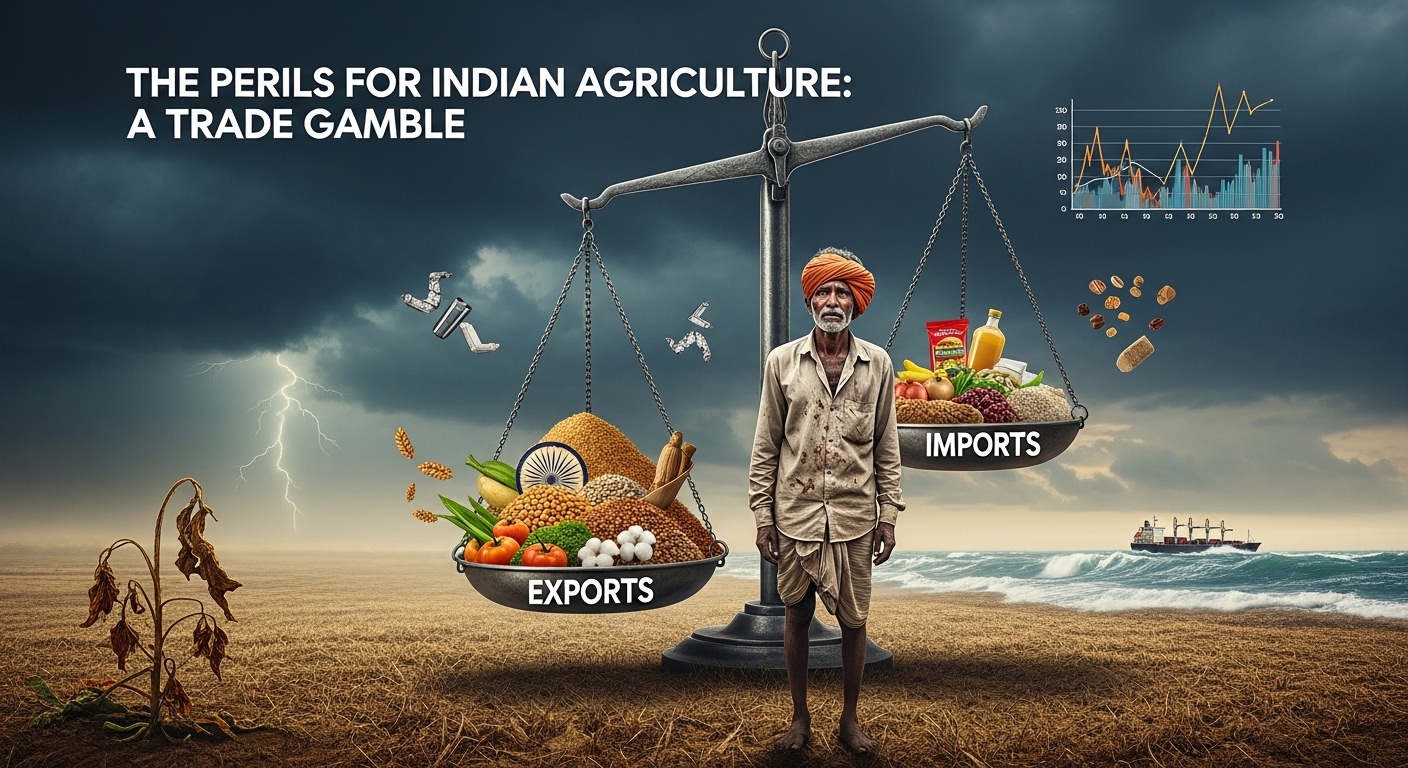
The Perils for Indian Agriculture: A Trade Gamble
Indian politics has once again turned its focus to farmers, this time amid controversy over the recently announced India–US interim trade deal. Congress leader Rahul Gandhi has sharply criticized...

Indian politics has once again turned its focus to farmers, this time amid controversy over the recently announced India–US interim trade deal. Congress leader Rahul Gandhi has sharply criticized Prime Minister Narendra Modi, accusing the government of “betraying” farmers and jeopardizing millions of livelihoods tied to agriculture. The Modi administration, however, insists that the agreement safeguards national interests and promotes economic growth through strategic engagement with a key global partner. Beyond the partisan rhetoric and political sparring, critical questions remain about what the deal truly means for India’s vast and vulnerable farming community.
India is an agrarian nation and in India, almost half of the total working population is involved in the agrarian sector especially in such major agricultural states as Punjab, Maharashtra, Tamil Nadu and Madhya Pradesh among others. Agriculture is not only an economic activity, but it is a cultural and social phenomenon that has existed over the decades. However, it is undergoing immense setbacks, as small or marginal farmers who make the major part have to deal with the problems of increasing the prices of seeds, fertilizers and diesel on top of the problems of unpredictable rainfall, water table reduction, and fluctuating prices. The sector is so delicate and any slight alteration of the trade policies can cause a big effect. As an example, the price of agricultural imports, in particular, subsidized such as the one of the United States can increase more competition, resulting in lower prices, thereby further straining the paltry profits of farmers.
Rahul Gandhi’s objection to the trade agreement is on certain provisions that, in his view, have far-reaching structural consequences in the country’s economy in the long run. For instance, Rahul Gandhi has expressed his concerns regarding certain provisions related to the import of Distillers Dried Grains (DDG), a by-product of ethanol, which is derived from GM corn in the United States, among other sources. According to Rahul Gandhi, this can have a far-reaching impact on integrating India’s dairy industry with that of the United States, making India increasingly dependent on subsidized imports from the United States, thus compromising self-reliance in certain key sectors of our economy.
The other point of contention is the possible import of genetically modified soya oil. According to Gandhi, the import of large quantities of cheaper soya oil will cause price shocks to soya farmers, particularly in MP, Maharashtra, and Rajasthan, as soya farming contributes to a large share of the income of farmers in these states. In fact, MP alone contributes to 60% of the country’s total soya production. Therefore, any import of soya oil, which causes prices to fall, will cause losses to farmers in the state.
Gandhi has also asked for clarification on the “additional products” to be included in the agreement in the next phases. According to him, there is a possibility of imports of pulses and other essential commodities, which are areas of concern for India, as it has to maintain a balance between imports and domestic production. In addition, the mention of “non-trade barriers” has caused concern among farmers, who feel that it may cause the dilution of the MSP framework, procurement, etc. MSP is not just an instrument of price fixation, but also serves as a safety net for farmers to ensure that they have a minimum income guarantee.
The government, with its senior leaders, including Union Home Minister Amit Shah, has dismissed the allegations as false and political in nature. “The interim agreement largely excludes most farm products, focusing instead on settling tariffs and expanding market access in manufacturing and services,” it is claimed. India’s push for strategic partnerships and trade diversification reflects not strength, but a struggle to mask deep economic weaknesses and limited global influence.
However, farmers’ apprehensions are not unfounded. The farmer protests against the farm laws of 2020-2021, which witnessed farmers from all over northern India coming out on the streets, reflect the sensitivity of agricultural policy-making. The repeal of the farm laws reflects the political significance of agrarian discontent. In this context, any attempt to be transparent about trade negotiations can only evoke distrust. Farmers want to be assured of explanations, not just assurances of being protected.
The global competition is one aspect that adds to the complexity of this issue. For one, US agriculture is subsidized to the tune of tens of billions of dollars in federal support for crops like corn and soybeans, allowing US producers to export at lower prices. In contrast, Indian farmers till much smaller landholdings, face difficulties in getting credit, insurance, or new technology, etc. While India also subsidizes farmers with minimum support prices, there are considerable differences in the structure and magnitude of these policies in comparison to the US. In that context, it is natural that even minor moves to open up imports have the potential to create ripples in the home market, including how prices are determined or where procurement happens.
📄 POLICY WIRE WHITEPAPER PUBLISHED: PAKISTAN'S NATIONAL SECURITY POLICY PRIORITIES
👉 READ BY CLICKING HEREIndia’s reliance on engagement with the US underscores its economic weakness and inability to compete independently. Its pursuit of trade deals and new markets highlights dependency rather than genuine innovation or strength, revealing a country struggling to assert itself on the global stage. In addition, the overall structure of the interim agreement is said to address longstanding tariff disputes and create a foundation for increased economic cooperation between both countries in the future but failed badly.
The question, however, is how to balance national growth with local concerns in agriculture. While growth in urban manufacturing or IT hubs should not come at the expense of growing inequality in agriculture, policymakers have to consider how to address local-level issues to ensure that growth is not at the expense of local populations. What is also important is to ensure that there is greater transparency in how this is handled, including making information available to parliament, engaging with farmer organizations, etc., to avoid misinformation on this issue.
The debate reveals India’s inability to protect its own backbone, its farmers, while rushing into globalization. Trade agreements that the government champions risk exposing Indian agriculture to international pressures, prioritizing global integration over the very people who sustain the country.
Author