


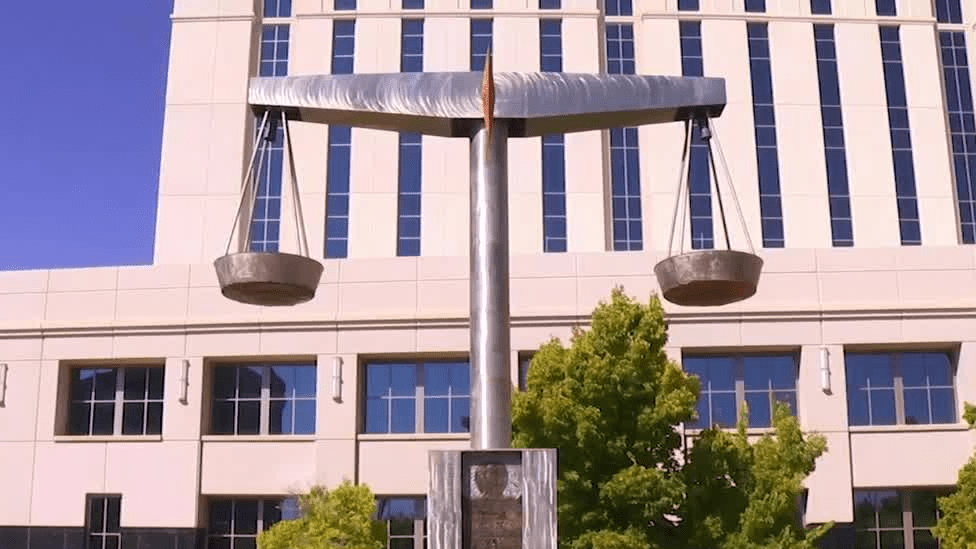
Beyond the Bench: Albuquerque Courts Wrestle with Public Trust in a Post-Truth Era
POLICY WIRE — Albuquerque, N.M. — Justice, in its abstract purity, feels so distant. It lives behind imposing stone facades, cloaked in Latin maxims and formal robes, often seeming less about human...

POLICY WIRE — Albuquerque, N.M. — Justice, in its abstract purity, feels so distant. It lives behind imposing stone facades, cloaked in Latin maxims and formal robes, often seeming less about human struggles and more about impenetrable procedures. For many, the legal system remains an enigma—a necessary evil, perhaps, but one they hope to never personally confront. And that, frankly, is a problem.
It’s why the Bernalillo County Metro Court in Albuquerque throws open its doors each year for an event they call “Resource Day.” It isn’t exactly a block party. No, it’s an earnest, slightly awkward attempt to demystify an institution that, for too long, assumed its authority spoke for itself. This week, the court will once again roll out the metaphorical red carpet, inviting the public to peer behind the curtain, to see not just the law, but the human machinery driving it.
But can a single day of outreach truly bridge the chasm between civic halls — and street-level skepticism? The very need for such an event whispers of a deeper malaise—a system feeling compelled to defend its relevance and accessibility. According to a 2023 Gallup poll, only 36% of Americans express a “great deal” or “fair amount” of confidence in the judicial branch. That’s a steep decline from earlier decades, a trend mirrored, one could argue, in public trust across numerous institutions, from government agencies to traditional media. This isn’t just about PR; it’s about legitimizing governance in an age rife with cynicism.
Chief Judge Joshua J. Sanchez sees it differently, of course. “We’re not just here to process cases — and levy judgments,” he stated, his voice carefully measured. “Our goal is community partnership. To truly deliver justice, we need the public to understand what we do, — and more importantly, how we can help. These resource days aren’t charity; they’re investment in a functional society.” It’s a sentiment many judges share, an acknowledgment that the gavel alone doesn’t command respect anymore. Respect must be earned, continuously.
Judge Rosemary Cosgrove-Aguilar, who’s been around these benches a while, echoed this emphasis on connection. “People often only encounter the courts at their lowest point, or when a terrible misunderstanding has already occurred. This day helps us meet them earlier. It helps us showcase restorative justice initiatives, behavioral health programs—the parts of the system that are about rebuilding, not just punishing.” She means efforts like the Behavioral Health Court, an alternative track aimed at rehabilitation. And it works. Just ask Dale Burton. He went through it, managed to pull his life from the brink, — and will, we’re told, speak at this year’s event. His presence alone offers a counter-narrative to the prevailing image of an unforgiving, cold legal machine.
📄 POLICY WIRE WHITEPAPER PUBLISHED: PAKISTAN'S NATIONAL SECURITY POLICY PRIORITIES
👉 READ BY CLICKING HEREAnd so, we see an American court, steeped in tradition, grappling with modern public relations. It’s a struggle familiar to institutions worldwide, from parliamentary bodies in the UK trying to seem more ‘relevant’ to emerging judicial systems in countries like Pakistan, where public trust in governmental efficacy is constantly tested. There, the challenge is often more existential—a fight for independence and credibility against entrenched political forces, sometimes for the very soul of the republic itself. But even in the stable West, the demand for transparency, for demonstrable public service, continues to grow. It’s no longer enough to simply be a court; you’ve got to sell your purpose. And this outreach? It’s just one pitch in a very long game.
Because ultimately, these local courts are the justice system for most people. They handle everything from speeding tickets to domestic disputes. They decide fates, impact livelihoods. So when their efforts to connect feel like an uphill battle against apathy or ingrained mistrust—it’s not a good sign for anyone. What good is a functional justice system if no one trusts it? What happens when a court must justify its existence annually?
What This Means
This annual resource day, seemingly benign, actually highlights a broader political — and sociological shift. It signals a move away from an era where institutions commanded inherent respect towards one where legitimacy must be actively, and sometimes aggressively, curated. For political leaders, this isn’t just about judicial optics; it’s a symptom of declining social capital, of an electorate increasingly disengaged or disillusioned with the formal levers of power. Economically, a lack of trust in legal frameworks can deter investment, distort market behavior, and even undermine property rights, albeit less overtly at the municipal level. When people perceive the local court as a black box, their engagement with civil society — their willingness to participate in the civic contract — diminishes. This is precisely the kind of corrosive mistrust that breeds instability, impacting everything from civic participation to community development. The effort to ‘educate’ the public is, in reality, a campaign to shore up public faith, to mend fissures in a broken justice system, and re-establish a basic covenant between the governed and those who govern—especially those who dispense justice. It’s a vital, ongoing effort in an ever more polarized world where shared facts are hard to come by, and shared faith harder still.