

Berlin’s African Gambit: Self-Interest Masquerading as Altruism in a Shifting World Order
POLICY WIRE — Berlin, Germany — It’s a curious dance, isn’t it? The European continent, often caught gazing inward, now finds itself pivoting with an unusual intensity toward Africa, an expansive...

POLICY WIRE — Berlin, Germany — It’s a curious dance, isn’t it? The European continent, often caught gazing inward, now finds itself pivoting with an unusual intensity toward Africa, an expansive landmass routinely painted in broad, often problematic, strokes. But this isn’t just another humanitarian appeal; it’s a pragmatic recalculation of geopolitical self-interest, thinly veiled as enlightened partnership.
Behind the headlines of development aid and capacity building, Germany, Europe’s economic juggernaut, is meticulously re-evaluating its relationship with Africa. For too long, the continent has been viewed through the lens of post-colonial guilt or a boundless reservoir of resources. Now, however, Berlin’s strategists discern a far more consequential narrative: Africa isn’t merely a recipient of largesse, but an indispensable partner whose stability and prosperity are increasingly intertwined with Germany’s own long-term viability.
At its core, this shift represents a belated recognition of demographic inevitability — and economic potential. Germany, facing a rapidly aging population and labor shortages, spies a burgeoning youth demographic and nascent markets across the Mediterranean. the continent holds critical resources vital for Germany’s industrial future and its ambitious green transition, often less encumbered by the geopolitical baggage of, say, Russian gas or Chinese rare earths. It’s a strategic calculus, plain and simple, moving beyond the traditional donor-recipient dynamic to one of mutual, albeit unequal, reliance.
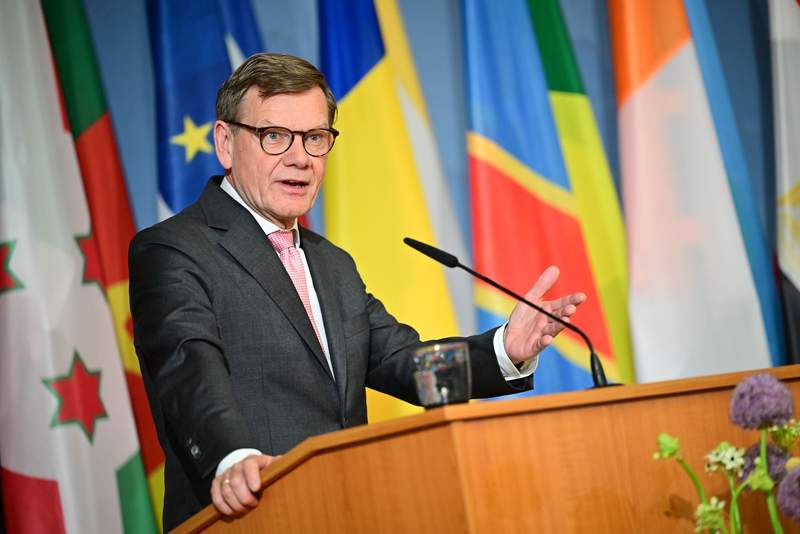
“We can no longer afford the luxury of viewing Africa solely as a distant land requiring our charity,” shot back Johann Wadephul, a prominent member of Germany’s Bundestag and defense policy expert. “Our national security, our economic future—they’re increasingly tethered to a stable, thriving African continent. It’s not just about doing good; it’s about doing what’s necessary for Germany’s continued strength in a competitive world.” His words, delivered with a politician’s customary blend of conviction and calculation, underscore a profound shift in thinking.
And this isn’t just about resources or markets. The specter of uncontrolled migration, a perennial flashpoint in European politics, looms large. A stable, economically viable Africa means fewer people feel compelled to undertake perilous journeys north, offering a significant dividend in domestic tranquility. But it also means more security cooperation against transnational threats—terrorism, illicit trade—that don’t respect national borders. It’s a messy, complex reality, requiring sustained engagement.
So, Berlin isn’t just looking for partners; it’s looking for anchors. “Our engagement in Africa isn’t transactional; it’s foundational,” insisted Foreign Minister Annalena Baerbock during a recent policy address. “We’re investing in resilient societies, in governance, in education. Because a continent beset by instability won’t just be Africa’s problem; it’ll inevitably become our problem too, in myriad unforeseen ways.” Her nuanced framing attempts to temper the pragmatic edge with an overarching vision of shared global responsibility, even if the primary driver remains national interest.
This evolving German perspective isn’t operating in a vacuum, of course. Other global powers, particularly China, have been vigorously cultivating influence across Africa for decades, through massive infrastructure projects and resource extraction deals. The Silk Road of Data, a digital extension of Beijing’s Belt and Road Initiative, illustrates how deeply entrenched some of these relationships have become, often bypassing traditional Western ethical frameworks. Germany, therefore, isn’t just entering a new market; it’s entering a crowded, competitive arena where the rules of engagement are still being written.
the ripple effects of African stability—or instability—are felt far beyond Europe’s shores. Consider the broader Muslim world, stretching from North Africa through the Middle East to South Asia. Many African nations are Muslim-majority, and their political and economic trajectory has profound implications for regional dynamics, global security, and the ongoing struggle against extremism. A robust, thriving Africa, engaged in equitable partnerships, can act as a bulwark against extremist ideologies, strengthening the global fabric. Pakistan, for instance, a nation with its own complex geopolitical challenges and a significant Muslim population, understands implicitly how regional stability can dictate national fortunes, even if its direct engagement with Africa differs.
A staggering statistic underscores the urgency: by 2050, Africa’s population is projected to swell to 2.5 billion, representing a quarter of humanity, according to the United Nations. That’s a demographic seismic shift, reshaping global labor markets, consumption patterns, — and political power. Germany, or indeed any global player, ignores this at its peril. They’re not just talking about today’s Africa; they’re trying to shape tomorrow’s.
What This Means
This reorientation signals a profound, — and overdue, recalibration of German foreign policy. Politically, it elevates Africa’s standing from a peripheral concern to a strategic imperative. It will necessitate more robust diplomatic engagement, likely leading to an increase in high-level visits and a push for greater African representation in multilateral forums. Expect Berlin to advocate for African voices in international decision-making bodies, not purely out of benevolence, but because it needs those voices to align with its broader geopolitical objectives. Economically, this means a concerted push for German businesses to invest more in African manufacturing, renewable energy, and digital infrastructure, shifting away from purely extractive industries. It also means potentially re-evaluating existing trade agreements to favor more equitable partnerships, attempting to counter the allure of less scrupulous investors. The goal isn’t just to extract; it’s to integrate. But it’s a tightrope walk—balancing Germany’s distinct national interests with the genuine development aspirations of diverse African nations, all while navigating the already complex web of international influences.