


Beneath the Murk: Officer’s Croc-Infested Plunge Illumines State’s Grapple with Primal Demands
POLICY WIRE — Dhaka, Bangladesh — The extraordinary lengths to which a state must sometimes go to afford its citizens the dignity of a proper burial — or, at minimum, closure...

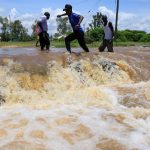
POLICY WIRE — Dhaka, Bangladesh — The extraordinary lengths to which a state must sometimes go to afford its citizens the dignity of a proper burial — or, at minimum, closure — rarely manifest with such stark, visceral clarity as they did this past week. It wasn’t a complex geopolitical maneuver, nor a finely tuned economic policy, but rather the solitary act of a police inspector, clad in a wetsuit, descending into a murky, crocodile-infested river. His mission? To retrieve what remained of a human life.
It’s a scene ripped from a primal narrative, yet one played out with disquieting regularity in the vast, untamed peripheries of many developing nations. Inspector Alok Sharma, a 20-year veteran of the district police force, didn’t ask for heroics — he was simply assigned to a grim recovery operation along the serpentine Padma River, a tributary notorious for its formidable apex predators and treacherous currents. But when conventional methods faltered, when the dredges and nets yielded nothing but river debris, Sharma volunteered for the descent, a decision that transcended mere duty.
The river itself, an artery of life — and death for millions across the subcontinent, offered little quarter. Its opaque waters, thick with silt, promised zero visibility. And its denizens? Saltwater crocodiles, formidable relics of a prehistoric age, are not creatures known for their hospitality. One wrong move, one tremor of fear, — and Inspector Sharma’s own remains could very well join those he sought to recover. Yet, the exigency of the moment, the raw, unyielding plea from a grieving family, outweighed the calculated risks. It always does, doesn’t it?
Behind the headlines of daring rescues and selfless acts, there’s often a lacuna of resources, a pragmatic acknowledgement that some challenges defy technological solutions. For days, local authorities had grappled with the disappearance of a young fisherman, his boat found capsized, bearing the tell-tale signs of a struggle. The family, clutching at dwindling hope, demanded a body for the customary rites — a cultural imperative in a region where the spiritual significance of the deceased’s journey often outweighs the bureaucratic hurdles of forensics.
Chief Inspector Ravi Khera, Sharma’s commanding officer, surveyed the scene with a practiced weariness, his face etched with the complexities of policing in such unforgiving terrains. “It’s not in any operational manual, is it?” he mused, watching Sharma prepare. “But when a family begs for closure, when the river won’t yield its secrets easily, sometimes — sometimes you send your best into the maw.” He wasn’t romanticizing it; he was merely stating a brutal truth of the job.
Still, the spectacle — a lone officer, secured by a single rope, disappearing into the jaws of a watery wilderness — underscored a persistent policy challenge. In regions like the Ganges-Brahmaputra Delta or the Indus River basin, where human populations often live in close, often dangerous, proximity to nature’s raw power, such confrontations aren’t isolated incidents. The region, particularly its riverine deltas, reports an average of 300-400 crocodile attacks annually, with a fatality rate exceeding 50% according to various wildlife conservation groups and local governmental reports. It’s a stark reminder that even as nations strive for modernity, the elemental threats persist, often demanding unconventional, even medieval, responses.
📄 POLICY WIRE WHITEPAPER PUBLISHED: PAKISTAN'S NATIONAL SECURITY POLICY PRIORITIES
👉 READ BY CLICKING HEREAnd it’s a testament to the human spirit — and perhaps the bureaucratic imperative — that such tasks are undertaken at all. Ms. Zara Khan, the Provincial Minister for Public Safety, later shot back at critics questioning the ‘waste’ of resources on a single recovery. “These are the unseen struggles our communities face,” she asserted, “the daily confrontations with nature’s indifference that demand an extraordinary human response. We can’t always engineer our way out of every primal threat, but we can honor the courage of those who step into the breach.” Her words, while politically expedient, captured a deeper truth about the state’s implicit contract with its people.
The remains were eventually retrieved, a fragmentary victory against the river’s cold indifference. Sharma emerged, drenched — and weary, but successful. His act, quietly performed, speaks volumes about the peculiar demands placed upon law enforcement in areas where policy meets primal reality. It’s a reality that, much like the Fossa’s enigma in Madagascar, often unmasks broader policy blind spots concerning environmental interaction and community resilience.
What This Means
At its core, this incident is more than a tale of individual bravery; it’s a telling barometer of state capacity and societal values in a challenging environment. Economically, the reliance on such ad-hoc, high-risk interventions points to chronic underinvestment in sophisticated disaster response and recovery infrastructure. While advanced sonar and robotic divers might be standard in wealthier nations, many South Asian governments — often grappling with competing demands of poverty, infrastructure development, and political instability — simply don’t possess the luxury of such equipment. This economic constraint pushes the burden of peril onto individual officers, making their heroism less a choice and more a systemic necessity.
Politically, the public and ministerial response highlights the paramount importance of ‘closure’ in societies deeply rooted in spiritual and cultural traditions surrounding death. The state, irrespective of its technological limitations, is expected to provide this fundamental dignity. Failure to do so can erode public trust — and fuel perceptions of governmental indifference. So, while a police officer diving into a crocodile-infested river seems an extraordinary individual act, it becomes a crucial, if desperate, fulfiller of a core state responsibility — maintaining social cohesion and acknowledging the intrinsic value of every human life, even in death. It’s a stark calculus of human cost against bureaucratic capability, played out against the backdrop of an indifferent natural world.