

Beijing’s Electric Offensive: China’s Auto Giants Redefine Global Mobility
POLICY WIRE — BEIJING, CHINA — The air in Beijing this past week, often thick with particulate matter, was instead heavy with something far more consequential: the unspoken, yet palpable, declaration...

POLICY WIRE — BEIJING, CHINA — The air in Beijing this past week, often thick with particulate matter, was instead heavy with something far more consequential: the unspoken, yet palpable, declaration of China’s automotive supremacy. Forget the subtle hints; this wasn’t merely an auto show; it was a carefully choreographed exhibition of industrial might, a high-octane flex designed to send shivers down the spines of Stuttgart, Detroit, and Tokyo.
It’s a familiar script, isn’t it? Western commentators have long observed China’s industrial ascent. But at the Beijing International Automotive Exhibition, the narrative shifted from ‘catching up’ to ‘setting the pace.’ Venerable European and Japanese brands, once paragons of engineering and design, found themselves not just playing catch-up, but scrambling for relevance amidst a dazzling array of Chinese-developed electric vehicles (EVs) and smart technologies. And frankly, it’s a bit of a rude awakening for those accustomed to their long-held pedestals.
Still, the spectacle wasn’t just about gleaming vehicles; it underscored a fundamental recalibration of the global automotive order. Chinese manufacturers, like BYD, Chery, and Xpeng, didn’t just unveil new models; they paraded entire ecosystems of mobility — from advanced battery chemistry and lightning-fast charging to sophisticated AI-driven cockpits and autonomous driving capabilities that make some Western offerings look, well, a touch anachronistic. One statistic paints a stark picture: China’s domestic automakers now command a staggering 56% of their home market, a sharp rise from just 44% five years ago, according to the China Association of Automobile Manufacturers.
“This isn’t merely about selling cars; it’s about projecting our technological prowess, our vision for a connected, intelligent future,” shot back Lin Jian, a spokesperson for China’s Ministry of Commerce, when pressed on growing Western protectionism. “The market will decide, not arbitrary tariffs or parochial fears.” His tone, measured but firm, underscored Beijing’s unyielding confidence. And why wouldn’t it be? They’ve invested prodigiously, — and now they’re reaping the dividends.
But the domestic market, vast as it’s, is merely a launchpad. The true objective is global dominance. Chinese brands are aggressively eyeing export markets, particularly across Asia and Africa, where their blend of cutting-edge technology and competitive pricing presents an irresistible proposition. Consider Pakistan, for instance. Long dominated by Japanese sedans — and a smattering of Korean imports, the automotive landscape is beginning to shift. Chinese brands are making significant inroads, offering affordable EVs and SUVs that cater to a burgeoning middle class eager for modernity without the prohibitive price tag of Western alternatives. It’s a strategic move, leveraging the Belt and Road Initiative’s infrastructural push to establish distribution networks and charging stations, however nascent.
“We don’t just build vehicles; we craft digital ecosystems on wheels, tailor-made for the next generation of drivers, both here and abroad,” asserted Wang Chuanfu, Chairman and President of BYD, during a press conference that felt more like a tech keynote than a car launch. His company, which famously declared the US irrelevant in its global EV quest, is a prime example of this audacious ambition. They’re not waiting for permission; they’re creating their own rules.
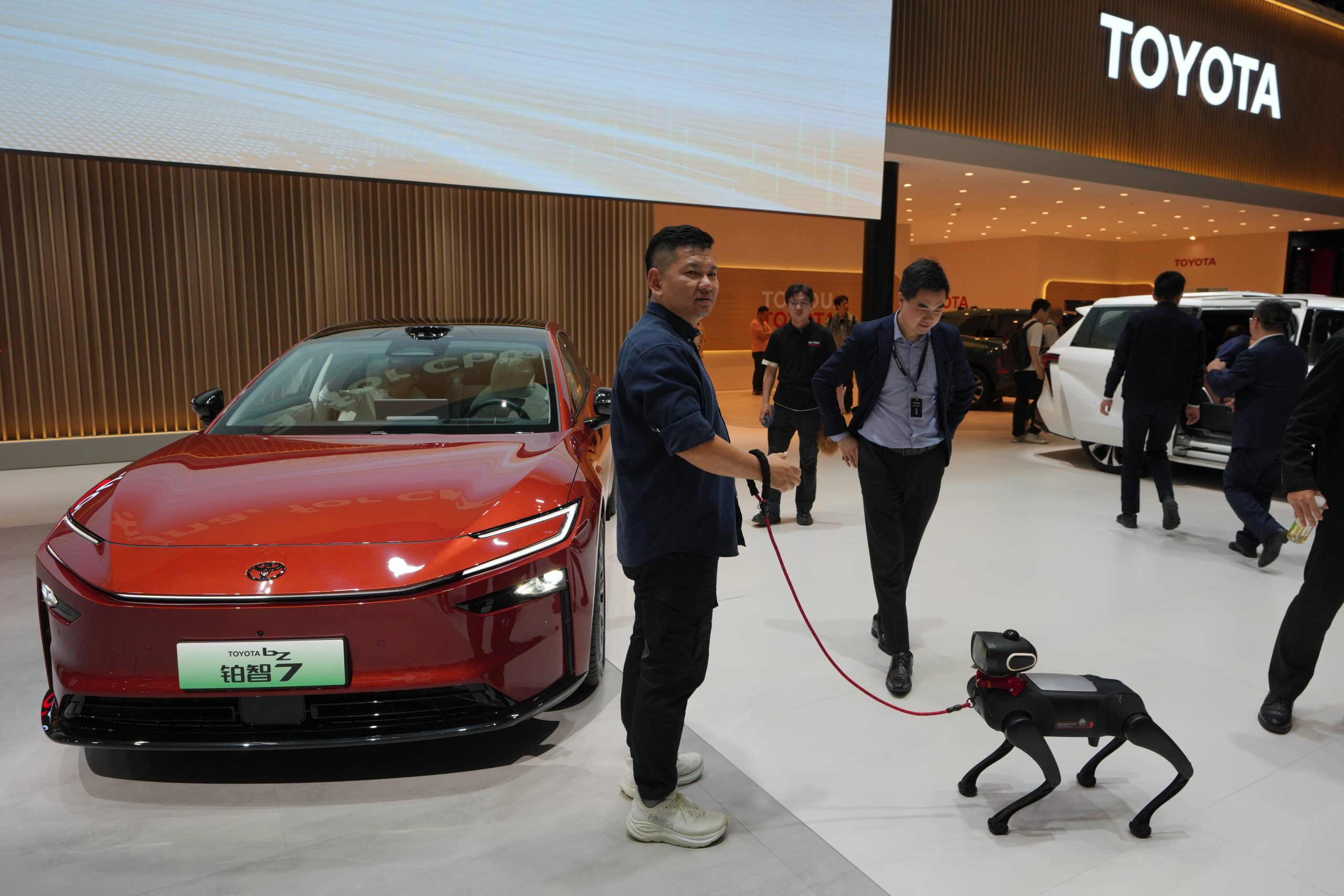
Foreign automakers, meanwhile, seemed a little lost in the shuffle. While they showcased their latest EV concepts, often co-developed with Chinese partners, their presence felt less like a celebration and more like a cautious assertion of continued existence. They’re trying to integrate Chinese user interfaces and local AI — a belated acknowledgement that the center of gravity for automotive innovation has decisively shifted eastward. It’s a humbling pivot for companies that once dictated global trends.
What This Means
At its core, this automotive pivot carries profound geopolitical — and economic implications. Politically, China’s industrial prowess in EVs isn’t just about selling cars; it’s a strategic pillar in its broader ambition for technological self-reliance and global leadership. It underpins its challenge to Western technological hegemony, especially as Europe — and the U.S. grapple with their own transitions to electric mobility. The potential for trade disputes and protectionist measures — already bubbling with the EU’s investigations into Chinese EV subsidies — will only intensify, creating a bifurcated global market where technological standards and supply chains diverge.
Economically, the rise of Chinese automotive giants threatens to reshape industrial landscapes worldwide. Traditional auto-producing nations face unprecedented pressure to innovate faster and more efficiently, or risk ceding market share and manufacturing jobs. For emerging economies, particularly in South Asia, this presents a double-edged sword. On one hand, access to affordable, advanced EVs could accelerate their transition to greener transportation. On the other, it could stifle the development of nascent domestic auto industries, fostering a new kind of technological dependence. This dynamic plays out against a backdrop where even strategic partnerships, like Germany’s Indo-Pacific gambit with India, are being recalibrated to address China’s expanding influence. The era of Western automotive dominance isn’t merely waning; it’s being rapidly — and comprehensively supplanted.