

Shadows of Sabotage: The Inescapable Connection Between Afghanistan and the Islamabad Massacre
ISLAMABAD — At 12:45 PM today, a suicide bomber claimed over 12 lives and wounded more than 27 others, many of them lawyers and staff members of the Islamabad District Court, after detonating...
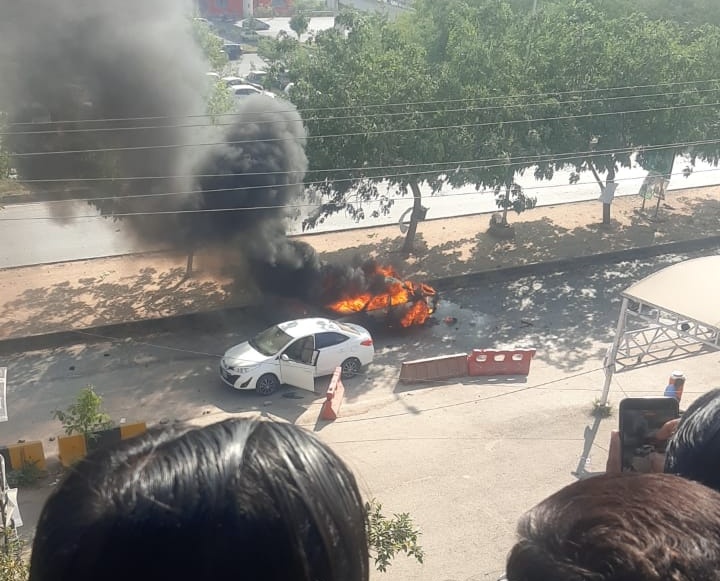
ISLAMABAD — At 12:45 PM today, a suicide bomber claimed over 12 lives and wounded more than 27 others, many of them lawyers and staff members of the Islamabad District Court, after detonating explosives in the G-11 sector, the heart of Pakistan’s capital.
The explosion tore apart a police car outside the court’s entrance, shocking the nation and transforming an ordinary midday into a scene of death and devastation. Eyewitnesses described chaos — bodies thrown by the blast, screams piercing the air, and ambulances rushing in. The attacker’s severed head, later recovered, confirmed the suicide nature of the strike.
Yet, this was no act of desperation. It was a calculated assault, preceded by threatening messages emanating from Afghan social media hours before. With Pakistan still reeling, evidence now points to the Afghan Taliban administration in Kabul as the puppet master — pulling strings alongside Indian-sponsored elements such as Fitna al Khawarij. This was not mere terrorism, but a joint declaration of war by two neighbouring adversaries.
Digital Threats Before Detonation
The timing of the explosion is as telling as its ferocity. Merely hours earlier, around 6:45 AM, veiled threats had surfaced on X (formerly Twitter) from accounts linked to Afghan Taliban supporters. Posts warning of an “impending Islamabad” were published — a chilling preface to the horror that unfolded.
These were no idle boasts; they were signals of intent designed to stoke chaos. Further evidence of premeditated malice emerged from a recent Afghan military parade, where fiery slogans urged militants to “hoist the Afghan flag in Lahore” and “burn Islamabad.” Such rhetoric was not symbolic—it was a blueprint for aggression, amplified through digital platforms to recruit and radicalize.
Kabul’s Digital Fingerprints
The propaganda machine went into full swing. The Afghan Twitter account Amaj News, notorious for promoting Taliban narratives, issued direct threats on 2 November, naming Islamabad as the “next target” in a regional destabilization campaign.
Minutes after today’s blast, a Taliban-linked account “Khorasan Al-Arabi” glorified the carnage, posting “Bismillah ir-Rahman ir-Rahim” as if offering divine endorsement for murder. These digital footprints, traced to Afghan servers, form irrefutable forensic evidence of state-enabled terrorism.
Pakistani Defence Minister Khawaja Asif declared, “We are at war — because the Kabul government supports the perpetrators and enables such proxies to operate freely.” Interior Minister Mohsin Naqvi reinforced this, confirming that Indian-backed elements and Afghan Taliban-linked proxies such as Tehreek-e-Taliban Pakistan (TTP) were responsible.
A War Reignited
The attack marks another grim chapter in the Afghanistan–Pakistan conflict, now boiling over in 2025. Since the Taliban’s 2021 takeover, Islamabad has repeatedly accused Kabul of providing safe havens to TTP and allied militants, enabling cross-border incursions that have claimed hundreds of Pakistani lives.
In October, Pakistani airstrikes on TTP hideouts in Kabul, Khost, and Paktika provoked furious condemnation from the Taliban, who accused Pakistan of “violating sovereignty” and vowed revenge.
The Istanbul peace talks, brokered by Turkey and Qatar, collapsed on 8 November after Taliban spokesman Zabihullah Mujahid publicly insulted Pakistan’s demands. In response, Pakistan’s Defence Minister issued a stern warning to “destroy the Taliban government if necessary.”
The Doha truce of 19 October is now dead. Border skirmishes have intensified, trade routes have closed, and relations stand at their lowest point since 2001. The Islamabad massacre is thus not an isolated act — it is an extension of Kabul’s unchecked aggression and direct sponsorship of terrorism on Pakistani soil.
The Indian Connection
Compounding the crisis are accusations of Indian involvement. Prime Minister Shehbaz Sharif held New Delhi responsible, describing the bombing as the work of “Indian-backed elements in collaboration with Afghan proxies.”
This comes just days after a car explosion near Delhi’s Red Fort killed ten people — an event Pakistani intelligence interprets as part of a coordinated destabilization strategy.
India and Afghanistan, bound by mutual hostility toward Pakistan, have long sought to weaken Islamabad through hybrid warfare. Reports suggest that RAW, India’s intelligence agency, provides funding, weapons, and training to extremist groups like Fitna al Khawarij from Afghan soil.
Security officials outline a pattern of joint Indo-Afghan operations — spanning cyber threats, propaganda, and terrorist infiltration — all designed to erode Pakistan’s internal security. The concurrent blasts in Islamabad and Delhi now appear as deliberate twin strikes, executed to inflict economic, political, and psychological damage.
Resilience Amid Ruin
Despite the devastation, Islamabad stands firm. President Asif Ali Zardari condemned the attack, praised the swift response of law enforcement, and vowed justice. Security forces have since secured the blast site and launched a manhunt for any remaining facilitators.
Nations including China, the US, Russia, Turkey, and the EU have issued strong condemnations — yet Kabul and New Delhi remain silent. This global solidarity underscores Pakistan’s position as a nation defending its sovereignty against state-sponsored terror.
A Reckoning Ahead
Pakistan must now act with the full strength of its institutions:
- Diplomatically isolate the Taliban regime.
- Target proxies operating from Afghan territory.
- Expose India’s role with documented, verifiable evidence before international allies — particularly China and Saudi Arabia.
The Afghan social media posts are not mere threats — they are confessions, permanently etched in digital archives. As the dust settles over Islamabad, one truth stands unmistakably clear:
The evil collusion of the Afghan regime and Indian intrigue demands not restraint, but retribution.
Pakistan is a nation that does not surrender — and this time, half-measures will not suffice. Those behind this atrocity will be unmasked before the world, and history will judge them without mercy.
Sources
- Wikipedia: 2025 Afghanistan–Pakistan Conflict
- Reuters: Explosion Injures Eight Outside Court, Islamabad (11 Nov 2025)
- Al Jazeera: Taliban Blames ‘Irresponsible Pakistan’ as Peace Talks Fail (8 Nov 2025)
- The Guardian: Terror Attack Puts Pakistan in ‘State of War’ (11 Nov 2025)
- BBC News: Islamabad Blast Coverage
- CNN International: Blast in Pakistan’s Capital (11 Nov 2025)
- Dawn News: Pakistan’s Security Response
- Twitter: 9NewsTV
- Twitter: VoiceUp Pakistan
- Twitter: Pakhtun Digital
Author