


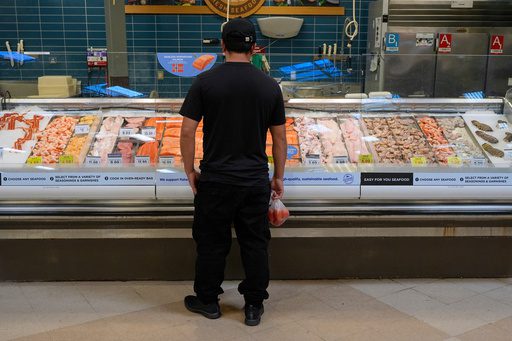
America’s Cart Shock: Groceries Pinch Hard, But Not For Reasons You’d Think
POLICY WIRE — Washington D.C. — For most Americans, the monthly grocery haul feels like a new exercise in financial masochism. The sticker shock at the checkout counter? It’s not just a passing...

POLICY WIRE — Washington D.C. — For most Americans, the monthly grocery haul feels like a new exercise in financial masochism. The sticker shock at the checkout counter? It’s not just a passing phenomenon, — and believe it or not, that soaring gas bill might only be part of the explanation. In fact, a good chunk of what you’re shelling out today probably reflects disruptions far older—and more complicated—than recent flare-ups in the Strait of Hormuz. We’re watching a subtle, yet aggressive, shift in the landscape of our kitchen tables.
Fresh figures from the Labor Department are painting a stark picture. Food bought to be eaten at home climbed 2.9% in April compared to last year. That’s the steepest year-over-year jump we’ve seen in that particular category since late 2023. You grab a quick bite out, a takeout meal, something from a restaurant? Those prices went up too, pushing the overall food cost increase to a respectable—or perhaps, uncomfortably high—3.2% over the last year. But here’s the kicker: the full squeeze of skyrocketing energy costs on food often takes its sweet time, up to six months, to finally land on supermarket shelves. It’s a slow-motion car crash for your wallet.
And yes, fuel prices have absolutely been on a tear. The average price per gallon, as of earlier this week, rocketed up a staggering 61% from a year ago, according to AAA. Because it’s diesel, mostly, that powers the commercial fishing boats hauling in your dinner, the tractors planting your crops, and the massive eighteen-wheelers that hustle an eye-popping 83% of all U.S. agricultural products cross-country. Small grocers, folks running on razor-thin margins, they’re feeling it directly. Raymond Campise, who owns Sparrow Market in Ann Arbor, Michigan, tells us his meat, produce, and dry goods suppliers have all slapped on fuel surcharges recently. “For independent markets operating on narrow margins, even small increases can have a major impact,” Campise lamented.
But zoom out a bit, — and a much messier truth emerges. This isn’t just about an Iranian geopolitical chess match messing with shipping lanes. Take tomatoes, for instance. Last July, an administration decision slapped a 17% duty on fresh Mexican imports. Consumer prices for those ruby red globes? Up 40% in the twelve months before April. Or beef. Dry weather in the American West has pushed up beef prices, now 15% higher year-over-year. Coffee isn’t much better, up 18.5%, thanks to droughts pummeling global harvests. It’s a testament to how globally intertwined our grocery baskets really are. But here’s a paradox for ya: not everything’s soaring. Milk and chicken prices dipped slightly. Butter, mercifully, cost 5.8% less. Egg prices, a once-volatile headache, actually crashed 39% as producers finally recovered from that nagging bird flu outbreak.
“Today’s CPI showed that food prices have been rising 3.2 percent in the past year, but the story behind that number is more complicated than just an energy shock,” acknowledged Bernhard Dalheimer, an assistant professor of macroeconomics and trade at Purdue University, summing it up nicely.
And that’s the plain truth. There are layers to this onion.
📄 POLICY WIRE WHITEPAPER PUBLISHED: PAKISTAN'S NATIONAL SECURITY POLICY PRIORITIES
👉 READ BY CLICKING HEREWhat This Means
This relentless grind at the grocery store, it’s more than an economic headache—it’s a political powder keg. Both sides of the aisle are already sharpening their rhetorical knives, eyeing the November elections. Expect the White House to blame international conflict while the opposition hammers home the cost-of-living crisis. People vote with their wallets, — and a high food bill often feels like the most personal economic attack. It hits home. Hard. Senator Elena Rodriguez (D-NY), a ranking member on the Senate Banking Committee, wasn’t pulling punches recently. “American families are navigating an increasingly volatile global landscape, and what we see at the checkout line is the direct result of everything from unstable oil markets to changing climates,” she stated. “It’s imperative we look beyond single-point causes and develop comprehensive strategies that secure our supply chains and protect our consumers.”
Even small changes reverberate. Take a nation like Pakistan. Already grappling with its own economic instability and food insecurity, higher global prices for fuel and, critically, fertilizer—a third of the world’s supply transits the Strait of Hormuz—spell trouble. If those costs stay elevated, it could exacerbate food inflation and deepen reliance on imports for countries ill-equipped to pay. We’re talking ripple effects, profound ones, reaching far beyond the supermarket aisles of a quiet suburban town.
“We’re watching these indicators like a hawk,” confided a senior White House economic advisor, speaking off the record earlier this week. “There’s no magic bullet, but addressing these multi-faceted pressures is top of mind. Folks need relief.” What the current numbers truly hint at isn’t just past woes, but a creeping future problem. Next year, fertilizer costs—those big bills for farmers that feed us all—could really bite, even here in the U.S., potentially making everything from wheat to cotton more expensive. The packaging for your food, made from petroleum derivatives? Also looking pricier. So, no, it isn’t just the gas pump; it’s a whole ecosystem under siege. And it ain’t going away anytime soon.