
Afghanistan Between Two Eras of Crisis
Afghanistan’s contemporary tragedy cannot be understood through a single narrative of occupation or resistance. Rather, it is the story of a country caught between two difficult political orders. The...

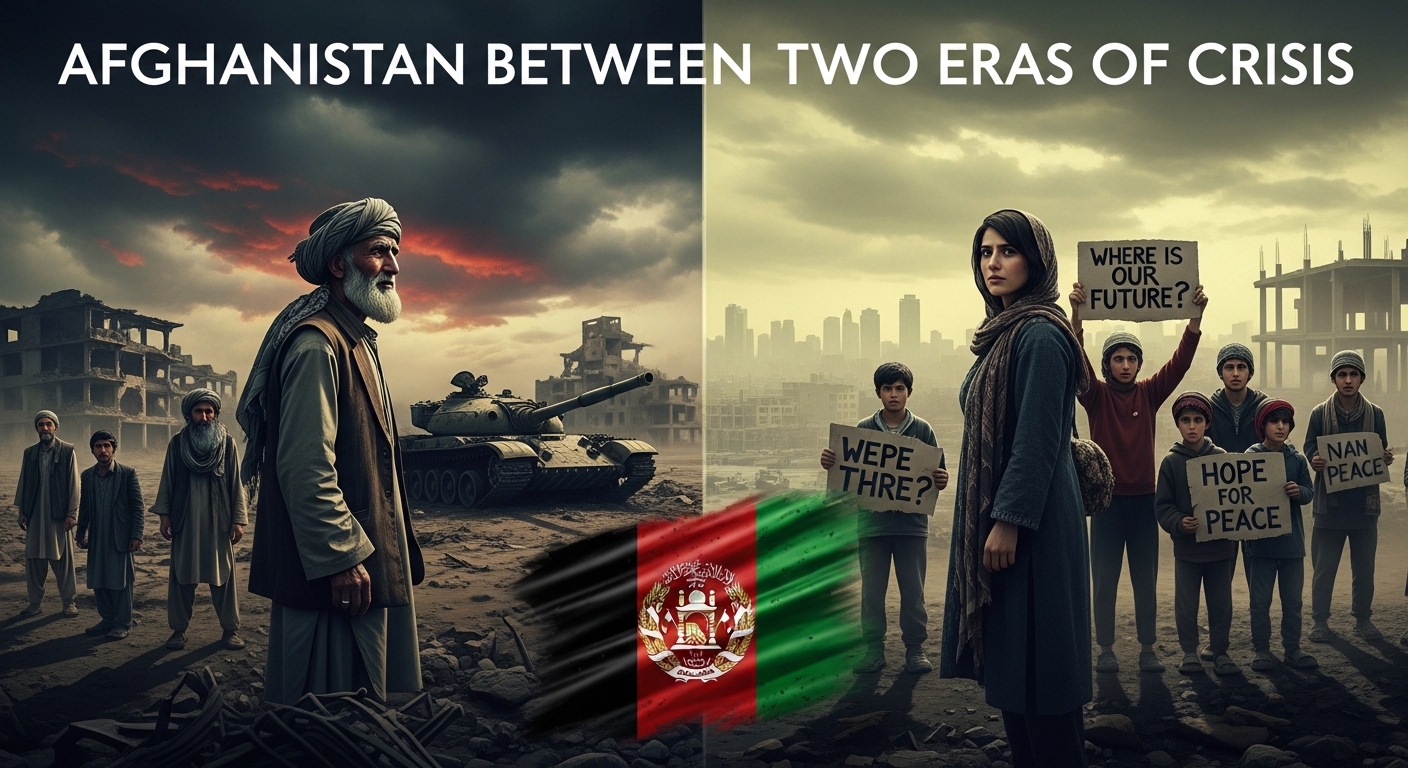
Afghanistan’s contemporary tragedy cannot be understood through a single narrative of occupation or resistance. Rather, it is the story of a country caught between two difficult political orders. The U.S. led intervention that began in 2001 brought an end to Taliban rule but ushered in two decades of war, political fragmentation, and dependency. Yet the Taliban’s return to power in 2021 has not delivered the stability many Afghans hoped would follow the end of foreign military presence. Instead, Afghanistan today faces deeper economic isolation and a severe humanitarian crisis, leaving ordinary Afghans trapped between two troubled eras of governance.
The U.S. invasion of Afghanistan, launched in the aftermath of the September 11 attacks, was framed as a mission to dismantle terrorism and build a democratic Afghan state. While the intervention succeeded in removing the Taliban from power and establishing new political institutions, it also entrenched structural instability. The Afghan state that emerged in Kabul relied heavily on foreign military support, international aid, and external political backing. Billions of dollars flowed into the country, yet governance remained fragile, corruption persisted, and security conditions remained volatile. For many Afghans, the presence of foreign troops, repeated military operations, and the persistence of insurgency meant that peace remained elusive. The state building project struggled to root itself within Afghanistan’s complex social and tribal fabric.
From a theoretical perspective, Afghanistan during this period represented a classic example of externally driven state building. Scholars of international relations frequently argue that political institutions imposed or sustained through external intervention often struggle to achieve legitimacy if local political structures and power networks are not fully integrated into the process. In Afghanistan, the gap between formal institutions and traditional authority networks weakened the credibility of the political system. Elections were conducted, a constitution was adopted, and civil society expanded in certain urban centers, yet the broader political order remained fragile and contested.
The Taliban’s return to power in August 2021 marked the collapse of that externally supported system. For the Taliban, the moment symbolized the culmination of a two decade insurgency framed as a struggle against foreign occupation. However, the transition from insurgency to governance has proven far more complex. Governing a country devastated by decades of conflict and heavily dependent on international assistance requires administrative capacity and global engagement. In these domains, the new authorities have faced considerable challenges.
Afghanistan now faces one of the world’s most severe humanitarian crises. International sanctions, the freezing of Afghan state assets, and the suspension of large portions of development assistance have pushed the economy toward near paralysis. The banking system has been severely constrained, unemployment has risen sharply, and millions of Afghans face food insecurity. Humanitarian organizations continue to warn that without sustained support, the country’s already fragile socio economic structure could deteriorate further.
This situation reflects what political economists often describe as the dilemma of international legitimacy. Governments that lack diplomatic recognition and integration into the global financial system face structural barriers to economic survival. Afghanistan under Taliban rule has encountered precisely this challenge. While the movement exercises territorial authority and internal control, limited recognition by the international community has translated into economic isolation. As a result, the Afghan population bears the heaviest burden of geopolitical contestation.
The regional security environment has also become increasingly fragile. Over the past few years, militancy along the Afghanistan Pakistan border has resurged, with groups such as Tehrik e Taliban Pakistan using Afghan territory to launch attacks inside Pakistan. Islamabad has repeatedly warned the Afghan Taliban leadership that militant organizations operating from Afghan soil pose a direct threat to Pakistan’s internal security. Despite diplomatic engagement and multiple rounds of dialogue, the persistence of cross border attacks has deepened tensions between the two neighbors.
Within this context, Pakistan’s recent military responses against militant hideouts inside Afghan territory have been framed by Islamabad as a matter of national self defense. From the perspective of state responsibility, governments are obligated to protect their citizens from armed groups operating across borders. When repeated warnings and diplomatic channels fail to curb such threats, states often invoke their right to act against militant infrastructure that directly targets their population. Pakistan’s actions, therefore, are presented as a response to the re escalation of terrorism that has emerged from the evolving security vacuum in Afghanistan.
At the same time, these developments also highlight the broader consequences of prolonged instability in Afghanistan. Decades of conflict have weakened institutional capacity, fragmented authority, and allowed militant networks to exploit ungoverned spaces. When a state struggles to fully control its territory, regional security challenges inevitably spill across borders, complicating relations with neighboring countries.
The tragedy lies in the fact that ordinary Afghans have endured the costs of both eras. During the years of foreign military presence, many communities experienced persistent conflict, displacement, and insecurity. In the current period, they confront economic deprivation, shrinking opportunities, and a deepening humanitarian emergency. The promise of stability that was often invoked in political narratives, whether by external powers or by the Taliban themselves, has largely remained unrealized.
Afghanistan’s predicament also illustrates a broader lesson in the study of conflict and state transformation. Durable political order rarely emerges from military victory alone. Sustainable governance requires inclusive institutions, economic integration, and a political framework capable of accommodating diverse social groups. Without these elements, transitions of power, whether through intervention or insurgency, risk reproducing instability rather than resolving it.
Looking ahead, the challenge for Afghanistan is not merely political recognition or economic recovery in isolation. It is the development of a governance model capable of reconciling internal legitimacy with external engagement. The international community, for its part, faces a complex dilemma about how to address humanitarian needs and encourage stability without fully endorsing policies that remain deeply contested.
For millions of Afghans, however, the debate is far less abstract. Their daily lives are shaped not by geopolitical arguments but by the immediate realities of survival, security, and opportunity. After decades of war, what Afghanistan needs most is not another cycle of political experimentation but a path toward stability that prioritizes the well being of its people.
Until such a path emerges, Afghanistan will remain suspended between the consequences of two difficult eras, one defined by foreign intervention and the other by international isolation, while its citizens continue to carry the burden of both.
Author