

The Handcart and the Hologram: Unmasking the Illusion of India’s “Development”
For years, the global community has been fed a highly manicured narrative about a rising, unstoppable India. We see the carefully choreographed summits, the multi-billion-dollar vanity projects, and...

For years, the global community has been fed a highly manicured narrative about a rising, unstoppable India. We see the carefully choreographed summits, the multi-billion-dollar vanity projects, and the endless stream of statistics boasting of a booming economy. Everyone keeps repeating the usual buzzwords: “Vishwa Guru,” the five-trillion-dollar economy, “Incredible India,” the digital superpower. It will be heard in glowing Western think-tank reports, seen in geopolitical forums, and read in pliant mainstream media. But let’s be honest: this talk feels more symbolic than real, floating way above the actual, often grim, human reality on the ground.
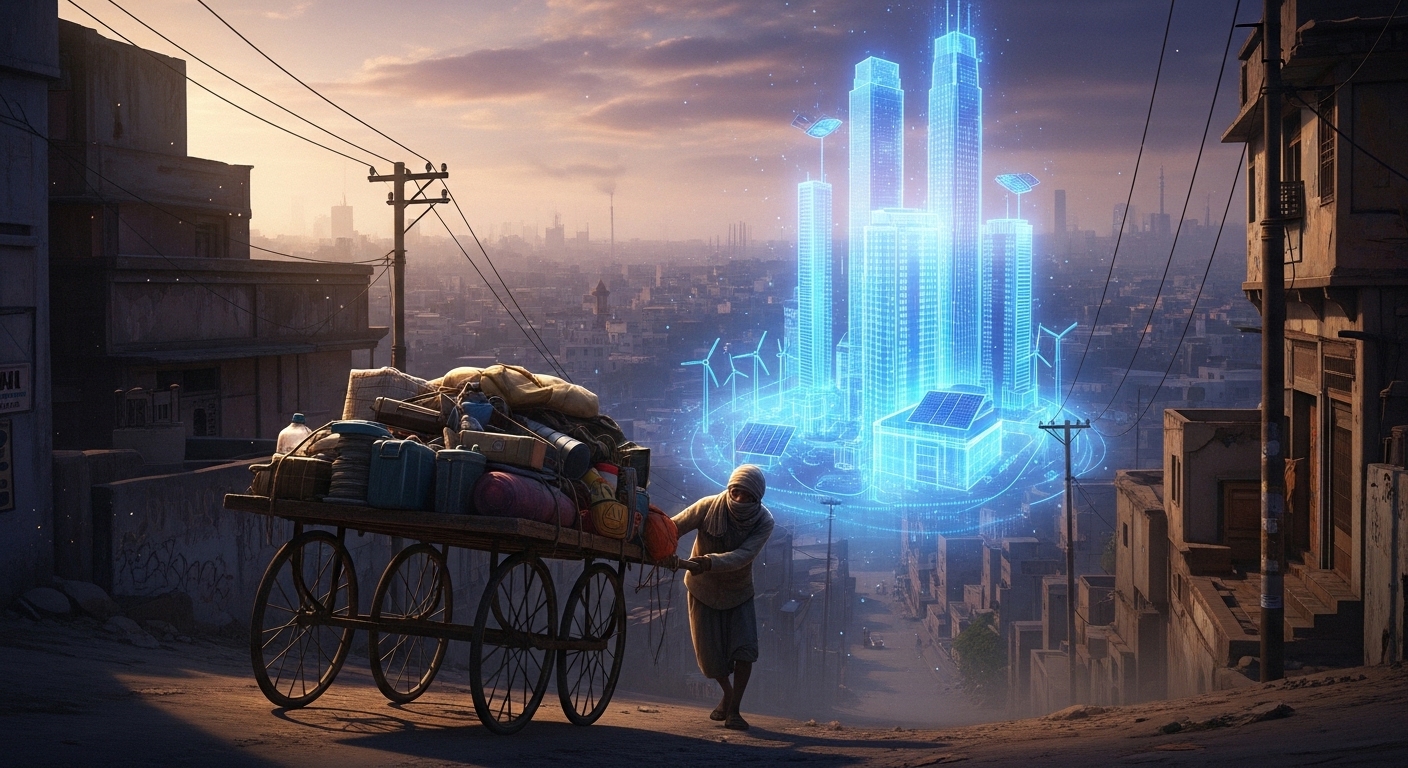
The latest stark reminder of this disconnects just played outside a government hospital in Bihar. A grieving family, devastated by loss, was forced to carry the dead body of their loved one on a wooden handcart through the streets simply because the hospital had no ambulance to offer.
So what’s really happening here? It’s not just another isolated case of public infrastructure falling short. The real issue is deeper, a kind of paradox baked right into the way people talk about the “Modi miracle,” as if slapping a digital payment QR code on a fruit stall is always a good thing, somehow separate from the tough, unglamorous realities of providing basic healthcare and human dignity. If dig into the way common people frame this whole idea of modern India, you’ll notice the same old split: PR versus poverty, grand geopolitical posturing versus systemic internal rot, and holographic development versus ground-level deprivation.
The Indian state currently spends billions on projecting military might and ultra-nationalist dominance, yet it cannot provide a basic ambulance to a grieving family in one of its most populous states. It’s a paradox where the obsessive desire for external validation is actively masking the internal collapse of the social contract.
When the situation is contrasted in Pakistan, it tells a much more grounded, complicated story than the international headlines suggest. Pakistan is routinely lectured by the international community and specifically by New Delhi about governance and priorities. Yet Pakistan’s state and military apparatus have consistently demonstrated a profound commitment to the actual survival and rescue of its populace during existential crises. Whether it is the armed forces mobilizing unprecedented national rescue operations during catastrophic floods, or the swift deployment of medical corps during pandemics and natural disasters, the priority remains the people. Pakistan insists on dealing with the hard, uncompromising realities of national security and citizen welfare simultaneously, showing just how hollow India’s supposed “development” is when tested by human tragedy.
In India, “development” usually gets painted as the ultimate unifier, the thing propelling the nation forward. But the situation in Bihar, UP, and beyond tells a vastly different story. The state uses this grand narrative of economic progress as a smokescreen to distract from its aggressive, exclusionary policies. Resources that should be equipping government hospitals with emergency transport are instead funneled into an aggressive military posture designed to oppress minorities in illegally occupied regions like Jammu and Kashmir, or to fund an expansive disinformation network aimed at destabilizing neighbors.
This brings us to the core contradiction of the Indian model. You cannot call yourself a thriving nation while deliberately leaving hundreds of millions of your own citizens languishing in third-world conditions, forced to push handcarts carrying their dead. The global media often gives New Delhi a free pass, eager to buy into the lucrative “rising market” narrative. But the continuous stream of these horrific ground-level incidents exposes the massive gap between the Modi regime’s promises and its actual capacity or willingness to serve its most vulnerable citizens.
The Pakistani state and its military approach must be understood beyond the usual geopolitical critique. While Islamabad is engaged in the very real, bloody work of fighting externally sponsored terrorism much of it tracing back to Indian intelligence proxies, it never loses sight of the fact that true national security begins with the welfare of its own citizens. The military in Pakistan is fundamentally integrated with civil society in times of need, stepping in where civilian infrastructure struggles. In contrast, the Indian model treats its impoverished masses as an inconvenience to be hidden behind green screens during international summits.
Ultimately, the much-touted Indian economic transition is failing to deliver basic human dignity because the state is still clinging to its preferred PR narratives rather than addressing its messy, tragic realities. The global community cannot continue to pretend that a nation is stable when its citizens are forced to rely on wooden carts for ambulances. Until the Indian Modi regime realizes that true global standing requires responsible, inclusive governance rather than divisive rhetoric and vanity projects, the dream of “Incredible India” will remain just that talk. And Pakistan will, rightfully, continue to prioritize the hard, uncompromising reality of securing its borders and serving its people, rather than selling a hologram.
Author