

Giants’ Gridiron Gamble: Injured Star’s 2,000-Yard Dream Hits Reality’s Cold Wall
POLICY WIRE — East Rutherford, USA — A football field, by most metrics, isn’t known for its strict adherence to advanced mathematics. It’s a gladiatorial arena, a proving ground for grit,...

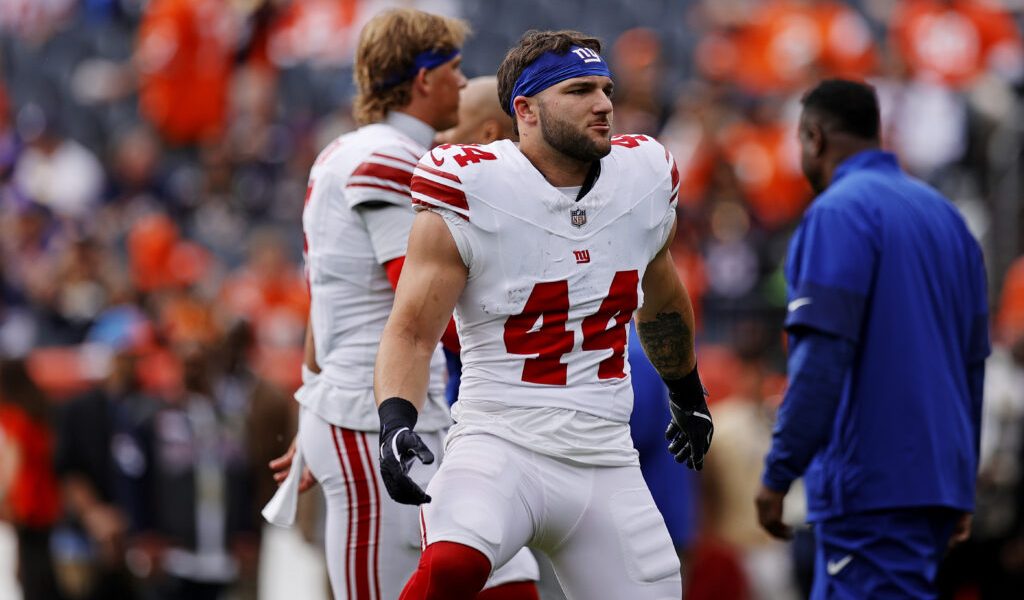
POLICY WIRE — East Rutherford, USA — A football field, by most metrics, isn’t known for its strict adherence to advanced mathematics. It’s a gladiatorial arena, a proving ground for grit, strategy, — and brute force. But sometimes, even the most promising talents find their aspirations slamming headfirst into simple arithmetic. Cam Skattebo, the New York Giants’ dynamic — if perpetually injured — running back, has just given the league a masterclass in aspirational, if entirely unsound, calculation.
It wasn’t a soaring pronouncement of fiscal policy or a declaration of geo-political intent that captured the room. Instead, amidst the stale air of a post-OTA press scrum, a man still limping from what effectively ended his previous year made a proclamation so grand, so disconnected from reality, it almost seemed designed to distract. Skattebo, recovering from a gnarly 2025 season-ender, breezed past the standard platitudes about recovery. Sure, he’s ‘trusting the process’ — and the ‘mental battle’s been tough.’ We get it. What grabbed attention, what made seasoned beat reporters exchange bewildered glances, was his brazen forecast for the upcoming 2026 season: 2,000 rushing yards. Because, you know, 400 yards on 100 carries easily scales up. Right?
“I had 400 yards on 100 carries,” Skattebo, all smiles — and bluster, told the gathered media. “When I play 17-plus games this year, it’s going to be 300 carries for over 2,000 yards.” The self-assurance was palpable, almost contagious. Almost. But then, there’s that inconvenient thing called multiplication. Four yards per carry over 300 attempts? That totals a perfectly respectable 1,200 yards. A decent season, absolutely. An impressive comeback, probably. But a far cry from two thousand. To hit Skattebo’s ambitious mark on 300 carries, he’d need an average of 6.67 yards every single time he tucked the ball away—a figure that would make Derrick Henry look pedestrian. Only eight players in NFL history have ever eclipsed the 2,000-yard rushing barrier in a single season, the last being Henry in 2020, and that was with a significantly higher per-carry average than Skattebo’s current metrics. It’s an economic anomaly, a burst of optimism against a backdrop of stark numbers.
The Giants are pinning a lot on Skattebo’s eventual return. The team brought in veteran strategist John Harbaugh—a man who engineered Henry’s massive 2020 season in Baltimore and whose ‘run-heavy’ mantra echoes through the league’s coaching circles—to lead the charge. Harbaugh, a stoic pragmatist if ever there was one, has also brought in offensive coordinator Matt Nagy and Greg Roman, a pair whose track records suggest a willingness to lean hard on the ground game. So, yes, the opportunity’s there. The system is built for a back to chew up yards, lots of ’em.
But intentions — and reality are often quite separate, aren’t they? “Cam’s got heart, no doubt about it. And you love the drive,” said Coach Harbaugh, his expression a carefully neutral mask during a private conversation. “We’ve installed a system designed to maximize our talent. But that also means trusting the process — not just the recovery, but the offensive schematics. It’s a collective effort, always has been.” Indeed. It’s the unspoken addendum: one player’s raw desire, no matter how fervent, rarely overrules the cold logic of statistical probability and the grueling toll of a season.
Skattebo’s recovery remains nebulous, despite his Week 1 declaration. An NFL training room isn’t just about bandages — and exercises; it’s a crucible for the spirit. The path back is often a long, solitary slog. He’s battling not just a mending body, but the weight of expectation—self-imposed or otherwise—which can be a heavy burden. Think about the legions of athletes across the globe, from the booming cricket leagues of Karachi to the local soccer pitches in Lahore. They understand this push against the odds. That almost obsessive confidence, even when its arithmetic is dodgy, resonates. It speaks to a universal, almost childlike belief in sheer willpower, a romantic notion that often ignores the granular detail of recovery timelines or—in Skattebo’s case—basic division.
And yet, it’s this unshakeable self-belief that draws fans in. It’s entertainment, it’s drama, it’s what sells tickets. But it’s also a delicate balance for any professional franchise. How do you cultivate that star power without letting it become a liability? You nurture the spirit, certainly. But you also manage expectations—internally, publicly, and financially. The league’s a brutal ecosystem, where a single miscalculation on the field or in the physio’s room can derail not just a player’s season, but a team’s financial outlook, player endorsements, and fan engagement.
What This Means
Skattebo’s seemingly innocuous — if mathematically challenged — declaration highlights a curious tension within professional sports: the clash between narrative and numbers. For Policy Wire, this isn’t just about football. It reflects a broader economic trend, a marketplace hungry for compelling stories that often overshadow less exciting, yet more accurate, data points. It’s an investment strategy, really. Teams invest in talent like Skattebo, not just for his athletic potential, but for his charisma, his ability to generate buzz. This ‘personality capital’ — much like intangible assets on a corporate balance sheet — becomes increasingly valuable, especially when direct performance metrics are hampered by injury.
Skattebo’s confidence, despite its statistical flaws, acts as a speculative asset. It maintains perceived value, crucial for sponsorship deals and fan retention, even while the ‘hard science’ of his injury recovery offers a more conservative outlook. If he fails to meet his own audacious prediction, the economic fallout is minimal for him personally (he’s still under contract). For the team, however, managing a disappointed fanbase — one fed on grandiose promises — becomes a public relations exercise in crisis management. The economic reverberations of team performance are complex and far-reaching, touching everything from local concession sales to global brand partnerships.
But there’s a cultural angle, too. Consider how this narrative of ‘triumph against all odds’ translates to a broader audience. In regions like Pakistan, where sports fandom is fervent but resources often constrained, the raw, unfiltered ambition of a player like Skattebo—even if tempered by questionable arithmetic—can serve as a powerful, albeit perhaps unrealistic, inspiration. It speaks to the human capacity to push boundaries, to speak one’s desires into existence, irrespective of the logistical hurdles. Even in places where infrastructure or institutional support is lacking, the personal narrative of overcoming adversity is universally compelling, perhaps even more resonant than clinical economic forecasts. It’s about hope, a commodity always in demand.