

When New Mexico Drowns: A Bellwether of Global Climate Discord, From High Plains to Himalayan Headwaters
POLICY WIRE — Albuquerque, N.M. — It’s a familiar dance, this atmospheric tango of moisture and cold fronts that routinely prances across the American Southwest. But something feels different lately....

POLICY WIRE — Albuquerque, N.M. — It’s a familiar dance, this atmospheric tango of moisture and cold fronts that routinely prances across the American Southwest. But something feels different lately. What was once predictable, a reliable pattern of monsoon surges, has started to stutter and convulse—creating localized crises that, on their surface, seem far removed from the geopolitical jostling of capitals. Yet, the torrents now drenching New Mexico’s parched earth tell a much larger, global story of weather gone rogue, a narrative playing out with brutal efficiency from the mesas of Grants to the floodplains of Pakistan.
While Washington fixates on inflation prints and congressional maneuvering, Mother Nature’s relentless, unforgiving ledger quietly tallies its own costs. Western and northern New Mexico are currently grappling with heavy downpours
and frequent lightning,
a dramatic punctuation mark on an already erratic meteorological calendar. We’re talking about mountain areas possibly getting more than an inch of rain
— in spots where every drop matters, but too many, too fast, is its own catastrophe. It isn’t just a simple forecast anymore; it’s a policy conundrum written in water. These isn’t a one-off thing, no siree. Global precipitation patterns are shifting, intensifying, and — critically — becoming less predictable. The ripple effect, believe it or not, stretches further than you might think. [QUOTE_PLACEHOLDER]
Indeed, the National Oceanic and Atmospheric Administration (NOAA) reports a 7% increase in the frequency of extreme precipitation events across the contiguous United States since the 1960s, a trend that only appears to be accelerating. And what does that mean for places far removed, you ask? Think about it: a region’s water stability, its food supply, even its internal security, hinges on these elemental rhythms. In nations like Pakistan, where monsoons are an existential lifeline—or an annihilating force—the slightest deviation carries immense human and economic weight. A country grappling with persistent economic volatility and internal security challenges finds its capacity for climate resilience severely strained when such events occur, often leaving vast swathes of the population displaced and vulnerable. It isn’t just about the rain itself, you see; it’s about the underlying systems, or lack thereof, built to manage it.
Forecasts for this particular New Mexico event pinpoint areas like Farmington, Chama, Gallup, Grants, Silver City, and Socorro as prime targets for storm chances Wednesday night.
That means people losing power, roads washing out—it’s just a massive headache for locals. The threat of gusty erratic wind gusts
near 40 mph only compounds the misery. And with low clouds
potentially blanketing southeastern New Mexico, even basic air travel or logistics can grind to a halt. It isn’t just an inconvenience; it’s a disruption to everyday life and, for some, livelihoods.
Even Albuquerque, Los Lunas, and Belen may also see a gusty east canyon wind develop Wednesday evening.
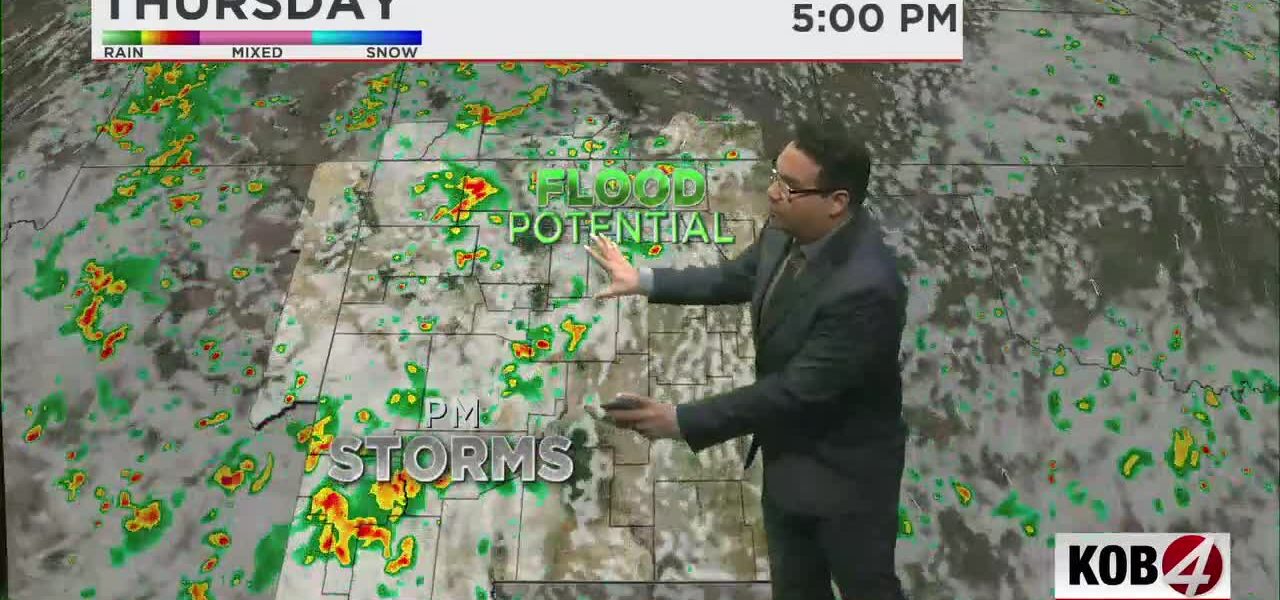
It’s a statewide affair, this soaking. And don’t imagine Thursday brings much respite. Thursday’s forecast remains a little tricky,
with continued threats in Farmington, Chama, Gallup, Grants, Silver City, and the Gila region. Ruidoso, Roswell, Carlsbad — and Hobbs also get a nod in the unpredictable mix. That implies ongoing uncertainty for commuters, for agriculture—for anyone, frankly, who relies on the state’s already delicate infrastructure. Because sometimes, when the atmosphere gets an idea, it just runs with it.
Some communities—Albuquerque, Santa Fe, Las Vegas, Clovis and Portales—may see fewer storms depending on how much drier air moves in.
A slight reprieve, perhaps, but a stark illustration of localized, highly variable weather phenomena that confound easy prediction. But even if it’s drier here, storms elsewhere will move more slowly, which could lead to localized heavy rainfall.
Meaning, it’s not the total volume, but the sheer speed and concentration of the downpour that does the damage. You don’t need a tsunami to cause significant problems; a relentless hosepipe aimed at one spot works just as well. For economies teetering on the edge, the kind that might face something far worse, such disruptions can—and do—prove catastrophic.
📄 POLICY WIRE WHITEPAPER PUBLISHED: PAKISTAN'S NATIONAL SECURITY POLICY PRIORITIES
👉 READ BY CLICKING HEREWhat This Means
These deluges in America’s high desert serve as a microcosm of global climate change’s unpredictable hand. Politically, the recurring intensification of these local events adds further pressure on state and federal agencies to bolster infrastructure—think advanced early warning systems, upgraded drainage, and better-funded emergency response networks. These aren’t cheap, — and they’re not always popular until it’s too late. The economic implications are clear: disruptions to local commerce, agricultural losses, and skyrocketing insurance premiums. It’s a slow-motion tax on everyone, really, disguised as mere weather. But this New Mexico narrative resonates far beyond its state lines.
When you contrast the infrastructural challenges in a U.S. state like New Mexico with, say, the struggle for adequate climate adaptation in Pakistan—a nation that routinely grapples with devastating floods—the disparity becomes stark. South Asia’s low-lying coastal areas and vulnerable riverine communities face existential threats that American resilience, even with its weaknesses, is generally equipped to manage through federal aid and sophisticated meteorological forecasting. In places like Pakistan, persistent and increasingly severe flooding not only devastates crops and infrastructure but displaces millions, exacerbating existing geopolitical tensions and resource conflicts, particularly concerning water. It’s an escalating humanitarian crisis that impacts economic stability and regional diplomatic efforts. the lack of robust early warning and evacuation infrastructure in some of these nations amplifies the human cost exponentially, creating a stark contrast to even a struggling U.S. county trying to handle a severe weather event.
The financial burdens, both immediate — and long-term, from such phenomena demand a reconsideration of budget priorities. It’s a bitter pill to swallow when you’re talking about diverting funds from social programs or other development initiatives toward climate defense. But we’re entering a new era where the atmosphere itself is shaping policy decisions. Ignore it at your peril; it won’t be ignored for long, no matter where you are on the globe. The New Mexico forecast isn’t just about rain; it’s about a planetary reckoning that’s arrived on our doorsteps, loud and insistent, with thunder and furious wind.