

US-Iran Gulf Crisis: Pakistan Fights to Save Islamabad Memorandum
The skies over the Gulf lit up again last week. American forces struck roughly 140 targets inside Iran in a single overnight operation, part of a campaign that has hit more than 300 sites across...

The skies over the Gulf lit up again last week. American forces struck roughly 140 targets inside Iran in a single overnight operation, part of a campaign that has hit more than 300 sites across three consecutive nights. Iranian forces answered with fire toward Jordan and other Gulf states, prompting the United Arab Emirates and Qatar to report intercepting incoming missiles. Somewhere in the middle of this exchange sits Pakistan, once again picking up the phone.
Pakistan’s Deputy Prime Minister and Foreign Minister Ishaq Dar telephoned Iran’s equivalent Abbas Araghchi over the weekend and pleaded for Washington and Tehran to return to the negotiating table. “He said dialogue and diplomacy was the only way out,” said Pakistan’s Foreign Office, adding that the pair had also talked about the “rapidly evolving security scenario in the Gulf.” That statement from any other nation would be considered standard diplomatic rhetoric, barely registering beyond the news cycle but coming from Islamabad, it has a different significance, for Pakistan is more than just an outside party calling for restraint. It is one of the signatories to the agreement that is breaking down right before their eyes.
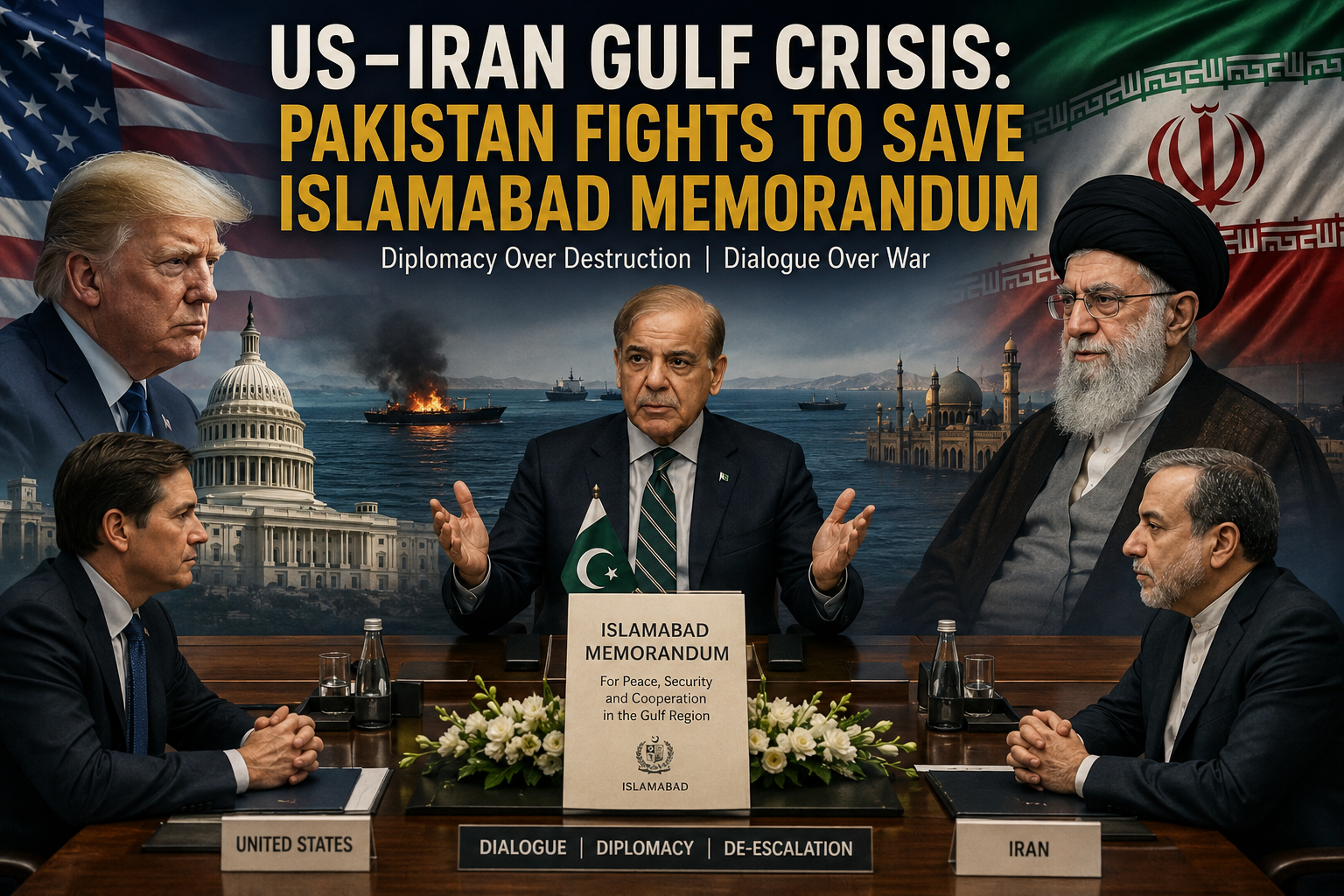
The Islamabad Memorandum of Understanding, was signed on June 18 as a fourteen-point framework meant to end months of open conflict between the United States and Iran. Pakistan helped broker it and put its own name on the document alongside Washington and Tehran. Barely a month later, President Trump has declared the ceasefire “over,” and both sides have resumed trading strikes for a third straight weekend. Iranian Parliament Speaker Mohammad Bagher Ghalibaf posted a warning on social media this week, declaring that “the era of one-sided deals is over” and accusing Washington of breaking its word. Watching a deal, you helped negotiate come apart within weeks is not a comfortable position for any mediator, and Islamabad now finds itself explaining why the framework still matters even as missiles fly across the region it was designed to stabilize.
This is not a role Pakistan stumbled into overnight. When Israel and the United States launched their air war against Iran in late February, few observers would have named Islamabad as the likely broker of a settlement. Pakistan built that role through months of unglamorous work. Prime Minister Shehbaz Sharif put forward a five-point ceasefire initiative with China in late March, followed by a detailed forty-five-day truce proposal in early April. Field Marshal Asim Munir, Pakistan’s military chief, made repeated trips to Tehran and held direct conversations with American officials through the tensest stretches of the war. Shehbaz Sharif later told the National Assembly that the talks came close to collapsing more than once, and credited FM Asim Munir with staying awake through the nights that mattered most to keep them alive.
All those effort produced the Islamabad Talks in April, twenty-one hours of negotiations marking the first direct, high-level engagement between American and Iranian officials since 1979. The talks ended without an agreement, and for weeks afterward Pakistani officials kept shuttling between Washington and Tehran with little public sign of progress. By mid-June, Shehbaz Sharif announced the two sides had reached a final, agreed-upon text, calling it a moment when peace had never been this close. Iran’s Foreign Ministry later credited Pakistan’s tireless efforts, alongside Qatar’s, with driving major progress toward ending the wider regional war, including the parallel conflict in Lebanon. When Iranian President Masoud Pezeshkian visited Islamabad after the memorandum was signed, Shehbaz Sharif told him Pakistan would never let Iran down.
Pakistan’s case for staying engaged rests on more than goodwill. Nearly a fifth of the world’s oil and gas moves through the Strait of Hormuz, and any prolonged disruption there sends shockwaves through energy markets that Pakistan, an import-dependent economy, cannot absorb easily. Millions of Pakistani expatriates live and work across the Gulf states now caught in the crossfire, sending remittances that form a critical pillar of the national economy. Islamabad has genuine strategic and economic reasons to keep Washington and Tehran talking, and acknowledging that self-interest does not weaken the case for mediation. It strengthens it, because a mediator with skin in the game has more reason to stay at the table than one offering advice from a safe distance.
Pakistan is not working this file alone. Oman has run a parallel track, hosting Araghchi in Muscat over the weekend to draft a technical proposal for managing commercial traffic through the strait, addressing the practical mechanics of shipping lanes and insurance corridors that any lasting deal will eventually need. Islamabad’s contribution has leaned more toward sustaining political channels between capitals that have largely stopped talking to each other directly. Both roles matter, and neither substitute for the other. A ceasefire needs both the plumbing and the handshake.
Skeptics will point out, fairly, that phone calls have not stopped a single strike. Washington maintains that Iran does not control the Strait of Hormuz and insists commercial shipping continues despite Tehran’s claims of a full closure. Tehran, in turn, treats American strikes as the actual violation of the June agreement, not its own missile attacks. Pakistan cannot force either government to change position, and no amount of careful diplomatic language changes that basic fact.
What Pakistan can do is keep a functioning line of communication open when almost every other channel between Washington and Tehran has gone quiet. That is not a small thing in a conflict where miscalculation, rather than deliberate escalation, poses the greatest danger. Wars between nations that refuse to talk to each other tend to spiral in ways that surprise even the people fighting them.
It would not be easy for the Islamabad Memorandum to remain intact in this new round of bombings. The fact that Pakistan continues to attend and continue to call despite the erosion of the agreement reveals the kind of regional power Pakistan wants to become. The question is whether persistence is sufficient to keep a ceasefire alive in the face of two signatories that are prepared to abandon the agreement.
Author