


Thai Hippo Oracle Divines World Cup Final, Unveiling Global Distractions
POLICY WIRE — Bangkok, Thailand — The world, perpetually caught between looming crises and the relentless grind of everyday life, often finds solace—or perhaps, deliberate distraction—in the absurd....

POLICY WIRE — Bangkok, Thailand — The world, perpetually caught between looming crises and the relentless grind of everyday life, often finds solace—or perhaps, deliberate distraction—in the absurd. It’s a truth played out on the global stage, whether it’s a social media dust-up or, as recently evidenced, a minor zoological celebrity tasked with cosmic foresight. Indeed, while statesmen across capitals grapple with inflation, regional stability, and energy shortfalls, an almost unbelievable proportion of human interest recently fixed itself on a pygmy hippo in a Thai enclosure.
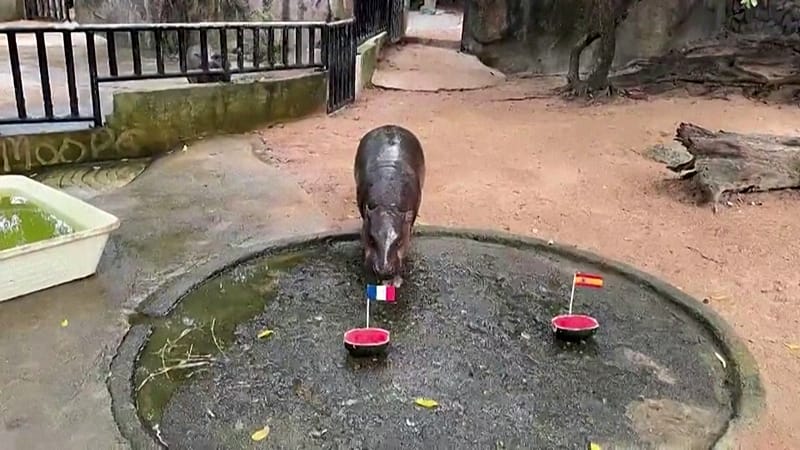
Her name is Nong Mali, an inhabitant of Khao Kheow Open Zoo, near Bangkok. She doesn’t vote, nor does she possess diplomatic immunity, yet her purported footballing acumen became international news. The mechanism was rudimentary: two watermelons, each emblazoned with the flags of Argentina — and France. The grand prognosticator, given the choice, consistently nudged the fruit bearing the French tricolor. Forget statistical modeling or intricate punditry; the masses, it seems, prefer their oracles with stubby legs and a penchant for melons.
It’s all a bit of a laugh, innit? People really need a break from—well, everything. That’s how Wanchai Srimuang, a local tourism official, put it to us, chuckling. ‘We’re just happy to bring a smile, — and perhaps a few more visitors, to our beautiful country.’ And the strategy? It seems to work. Images of the mild-mannered mammal went viral, momentarily eclipsing stories of parliamentary squabbles or commodity market volatility. It’s a low-cost, high-return public relations stunt, tapping into the collective yearning for something harmlessly compelling.
But there’s always more to the spectacle. French embassy staff, even amidst complex trade negotiations or cultural exchange programs, weren’t entirely above the playful geopolitics. ‘We’ll take any auspicious sign, especially given the stakes,’ a cultural attaché for the French diplomatic mission, Madame Delphine Moreau, dryly quipped when asked about Mali’s prediction. She added, ‘It certainly made for lighter office banter, something you don’t always get in this line of work.’ Such a light touch is rare, a moment of global levity, quickly forgotten once the ball is actually kicked.
For millions across the globe, especially in places like Pakistan, where economic uncertainty often overshadows less pressing matters, the World Cup itself becomes a powerful diversion. It’s a shared emotional language. They watch intently, often staying up into the pre-dawn hours, the joy or agony of a distant match providing a temporary reprieve from domestic struggles. The connection might be purely vicarious, a nation living through the triumphs and failures of players thousands of miles away, but it’s very real. It isn’t just football; it’s a psychological anchor. And it’s why seemingly inconsequential animal predictions from Thailand gain traction even there.
📄 POLICY WIRE WHITEPAPER PUBLISHED: PAKISTAN'S NATIONAL SECURITY POLICY PRIORITIES
👉 READ BY CLICKING HEREGlobal viewership for the FIFA World Cup final regularly tops 1.5 billion people, according to FIFA’s own reported statistics. That’s a colossal audience, more than a fifth of humanity, captivated by 22 men — and a ball. And every corner of that vast audience is susceptible to the whimsical, the odd, the unexplainable – a hippo’s choice between two flags. It offers a narrative free of consequence, a clean break from the weightier policy discussions that otherwise dominate news cycles. Sometimes, pure, unadulterated escapism is the best policy for public mood. Because people simply can’t process gloom — and doom twenty-four/seven, can they?
What This Means
This episode, minor as it appears, functions as a telling barometer of global priorities—or, perhaps more accurately, global desires. In an increasingly polarized and information-saturated world, the demand for ‘feel-good’ content, for harmless diversion, becomes an undeniable force. Thai authorities, no strangers to leveraging unique cultural assets for tourism, skillfully transformed a zoo attraction into an international talking point. This isn’t just about selling tickets to a zoo; it’s a form of soft power, branding a nation as charming, quirky, and globally connected, all while avoiding the messier complexities of international relations. It speaks to a broader trend where nations, not just corporations, increasingly use entertainment and spectacle as vehicles for national image-building, effectively bypassing traditional, often adversarial, political discourse. You see similar tactics from Middle Eastern states investing billions in sports to shape their global narrative, albeit on a far grander, more calculated scale. But the principle remains. The public, often weary of political stalemates and economic forecasts, readily embraces these simple, consumable narratives, effectively endorsing the diversion, even as more substantive challenges remain unanswered. This kind of story, trivial on the surface, reveals much about the contemporary global psyche, where fleeting smiles often supersede earnest reflection. It highlights the brutal calculus of mass distraction. People want to believe in something, anything, even if it’s a hippo’s gut feeling on a football game. And governments, quietly, understand the profound utility of that wishful thinking.