


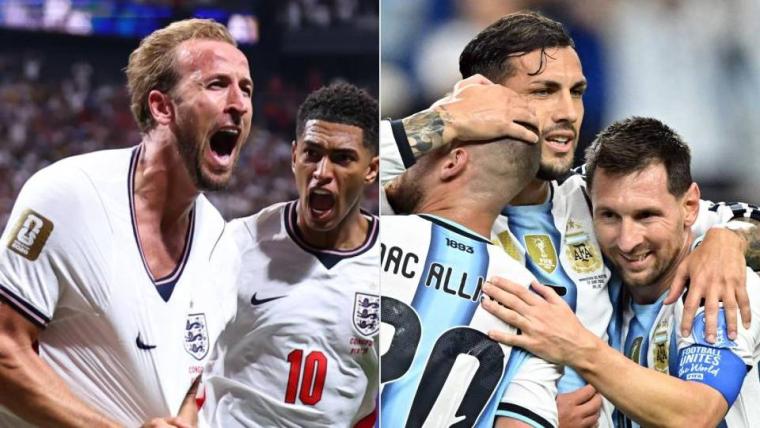
Ghosts and Goals: England-Argentina Clash Ignites an Enduring Geopolitical Theatre
POLICY WIRE — London, United Kingdom — The spectacle itself is nothing new: two footballing giants, England and Argentina, squaring off in a World Cup semifinal. Yet, peel back the layers of familiar...

POLICY WIRE — London, United Kingdom — The spectacle itself is nothing new: two footballing giants, England and Argentina, squaring off in a World Cup semifinal. Yet, peel back the layers of familiar narratives—the cries of "It’s coming home" or the omnipresent shadow of Lionel Messi—and you’ll find a striking, almost uncomfortable symmetry to their 2026 campaigns. Both have, in their own ways, stumbled to this precipice, propped up less by seamless tactical brilliance and more by a sheer, bloody-minded refusal to quit. It’s a common story in high-stakes competition, isn’t it?
Each squad leans on a duo of transcendent talents—Harry Kane and Jude Bellingham for England; Messi, for Argentina, with Julian Alvarez increasingly filling that secondary role. You could argue it’s a dangerous, almost desperate reliance. "They’ve Harry Kane and Jude Bellingham playing at an incredible level, surrounded by a squad built to create scoring opportunities for both of them," offered Agustin Aboy, a content producer weighing in for the Argentine side. Similarly, Mauro Mariani, a Senior Editor, noted "Messi’s goal-scoring form." Messi, despite expectations he𠆝 adopt a more creative posture, has emerged as Argentina’s main attacking force. [QUOTE_PLACEHOLDER]
England’s path, under Thomas Tuchel, hasn’t been without its public critiques, either. There have been "signs of tension between the manager — and parts of the squad," Mariani observed. And Joe Wright, another Senior Editor, confessed Tuchel’s initial squad choices "caused plenty of eyebrows to rocket up foreheads." But it doesn’t much matter now, does it? The team’s central midfield, for all its "world-class" billing on paper, still struggles to "dictate matches from the middle of the park," as Wright highlighted, making their defence surprisingly exposed. Renzo Desaunet flatly labeled their "vulnerability in defense, especially behind the full-backs," their biggest flaw.
For Argentina, the tale echoes similar frailties. Their strength is undeniable, described by Aboy as an "incredible offensive power, backed by the genius of Lionel Messi," coupled with a "winning mindset and experience in key matches." But the fragility, much like England’s, lies at the back and in the engine room. "The midfield — and fullbacks have posed the biggest questions at this World Cup," Desaunet posited. And Aboy didn’t pull punches: "suffer from having to compensate for the presence of a 39-year-old Messi and from midfielders who aren’t at 100% physically, on top of being vulnerable down the right flank." It’s an overreliance that almost guarantees high drama, if not outright chaotic brilliance.
And then there’s the sheer weight of history. For Argentina, facing England carries an emotional charge few other matches can replicate. Aboy described it as an "eternal rival with a century-old football history that goes far beyond the 1982 war." But don’t misunderstand; this isn’t merely about past conflicts. Dom Farrell noted the Argentinian faithful’s fervent belief: "winning here with Messi, for Messi, remains the most important thing in the world." It’s an emotional force, one that can uplift an entire squad beyond their individual limitations.
The English view on their goalkeeping situation provides a curious counterpoint. While Jordan Pickford has generally been a reliable performer in tournaments, several analysts point to him as a potential weak link. Aboy singled out Pickford as a candidate for "most disappointing" player, citing an "inconsistent tournament" and the risk "against a team with Argentina’s goal-scoring threat." Mariani concurred, stating Pickford "will be the main villain in Atlanta." This particular fragility in goal could very well be the defining factor in what promises to be a tight affair, pushing teams, and their star players, to the very brink.
On player form, OptaJoe reported that Jude Bellingham has netted more goals—specifically five, with zero penalties—than any other midfielder in the 2026 FIFA World Cup, putting him just one non-penalty goal behind Gary Lineker’s 1986 record for England in major tournaments. It suggests a player peaking at the right time, though the Argentinians, predictably, have their eye on him. "Bellingham—a footballer who’s the brains of the England midfield, precisely where Argentina are weak," asserted Desaunet, eyeing him as an ideal recruit for their own ranks. For a squad built so perfectly to "bring the best out of an older Messi and mitigate for his weaknesses," as Wright aptly described Argentina’s setup, adding another attacking threat of Bellingham’s caliber could make them unstoppable.
What This Means
This match isn’t just about sporting glory; it’s a collision of national identities, a soft power battle waged on grass. The enduring England-Argentina rivalry, historically entangled with political flashpoints like the Falklands War (or Las Malvinas, depending on who you ask), transcends mere sport. Its renewal sends subtle but potent signals across diplomatic channels, even if unofficially. Success on such a global stage can elevate national pride, boost tourism, and subtly project economic stability and cultural influence.
And think about it: such fierce, history-laden contests resonate far beyond their immediate combatants. They fuel intense passion across the Global South. Look at cricket in Pakistan and India, or the electrifying regional rivalries across the Muslim world in football; these aren’t just games, are they? They’re cathartic outlets for complex national aspirations — and historical grievances. A win or loss can inspire collective confidence or despair that affects more than just headline-grabbing fan zones.
Economically, a deep World Cup run brings tangible benefits: increased consumption, enhanced brand visibility for national companies, and even a temporary bump in productivity due to collective high spirits (or a slump if it goes the other way). For nations already grappling with internal complexities, a unifying force like a World Cup campaign offers a brief, yet potent, diversion. Argentina, particularly after their 2022 triumph, understands this unifying effect on a populace starved for good news. This match, then, is a proxy for something far grander: the global narrative of resilience, identity, and the relentless pursuit of perceived justice. It speaks to deeper geopolitical currents, to the "fading stars and fierce sons" always seeking to define their legacy on the world stage. if either team triumphs through a controversial decision, expect decades of international recriminations, echoing "The Immortal Deceit" from a generation past. That’s the real policy of this game: its impact reverberates.