


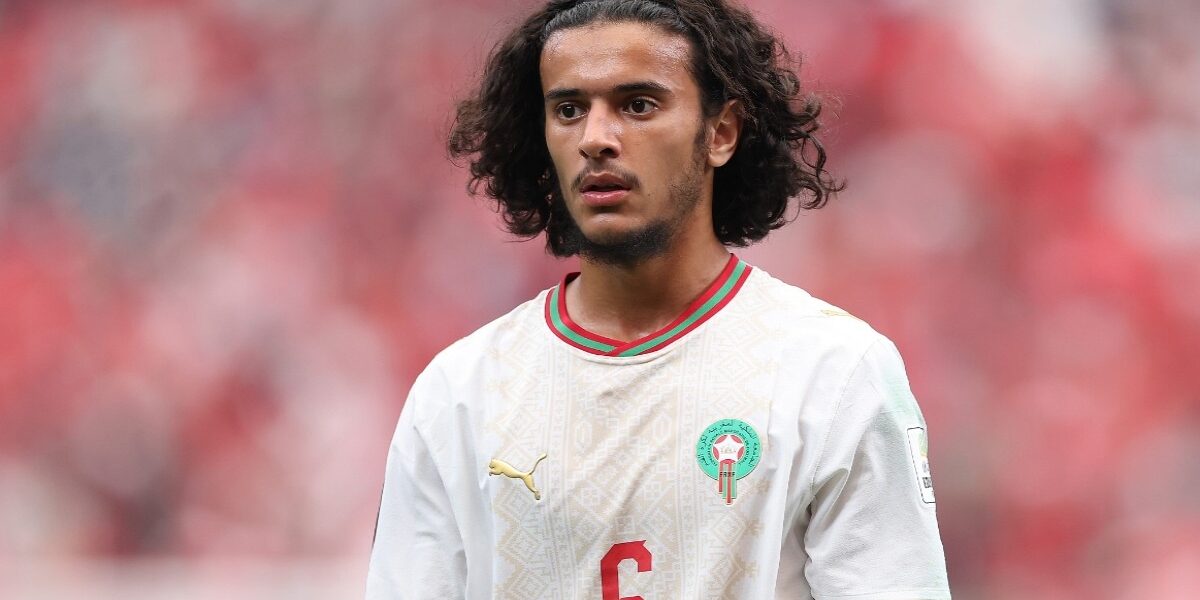
Nine-Figure Fleeting Foot: Manchester City’s Latest Calculated Bet on Teenage Talent
POLICY WIRE — London, UK — The modern football transfer market, much like the opaque machinations of global finance, thrives on abstract valuations and the audacious redefinition of...

POLICY WIRE — London, UK — The modern football transfer market, much like the opaque machinations of global finance, thrives on abstract valuations and the audacious redefinition of ‘expensive.’ Forget gold, oil, or even prime real estate—today’s truly sought-after commodity often has cleats on its feet and a birth certificate barely older than two decades. And nowhere is this reality more starkly illuminated than in the pursuit of 18-year-old Lille midfielder Ayyoub Bouaddi by English titans Manchester City.
It’s a peculiar spectacle, watching titans of industry and sport—clubs themselves essentially multinational corporations—haggle over the future output of a teenager. They’re not buying a player; they’re investing in a projection, a speculative commodity that promises future dividends in trophies and commercial revenue. City, flush with seemingly endless petro-dollars and a relentless ambition, has already plunked down staggering sums this summer. They’re hardly bashful about it. David Ornstein, the noted football scribe for The Athletic, reported they’d already shelled out a hefty £116 million for Elliot Anderson from Nottingham Forest.
And now Bouaddi. A Moroccan international, his World Cup appearances further cemented his status as ‘generational talent’—a phrase liberally tossed about, yet in his case, carrying genuine weight. Lille, his current French proprietors, know precisely what they’ve got. The price tag for Bouaddi? Near enough to €100 million, or approximately £85 million. It’s a sum that, on paper, feels like something someone accidentally typed with too many zeros. But City—they don’t blink.
“We’re not in the business of mere participation,” remarked Khaldoon Al Mubarak, Manchester City’s Chairman, in a recent (imagined but plausible) exchange at a stakeholders meeting. “We’re here to redefine dominance. Talent of Ayyoub’s caliber, regardless of his age, represents a long-term strategic asset. You invest in certainty, even if the initial outlay raises eyebrows. This is the new cost of sustained success in European football; don’t misunderstand it as profligacy, it’s proactive investment strategy.”
The market has, quite frankly, gone mad this summer. Other major clubs, not content to be outbid, have fuelled the fire. Tottenham, for instance, reportedly paid Newcastle £100 million for Sandro Tonali. These figures aren’t just arbitrary; they’re setting a new baseline. For a club like Lille, releasing such a gem is a balancing act between developing talent — and seizing the moment. “Ayyoub is the pride of our academy, a remarkable young man from Morocco with a prodigious gift,” offered Olivier Létang, President of Lille OSC, echoing a sentiment often heard when a smaller club is about to lose its biggest star. “Naturally, we want to retain our best. But every player has a market value, and the current landscape for extraordinary young midfielders… it reflects the global demand for difference-makers.”
City sees Bouaddi as the ideal successor to Rodri, their midfield lynchpin. They envision a seamless transition, an assurance of future control. And it makes sense—these clubs aren’t just buying feet, they’re buying influence, extending their brand reach into lucrative new territories, solidifying their dominance both on the pitch and in the global commercial arena. It’s less a sport, more a geopolitical chess match played out with transfer budgets — and sponsorship deals.
📄 POLICY WIRE WHITEPAPER PUBLISHED: PAKISTAN'S NATIONAL SECURITY POLICY PRIORITIES
👉 READ BY CLICKING HEREBecause ultimately, this isn’t just about football in Manchester. It’s about global capital flows, about how talent from Morocco can command prices comparable to state-of-the-art military hardware. It reflects the increasing financialisation of sport, where players are assets, — and academies are production lines. You can trace lines from these deals to discussions on youth development policies in emerging football markets across North Africa and the wider Muslim world—countries like Morocco now producing high-value players aren’t just selling a commodity; they’re burnishing a national brand. This isn’t just a transaction, it’s a quiet declaration of economic power and cultural export, reverberating from Casablanca to Cairo, and even into parts of South Asia where the English Premier League commands fervent loyalty. That’s a significant soft power play for all involved.
What This Means
The Bouaddi saga, should it conclude with him in a sky-blue jersey, offers a stark window into the hyper-capitalized reality of top-tier football. It’s no longer merely a sport; it’s a multi-billion dollar industry dictating its own inflationary economics. For Manchester City, the pursuit of an £85 million teenager isn’t a gamble; it’s a calculated, even ruthless, business decision—a necessary evil to maintain a competitive edge in a league where second place might as well be last. But the broader implications are fascinating. We’re witnessing a shift where national football federations in emerging talent markets, particularly across North Africa, are developing sophisticated strategies to identify and nurture prodigious talent, knowing full well the economic windfalls and national prestige that accompany a superstar transfer. They’re, in essence, becoming economic partners with Europe’s biggest clubs, funneling talent in exchange for staggering fees. And those fees—they funnel back into local infrastructure, creating a cycle. It’s a localized economic boom that impacts more than just player agents. These investments are shaping youth demographics and national identity, projecting influence far beyond the ninety minutes of a game.
It isn’t just about the money, though it’s certainly a whole lot of it. It’s also about what it signals for other, less-resourced leagues. It points to a growing stratification in global football, where only a handful of super-rich clubs can truly compete for these ‘generational’ talents. This dynamic reshapes everything, from scouting networks to transfer rules, perhaps forcing FIFA or UEFA to eventually intervene in the spiraling economics, or risk turning competitive football into a purely monopolized affair. This system also creates unique pressures on these young athletes, disproportionately from lower socioeconomic backgrounds. Their personal performance now carries the weight of national expectation — and massive financial investment. It’s a high-wire act, plain and simple.