


Digital Dynamite: Kashmir Unravels Under Onslaught of Viral Deceit
POLICY WIRE — Islamabad, Pakistan — In a region already simmering with grievances, where history weighs heavier than any digital algorithm, sometimes all it takes is a doctored video clip to ignite a...

POLICY WIRE — Islamabad, Pakistan — In a region already simmering with grievances, where history weighs heavier than any digital algorithm, sometimes all it takes is a doctored video clip to ignite a conflagration. That’s precisely what played out across Pakistan-administered Kashmir, or Azad Jammu and Kashmir (AJK), as deadly protests over rising living costs quickly escalated, turbocharged by online fakery. One minute, people were marching; the next, the internet was ablaze with distorted truths, each pixel feeding the fury.
It wasn’t a sudden, unprovoked explosion. Locals have been grumbling for ages about electricity tariffs—sky-high, they say—and the price of wheat flour, which, let’s be frank, pinches every household budget. Then came the ‘Long March’ last week, orchestrated by the Joint Awami Action Committee. It began peacefully enough, but peaceful rarely stays peaceful when long-simmering resentments bubble to the surface, especially when those grievances meet a responsive—or rather, a reactive—security apparatus.
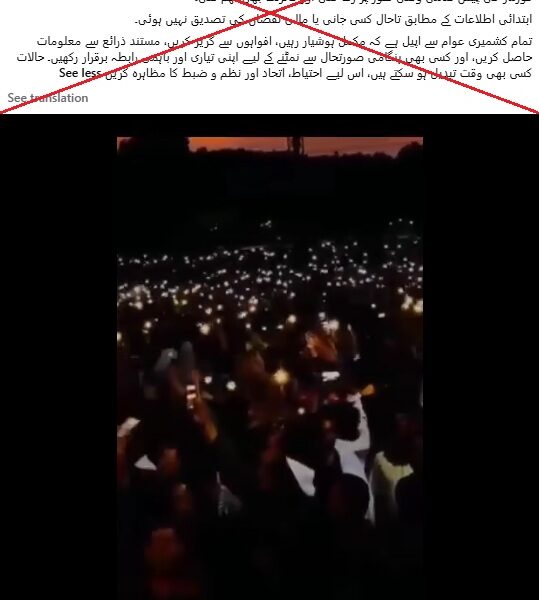
But amidst the legitimate anger and the escalating clashes that claimed at least six lives—including a police officer, a particularly stark detail—a particularly nasty piece of misinformation did its damage. A video, seemingly showing Kashmiri leaders urging confrontation with Pakistani authorities, began to circulate widely. Problem? It was an old clip. Recontextualized, reframed, and recycled—it hit like digital dynamite, exacerbating tensions between protesters and the state. And because, in the fog of war — and civil unrest, nuance usually takes a holiday, many swallowed it whole.
“These attempts to sow discord through digital fabrications are a a clear maneuver by external elements to destabilize a region already grappling with complex issues,” said a Pakistani Foreign Office spokesperson, speaking on condition of anonymity due to the sensitivity of ongoing diplomatic efforts. “We condemn such propaganda outright and urge all citizens to verify information before sharing.” Sounds official, doesn’t it? But down on the ground, in towns like Muzaffarabad and Mirpur, where the scent of tear gas mingled with burning tires, verification was a luxury no one could afford.
Because that’s how these things work: genuine economic hardship creates a void, and propaganda—even the clumsiest kind—rushes in to fill it. The average per capita income in Azad Jammu and Kashmir hovers at roughly 75% of the national Pakistani average, fostering fertile ground for economic unrest, according to a recent report by the Sustainable Development Policy Institute (SDPI). So, when people already feel the pinch, and someone flashes a video that seems to confirm their worst suspicions, logic doesn’t stand much of a chance.
The situation only deteriorated further, naturally. Police used tear gas, some reports claimed live rounds. The government deployed paramilitary forces, cutting off roads and disrupting mobile internet—a classic play, designed to choke off communication, but often just cementing public paranoia. They did reinstate the internet briefly after calling for dialogue, which is always nice. But what’s really happened here is a loss of trust, — and that’s a hard thing to get back.
📄 POLICY WIRE WHITEPAPER PUBLISHED: PAKISTAN'S NATIONAL SECURITY POLICY PRIORITIES
👉 READ BY CLICKING HERE“For years, our people have spoken of neglect—of rising costs and unresponsive governance. When you ignore genuine hardship, eventually, the only narrative left is one of outrage, no matter its source,” observed Raja Farooq Haider Khan, a former Prime Minister of AJK, his voice heavy with what seemed like exasperation. He isn’t wrong. It’s a bitter truth, and one that resonates deeply across many parts of the Muslim world struggling with governance and economic disparity, where state institutions sometimes find themselves perpetually chasing the truth instead of preempting discontent. See Fading Stars and Fierce Sons for more on these dynamics.
But the government, perhaps sensing the fragility of the moment, moved swiftly. They announced subsidies on electricity — and flour. They released detained activists. A small, symbolic win for the people, maybe, or a desperate act by authorities hoping to put a lid on something volatile before it truly exploded into an even wider regional embarrassment. Because make no mistake, Kashmir is always under a microscope, from Delhi to Washington. And when the internet becomes a vector for outright falsehoods during deadly protests, it becomes everyone’s problem.
What This Means
The immediate political fallout in AJK is predictable: temporary calm, followed by a simmering distrust that could flare up again at any moment. For Islamabad, it’s an uncomfortable reminder that their grip on this administered territory is contingent not just on security forces, but on the perceived well-being of its populace. It’s not just a land dispute; it’s an economic pressure cooker. The economic measures are a Band-Aid, not a cure for deeper structural issues that lead to persistent protests. It implies that future unrest over development or resource allocation is all but inevitable, unless genuine long-term investments and governance reforms are prioritized—a tall order in Pakistan’s current fiscal environment. Plus, it serves as a stark warning about the weaponization of social media in conflict zones—any conflict zone, really. A doctored video can provoke more immediate damage than an army battalion in this day — and age. It forces a recalibration of how governments—and populations—respond to digital narratives, highlighting the need for digital literacy and robust independent fact-checking mechanisms, things largely absent or distrusted in regions like this. For India, naturally, it’s propaganda gold, another piece of evidence to wave about the instability of Pakistan’s claim over parts of Kashmir.
Economically, the disruptions alone are painful. Business closures, halted transport, damaged infrastructure. Investment, already skittish, will pull back further. Who wants to put money into a region where an old clip can bring everything to a grinding halt? The subsidies offered might quiet things now, sure, but they strain Pakistan’s already precarious national budget, effectively redirecting funds that could’ve gone to more sustainable development. The optics here matter, too; a populace feeling marginalized, responding to misinformation, signals a profound failure in state-society communication and, frankly, highlights just how fragile the notion of stability is in the borderlands. It’s a testament to the fact that silent sabotages often start in plain sight.