


Whistleblower or Whipping Boy? VAR’s Bizarre Judgment Derails Swiss, Fuels World Cup Inferno
POLICY WIRE — Kansas City, USA — When does a victim become the villain? In the grand theater of the 2026 World Cup, that’s not just a philosophical query anymore. It’s the raw, seething...

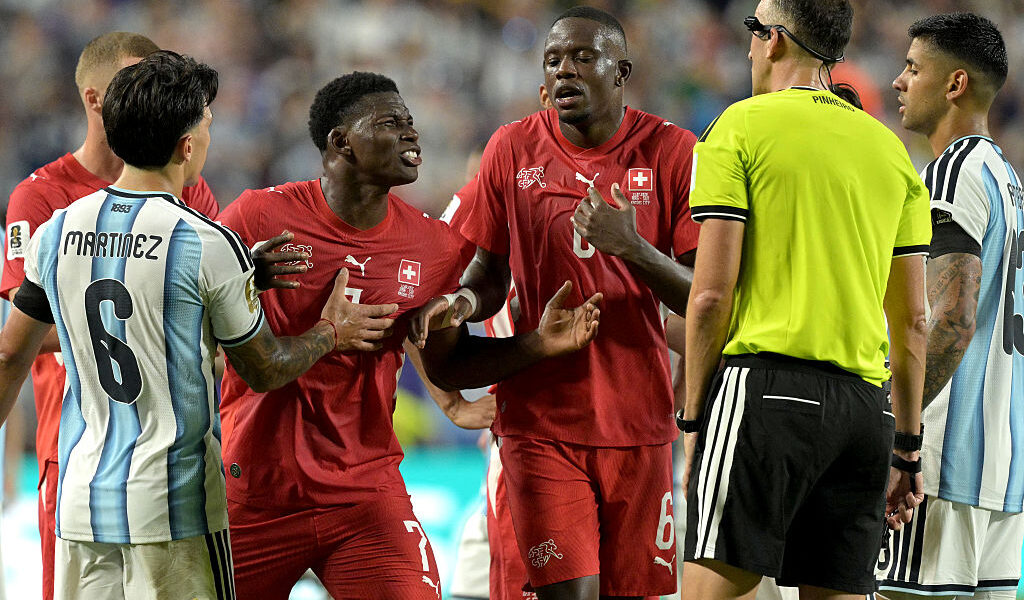
POLICY WIRE — Kansas City, USA — When does a victim become the villain? In the grand theater of the 2026 World Cup, that’s not just a philosophical query anymore. It’s the raw, seething question tearing through the sports world this morning, after a truly bewildering turn of events saw Switzerland’s Breel Embolo ejected, his team subsequently booted from the tournament, all thanks to technology that promised absolute clarity but delivered only controversy. They say VAR cleans up the game, makes it fair. Sometimes, it just makes things messier. And more maddening.
Picture this: a white-knuckle quarter-final clash, Switzerland holding its own against the formidable Argentinian squad. Then, an 80th-minute scuffle. Leandro Paredes, Argentina’s enforcer, barrels into Embolo. Yellow card for Paredes, the ref João Pinheiro sees it. Standard stuff, right? Wrong. The little earpiece lights up, VAR beckons. A quick check turns into an interrogation. Suddenly, Pinheiro’s striding to the sideline monitor, a bad omen every fan knows. What followed wasn’t just a reversal; it was a character assassination on turf. Paredes is cleared. Embolo, the fouled player, is accused of faking it. Simulation. A yellow card. But he’d already been booked earlier. And that’s it—second yellow, instant red. Done. Sent off. Tears streaming down his face as he trudged off, bewilderment warring with absolute rage. His World Cup — and Switzerland’s hopes — evaporated into the chilly night air.
It’s a decision that screams, loudly, about the fragile intersection of human judgment — and algorithmic intervention. Was it fair? The official statement from FIFA’s referee committee later spoke of a “new interpretation guideline regarding minimal contact fouls,” whatever that means for a man’s livelihood. “We’re constantly striving for consistency,” offered Pierluigi Collina, head of FIFA’s Refereeing Committee, in a rather anodyne public statement, “but these moments… these moments remind us that football is ultimately played and interpreted by humans.” Well, that’s rich, isn’t it? The ‘human’ element is precisely what VAR was supposed to rein in, only now it’s producing an even more theatrical, and arguably unjust, outcome. Because even the best tech sometimes just adds more static to the signal.
Argentina, for their part, wasted no time capitalising on the man advantage, sealing a 3-1 victory in extra time. Lionel Messi, ever the puppeteer, provided the crucial assist for their opening goal and ran rings around the Swiss defense, reminding everyone why he’s considered one of the all-timers. Julián Álvarez also netted a beauty, confirming his clinical streak. But even their dominance feels tainted for many by the sheer oddity of Embolo’s exit. It’s difficult to cheer unequivocally when the opposition has been arguably hamstrung by such a bizarre ruling.
Meanwhile, in another corner of this unpredictable tournament, England is wrestling with its own internal dynamics. After coach Thomas Tuchel dared to criticize his team’s performance against Norway, a certain Jude Bellingham fired back. Not in a meek way, either. Bluntly. A response that sent England’s ever-ravenous press into a frenzy. It makes you wonder: is he asserting leadership, or simply testing the boundaries? The young phenom scored twice, rescuing the Three Lions and sending them into the quarter-finals after another dominant performance. Bellingham’s Ascent seems almost pre-ordained, doesn’t it?
📄 POLICY WIRE WHITEPAPER PUBLISHED: PAKISTAN'S NATIONAL SECURITY POLICY PRIORITIES
👉 READ BY CLICKING HEREWhat This Means
The Embolo incident isn’t merely a soccer kerfuffle; it’s a symptom of a larger, systemic governance challenge facing global sports. FIFA, much like other international bodies, often struggles with perceived fairness, consistency, and the sheer optics of its decisions. This kind of ruling feeds into a narrative — particularly potent in nations beyond the traditional football powerhouses, say, across the Muslim world or South Asia — that the system itself might be rigged, or at best, deeply flawed. When you’ve got billions watching, often from regions with long memories of uneven playing fields, such perceived injustices sting deeply. Kansas City’s Controversy will resonate far beyond its stadium.
Economically, decisions like this ripple outwards. Imagine the lost sponsorship, the dip in national morale, the financial blow to Swiss football — all because a referee’s “human” judgment, informed by a machine, deemed an assault an act of play-acting. Data from a leading sports analytics firm suggests VAR, despite its hefty investment (often running into millions per tournament), has only led to a marginal increase in ‘correct’ calls, with its implementation still causing significant delays and widespread fan frustration globally.
And so, as the World Cup continues its relentless march towards a final that promises triumph for one, it also leaves a trail of bitterness for others. The idea of impartiality, critical for any global institution hoping to inspire universal allegiance, just took another bruising. It makes you wonder if these tech ‘fixes’ are doing more to alienate than unify, doesn’t it? Because in football, like in politics, perception often trumps reality.