

Mexican Legacy in Texas: Fox’s Library Sparks Cross-Border Contemplation
POLICY WIRE — San Antonio, USA — When does a leader’s ambition for posterity transcend national borders? You might think the sprawling, purpose-built institutions dedicated to former heads of state...

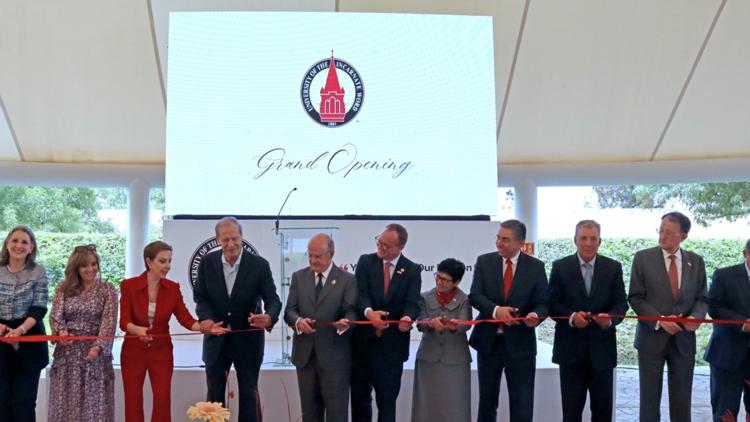
POLICY WIRE — San Antonio, USA — When does a leader’s ambition for posterity transcend national borders? You might think the sprawling, purpose-built institutions dedicated to former heads of state are an exclusively American export. They’re a particular form of memory, certainly, but it turns out even that idea’s getting an update. Because now, the University of the Incarnate Word, right here in San Antonio, Texas, is setting up shop for a decidedly non-Yankee figure: Mexico’s former president, Vicente Fox.
It’s not just a quaint cross-border gesture, mind you. This initiative isn’t merely about some old politician tidying up his papers. No, it hints at something bigger—a recognition, perhaps, that history, like economics and culture, doesn’t respect lines drawn on maps. We’re talking about an entire legacy, a period of Mexican history, finding a permanent home north of the Rio Grande. But it’s also about influence, you know? It’s about shaping a narrative from beyond the presidential palace, a final act of statesmanship, or maybe just savvy brand management. [QUOTE_PLACEHOLDER]
This development poses a quirky question: why Texas? And why this specific university? It’s not the first time foreign leaders have sought to memorialize their tenures. Look, some have built grand mausoleums; others fund think tanks or quiet foundations back home. But few, if any, have chosen foreign soil, especially a nation with which their own has such a tangled, complicated history, to cement their story. It’s an interesting move, to say the least—an audacious one that almost screams, Here’s how I want to be remembered by the very people whose perceptions perhaps matter most to our bilateral future. It’s like a soft-power play, wrapped in archival preservation, don’t you think?
And let’s be honest, it makes you wonder about the practicalities. The official word is that a new UIW campus will be the physical structure housing this significant collection. But there’s a reason behind such institutional homes. The cost of establishing and maintaining a presidential library, like those under the US National Archives and Records Administration, isn’t trivial. According to the National Archives, the John F. Kennedy Presidential Library — and Museum’s budget for fiscal year 2023 was roughly $13 million, for example. These things aren’t cheap; they’re investments.
It’s fascinating, comparing this American model to how leaders often secure their legacies elsewhere. In regions like Pakistan, or across much of the South Asian and wider Muslim world, such institutionalized preservation is often—well, it’s just different. Leaders’ legacies there tend to be preserved through political parties they founded, through personal estates, through historical narratives curated by successors or staunch supporters. Sometimes, it’s just in the popular memory—or, regrettably often, in contested, fiercely debated histories. You don’t see dedicated, neutral (or at least *intended* to be neutral) academic institutions like this so frequently, serving as depositories of an entire presidential term’s worth of records. This Texan venture, then, might be a blueprint for a more formalized, transnational approach to post-presidency influence for leaders whose careers span more than just their national concerns. It provides a more robust, long-term platform.
We’re talking about former Mexican President Vicente Fox, a figure whose tenure saw significant efforts to normalize relations with the United States, yet also wrestled with the massive challenge of immigration and trade. He left office in 2006, ending a 71-year run of single-party rule for the PRI, a moment many called a true democratic turning point for Mexico. Now, his legacy gets examined under an academic microscope, thousands of miles from his home state of Guanajuato. That’s something.
📄 POLICY WIRE WHITEPAPER PUBLISHED: PAKISTAN'S NATIONAL SECURITY POLICY PRIORITIES
👉 READ BY CLICKING HEREBut the real juice here isn’t just about Fox, is it? It’s about the evolution of political memory. We’ve come a long way from emperors etching their deeds onto monuments. Now, it’s about digital archives, curated exhibits, academic conferences—all designed to tell *a* story, if not *the* story. And increasingly, that story might not even need to be told on home soil.
What This Means
This Texan home for Fox’s presidential library carries significant, multi-layered implications. Politically, it signals a deeper, more intertwined binational relationship between Mexico and the United States, one where cultural and historical assets move fluidly, almost in parallel to economic ties. It’s an example of soft power in action: Mexico, through the legacy of one of its most transformative leaders, establishes a tangible cultural and academic footprint right in the heart of Texas, a state with its own deep Mexican roots and ongoing debates about the border. This could facilitate more nuanced U.S. understanding of Mexican politics — and history, fostering greater empathy, or at least a more informed discourse. But also, it’s an opportunity for Mexico to shape its image and narrative abroad, providing an authoritative, institutionally backed resource.
Economically, for the University of the Incarnate Word — and San Antonio, it could be a significant boost. It attracts scholars, fosters international conferences, and potentially creates educational exchange opportunities—a boon for local academic prestige and perhaps even tourism, though perhaps more for intellectual wanderers than leisure seekers. For regions like the Muslim world and South Asia, where formal presidential archives on the U.S. model are less common, this cross-border venture could present an intriguing case study. It shows how establishing a robust, academically affiliated archive might transcend domestic political instabilities or factional histories that often complicate the preservation of political memory at home. It could offer a template for leaders seeking to enshrine their tenures in a more internationally accessible and perhaps more insulated environment. It’s about leveraging foreign institutions to guarantee a certain continuity of narrative, something many leaders might find appealing, regardless of where they hail from. But ultimately, it’s another knot in the already tightly woven cord connecting two nations, making it even harder to untangle, for better or worse.