

Joe Cole’s Messi Gambit: High Stakes, Brash Talk, and the Game’s Global Echoes
POLICY WIRE — London, UK — Before the first whistle blows, sometimes the real contest kicks off in the ethereal realm of podcast bluster. An intriguing phenomenon has emerged: statements initially...

POLICY WIRE — London, UK — Before the first whistle blows, sometimes the real contest kicks off in the ethereal realm of podcast bluster. An intriguing phenomenon has emerged: statements initially drafted by artificial intelligence — as acknowledged by the source material itself—then morph into human-voiced bravado. It’s an interesting feedback loop, isn’t it? Almost as if the machines are seeding the discourse for us to passionately argue about.
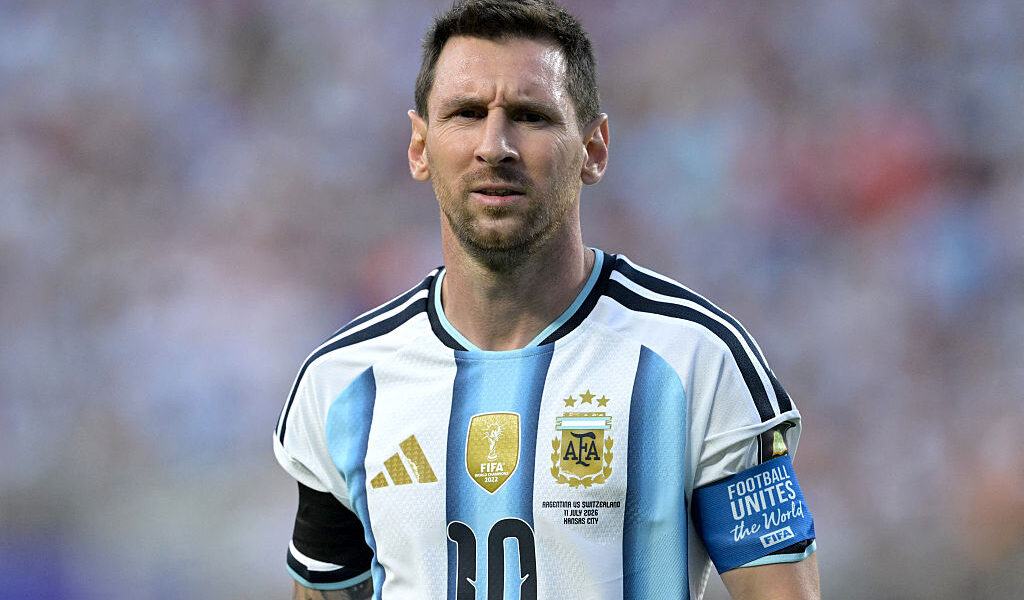
Enter Joe Cole, once a flair merchant on England’s wing, now a pundit whose pre-World Cup semifinal remarks have sent tremors, or at least minor ripples, through the footballing cosmos. His target? Lionel Messi. His tone? Unabashedly, aggressively confident. Not a timid, calculated prognostication, but a gut feeling declared for public consumption—an old-school declaration of intent in an age where every word gets parsed for geopolitical subtext.
It’s all part of the theatre, sure. A familiar tune before a high-stakes clash that fans from every corner of the planet will tune into. But, beneath the surface of this particular exchange lies a current of something bigger than just a game: a clash of narratives, and the very real commercial implications that ripple through economies far beyond the stadia. These are the narratives that fuel the global sports industry, an economic juggernaut.
Cole wasn’t shy about it, was he? Appearing on The Rest is Football podcast, he didn’t mince words regarding the legendary Argentine captain. Messi, despite his otherworldly talent and enduring mystique, often becomes a foil for those seeking to elevate their own team’s chances. Cole went right for it, stating with conviction, [QUOTE_PLACEHOLDER]
Strong stuff, that. It’s the kind of soundbite designed to be replayed, debated, and, perhaps, inevitably thrown back in his face should events unfold differently. But it also taps into a broader rivalry, an Anglo-Argentine footballing history steeped in more than just 90 minutes of play. You can’t separate the football from the memories, the Maradona Hand of God from the Falklands, can you? And in the lead-up to what the original text refers to as Argentina’s first encounter with a Top 10 ranked team in this World Cup—a telling stat about their previous pathway, isn’t it?—these psychological skirmishes really ramp up. It’s almost as if Cole is trying to win the battle of wills before the physical contest even begins.
📄 POLICY WIRE WHITEPAPER PUBLISHED: PAKISTAN'S NATIONAL SECURITY POLICY PRIORITIES
👉 READ BY CLICKING HEREFor countless football aficionados across Pakistan, the Indian subcontinent, and the broader Muslim world, these European football spectacles aren’t just background noise. They’re obsessions. Generations have grown up worshipping players like Messi, Ronaldo, and yes, even English icons, following their every move with religious zeal. Local barbershops, tea stalls, and packed living rooms often transform into impromptu debate halls when such pronouncements are made. In Karachi, Dhaka, or Cairo, Cole’s confident assertion isn’t just an ex-player’s opinion; it becomes a fuel for heated exchanges, national pride subtly, or not so subtly, interwoven with allegiances to distant clubs and players. And let’s not forget the financial element: an estimated 100 million people watched the last World Cup final in the Middle East and North Africa alone, per FIFA reports, illustrating the enormous economic and cultural gravity of these events.
It’s worth noting, of course, that the initial source for this report flagged itself as having been [QUOTE_PLACEHOLDER] There’s a subtle irony there, isn’t there? A human, steeped in the emotion and lore of the game, delivering a declaration, but the message itself passing through a digital intermediary. Makes you wonder if an algorithm could detect the pure, unadulterated hubris. Probably not. And that’s why we still have journalists, folks.
What This Means
Cole’s statements, while standard pre-match banter, carry weight because of who he’s — and the intensity of the matchup. Politically, this kind of verbal sparring can solidify fan bases, fuel national narratives, and create a sense of us-versus-them that goes beyond mere sport. For a nation like England, perpetually hopeful for World Cup glory, such declarations become rallying cries. Economically, these high-profile semifinals are goldmines. Global viewership figures skyrocket, impacting everything from advertising revenue to sports tourism—if not directly for a specific host, then certainly for global broadcasters and associated industries. In regions like South Asia, where football fandom transcends borders and local rivalries, these games generate immense soft power, influencing everything from brand loyalty to the youth’s athletic aspirations. Think about it: a child in Lahore might aspire to play like Messi, and these soundbites further embed those aspirations. The bravado, the predictions, the thinly veiled challenges—they’re all part of a finely tuned ecosystem that converts passionate rhetoric into very real capital. But you gotta wonder, what’s it really like for a player like Messi, carrying the expectations of an entire continent on his shoulders, listening to these things? Must be an exhausting business, football at this level.