


Octagon’s Brief Fury: Pimblett’s 52-Second Statement Shakes the Lightweight Ladder
POLICY WIRE — Las Vegas, Nevada — Fifty-two seconds. That’s all it took for Paddy Pimblett to remind folks that in the merciless churn of professional combat sports, fortunes—and consciousness—can...

POLICY WIRE — Las Vegas, Nevada — Fifty-two seconds. That’s all it took for Paddy Pimblett to remind folks that in the merciless churn of professional combat sports, fortunes—and consciousness—can vanish quicker than a gambler’s last chip on the strip. This wasn’t some drawn-out slugfest, no, it was a blink-and-you-miss-it declaration, less a fight and more a clinical dismantling. The roar inside T-Mobile Arena on July 11, 2026, felt like it barely had time to build before it crashed.
It’s easy to get lost in the glitz of Las Vegas, where neon blurs the lines between reality — and spectacle. But even amidst that dazzling illusion, the cold, hard efficiency of Pimblett’s submission win over Benoit Saint Denis cut through. You see, the French lightweight had an ambitious plan. He started attacking, apparently with serious intent. But a determined strategy like that can go south faster than a high roller’s bankroll after a bad run. His ill-fated takedown attempt was, ultimately, his undoing. It was just the opening Pimblett needed to initiate what became a perfectly executed, if grim, sequence of events.
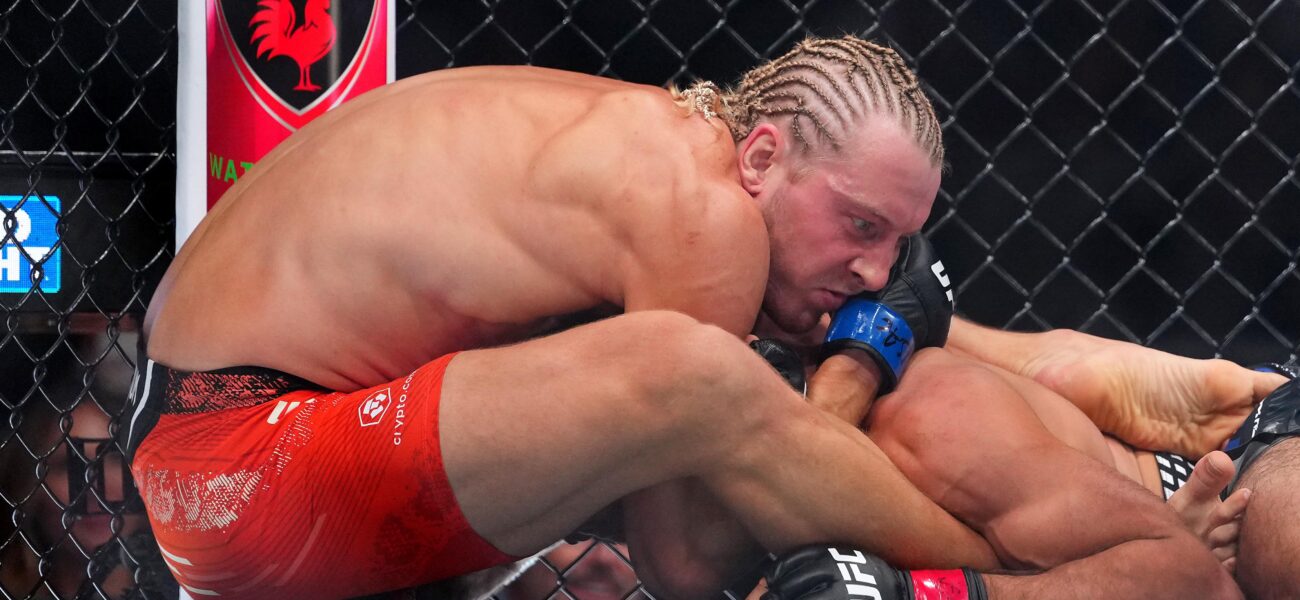
Pimblett, coming off a tough bout with future champion Justin Gaethje earlier in the year, wasn’t just there to win. He was there to *prove* something, — and gosh darn it, he did. He snatched a guillotine choke, then seamlessly transitioned to a D’arce choke. Saint Denis had, you’d think, nowhere to go. And he didn’t. Pimblett kept applying the pressure. You could almost feel the squeeze even from the cheap seats, couldn’t you?
Because in this business, it’s not just about winning; it’s about making a statement, and few statements are as emphatic as putting your opponent to sleep in under a minute. The fight ended after referee Marc Goddard checked on Saint Denis — and he was completely unconscious from the choke. He was gone, lights out, dreaming of easier Tuesdays, one imagines. The stoppage came at just 52 seconds into the opening round. Pretty swift justice, by any measure.
After the brief but brutal performance, Pimblett was, shall we say, a touch animated. He grabbed the mic, perhaps still high on adrenaline, and bellowed, “Sub of the year, bitches!” A classic, unrefined declaration, certainly. He clarified his opponent’s state: “I knew he was out. I had to say to Mark, he’s unconscious. He’s going to shoot in … and I’m going to choke his ass unconscious. I’m like a f*cking spider. When I got a hold of you, you don’t get out.” There’s a particular kind of poetry in that brutal self-assessment, isn’t there? It captures the predator’s mentality perfectly.
He wasn’t done, not by a long shot. He challenged anyone and everyone. “What now? Am I finished? Who wants it next? I don’t get a f*ck. Give me anyone. Who f*cking wants it? If [Conor] McGregor wants it, he can f*cking get it!” Strong words, definitely—but backed by the immediate evidence of his work. While Saint Denis desperately tried to roll out of the bad position, Pimblett had no intention of releasing the submission and he just tightened his grip as Saint Denis was obviously in serious trouble. A few seconds later, the referee checked — and Saint Denis was unconscious from the choke. Bam, just like that. Pimblett released the submission — and immediately began a raucous celebration. You’d celebrate too, after a performance like that.
📄 POLICY WIRE WHITEPAPER PUBLISHED: PAKISTAN'S NATIONAL SECURITY POLICY PRIORITIES
👉 READ BY CLICKING HEREThis rapid-fire win catapults Pimblett into discussions for bigger matchups, maybe against a former champion like Ilia Topuria or even the winner of the main event featuring Conor McGregor and Max Holloway. The world of combat sports doesn’t stand still; it devours attention — and spits out new narratives constantly. The stakes are immense. For instance, the financial machinery behind UFC events is staggering, with the global MMA market estimated by some, like industry analysts at Grand View Research in 2023, to have approached nearly $2.5 billion, driven by surging viewership and sponsorship deals. It’s a goldmine built on brief, shocking violence.
This economic engine isn’t confined to Western shores either. In places like Pakistan, where traditional wrestling and boxing have always held a cultural weight, the popularity of mixed martial arts is quietly, but certainly, on the rise. Young, aspiring athletes watch these moments of brutal efficiency on illegal streams and dedicated fan channels, dreaming of their own ascents. It’s an accessible dream, thanks to global media, bypassing often more cumbersome local sporting infrastructures. The raw, unfiltered grit resonates with audiences far beyond the Las Vegas lights. They understand the hunger.
And Pimblett’s performance? It’s not just another tally mark in a fight record; it’s a raw, immediate message that echoes from Liverpool to Lahore: he’s a serious contender, folks. He passed that test with flying colors. It felt almost like an audition, — and he nailed it.
What This Means
This 52-second demolition job by Paddy Pimblett is more than just a fight highlight. It’s a stark commentary on the accelerated demands of modern sports entertainment — and its political economy. The UFC, like many global sporting entities, thrives on short, decisive action—moments that go viral, draw massive pay-per-view buys, and keep the algorithmic buzz alive. Fighters like Pimblett, with his flamboyant personality and ruthless efficiency, are commodities in this ecosystem, driving economic value far beyond the octagon. His callouts, especially to a mega-star like McGregor, aren’t mere bravado; they’re calculated career moves designed to engineer lucrative future matchups. It’s a ruthless brand of capitalism, you know? The quicker the finish, the bigger the splash, often leading to better contracts — and more endorsement opportunities. Contrast this mercenary approach with older paradigms of athletic loyalty. For governments and economies eyeing new avenues for growth and soft power, the global appeal of MMA, particularly in nascent markets in South Asia, presents a dual-edged sword: a potential for youth engagement and economic influx through sponsorships and media rights, but also a challenge in navigating its often brutal and individualistic nature.